Welfare Group Management Software Kenya: A Practical Guide to Better Contributions, Records and Member Support
A welfare group succeeds when members can trust the rules, the records and the people responsible for handling group money. Welfare Group Management Software Kenya can help committees replace scattered notebooks, spreadsheets and WhatsApp messages with a more organised way to manage members, contributions, welfare requests, payments and reports. This guide is for employee welfare associations, family welfare groups, church groups, community organisations, alumni groups, professional associations, savings groups and other member-based organisations in Kenya. It explains what the software should do, why it matters, the features to prioritise, how to move from manual records, and how to choose a system that fits the group’s actual rules.
What Is Welfare Group Management Software?
Welfare group management software is a digital platform used to organise the administrative and financial activities of a welfare organisation. Welfare Group Management Software Kenya is most useful when it connects member records with contributions, welfare support, approvals, expenses, statements and reports instead of keeping each activity in a separate file.
A welfare group may have only a few dozen members at the beginning. The treasurer can remember most payments, the secretary may keep a notebook, and committee decisions may be discussed in a WhatsApp group. As membership increases, however, the organisation accumulates more transactions and more questions. A digital system gives authorised officials a structured place to record what happened and retrieve it later.
The software does not replace the group’s constitution or committee. It supports the processes the group has already agreed upon. Welfare Group Management Software Kenya should therefore be evaluated against the organisation’s real workflow rather than against a long list of fashionable features.
For example, a group may require members to contribute a fixed amount every month and provide assistance when a qualifying event occurs. Another organisation may have different contribution categories, waiting periods, approval levels or benefit limits. Good software should make those rules easier to administer, not make the group abandon them.
Who Can Use It?
The term welfare group covers many different organisations. Common examples include:
- Employee welfare associations
- Family welfare groups
- Church welfare committees
- Alumni welfare associations
- Professional welfare groups
- Community self-help groups
- Women’s and youth groups
- Savings groups with a welfare fund
- Associations supporting members during emergencies
- Organisations that combine welfare, savings and other member activities
Welfare Group Management Software Kenya can be particularly useful for groups where several people share administrative responsibilities. A chairperson may oversee decisions, a secretary may maintain membership information, a treasurer may record money received and paid, and other committee members may participate in approvals.
The central benefit is shared visibility. Instead of asking one person to search through a personal notebook or phone before answering a question, authorised officials can work from a common record.
Why Kenyan Welfare Groups Need Better Record Keeping
Welfare organisations handle information that affects real people. A missed contribution can affect eligibility. An incorrectly recorded payment can create a dispute. An unclear approval can make members question how assistance was allocated. Poor records can also make it difficult for a new committee to understand what happened under the previous leadership.
Welfare Group Management Software Kenya helps address this administrative problem by giving the group a central place to organise its records.
Consider a welfare association with 80 members. If every member contributes monthly, the committee already has hundreds of expected payment records each year. Add late payments, advance payments, exemptions, penalties, welfare claims, approved assistance, expenses and meeting decisions, and the volume grows quickly.
Manual records may still work for a small organisation. The problem is not that notebooks or spreadsheets are automatically bad. The problem appears when the method makes ordinary questions unnecessarily difficult to answer.
A treasurer should be able to determine:
- How much was expected this month?
- How much has actually been received?
- Which members have outstanding balances?
- Which payments were made for welfare support?
- What expenses were incurred?
- What balance remains in the welfare fund?
- Which requests are pending?
- Who approved completed payments?
- Can a member receive a clear statement?
- Can the committee produce a useful report without rebuilding the records?
Welfare Group Management Software Kenya becomes valuable when it makes those questions easier to answer while preserving a clear history of transactions.
The Biggest Problems With Manual Welfare Administration
Manual administration often begins because it is cheap and familiar. A group may start with an Excel sheet and a WhatsApp group, then gradually add notebooks, mobile-money messages, receipts and separate documents.
The difficulty is fragmentation.
One person may know the contribution balance. Another may have the member list. Someone else may have screenshots of payments. A welfare committee may record approvals in meeting minutes while the treasurer records the actual payment somewhere else.
Welfare Group Management Software Kenya can bring these pieces closer together.
1. Scattered Member Information
Member details can change. People join, leave, change phone numbers, change employment status or update emergency contacts. If the secretary and treasurer maintain separate lists, inconsistencies can develop.
A central member profile reduces duplication. It can provide a single reference for the information the group actually needs.
2. Contribution Tracking Errors
A contribution is more than a number. The group needs to know who paid, when the payment was made, what period it covers and whether it has already been recorded.
Welfare Group Management Software Kenya should make it easier to connect payments with individual member records and contribution obligations.
3. Difficult Welfare Claim Follow-Up
A welfare request can pass through several stages: submission, review, approval, payment and closure. When those stages are managed through chats and paper documents, it can be difficult to determine the current status.
A structured workflow gives the committee a clearer picture of what is pending and what has already been completed.
4. Slow Reporting
Members may ask for a financial update before a meeting. If the treasurer must reconcile multiple files first, reporting takes longer.
Welfare Group Management Software Kenya can reduce the amount of manual preparation required for recurring reports.
5. Leadership Handover Problems
Committee positions often change. A new treasurer should not have to reconstruct the organisation’s financial history from a former official’s personal files.
A central digital record supports continuity and makes handover more manageable.
Essential Features to Look For
Not every welfare organisation needs the same software. A small family group may have simpler requirements than a large employee association. However, there are several capabilities worth examining before making a decision.
Welfare Group Management Software Kenya should provide a practical combination of membership, contribution, financial, welfare and reporting functions.
Member Management
The member module should provide a clear record for each person.
Depending on the organisation’s rules, useful information may include:
- Full name
- Member number
- Phone number
- Email address
- Date of joining
- Membership status
- Contribution category
- Next-of-kin or emergency contact
- Relevant notes
- Historical transactions
The important point is control. Only authorised people should be able to change sensitive records.
Welfare Group Management Software Kenya is more useful when member information connects directly to contribution and financial activity instead of existing as an isolated contact list.
Contribution Management
Contribution tracking is the foundation of many welfare organisations.
The system should help administrators see expected contributions, recorded payments and outstanding balances. It should also distinguish between different contribution types where the group has more than one fund.
Welfare Group Management Software Kenya can help committees maintain a more consistent contribution ledger.
A good process should answer a simple question quickly: “What has this member contributed, and what remains outstanding?”
That clarity is useful for both administrators and members.
Welfare Fund Management
Some groups operate a single welfare fund. Others have several categories or separate accounts for different purposes.
The software should allow the committee to understand the movement of money into and out of the welfare fund. Welfare Group Management Software Kenya should make it easier to separate welfare transactions from unrelated group activities.
This is particularly important for organisations that combine welfare with savings, investment or loan activities. If all money is placed into one undifferentiated record, reporting becomes confusing.
Welfare Claims and Assistance
A welfare request normally has a reason, an applicant, supporting information and an outcome.
The exact process depends on the organisation’s constitution. Software should support that process rather than invent eligibility rules.
Welfare Group Management Software Kenya can be used to organise claim records so officials can see requests, decisions and payments in a consistent manner.
A simple workflow might be:
- Member submits a request.
- Secretary records the request.
- Committee reviews eligibility.
- Authorised officials approve or reject it.
- Treasurer records the payment if approved.
- The request is marked as completed.
- The transaction appears in the appropriate financial report.
This creates a useful chain between a request and the final financial entry.
Income and Expense Management
Welfare groups need to know not only what members contribute but also what the organisation spends.
Expenses might include approved welfare support, bank or transaction charges, meeting costs, administration expenses or other costs permitted by the group’s rules.
Welfare Group Management Software Kenya should allow the committee to distinguish income from expenses and understand the effect of each transaction on the group’s balance.
Member Statements
Members naturally want to understand their own records.
A useful statement may show contributions, outstanding amounts, welfare-related transactions and other information relevant to the organisation’s rules.
Welfare Group Management Software Kenya can make statements easier to prepare and share through controlled channels.
This is also a transparency tool. A clear statement can prevent disagreements that begin simply because a member does not understand how the balance was calculated.
How M-Pesa Fits Into Welfare Group Administration
Mobile money is part of everyday financial activity in Kenya, so welfare groups often encounter M-Pesa records when collecting contributions or making payments.
The important issue is not merely whether software displays the words “M-Pesa.” The committee should examine the complete workflow.
Welfare Group Management Software Kenya should fit the group’s payment process and help officials reconcile received money with member records.
A strong workflow should make it clear:
- Who made the payment
- The amount received
- The date
- The relevant contribution period
- The transaction reference where applicable
- Whether the payment has already been allocated
- Whether any amount remains unmatched
Groups should also define who is responsible for reconciliation. Technology does not remove the need for financial controls.
For example, if a member sends money but does not provide the expected reference, the treasurer still needs a process for identifying and allocating the payment correctly.
Welfare Group Management Software Kenya should support that discipline rather than encourage the committee to assume that every mobile-money transaction has automatically been understood.
Transparency and Accountability
Trust is one of the most important assets a welfare group has.
Members contribute because they believe the organisation will administer the fund according to agreed rules. Transparency is therefore not just a reporting feature; it is part of the relationship between members and leadership.
Welfare Group Management Software Kenya can strengthen transparency by creating a consistent record of contributions, payments, expenses and other financial activity.
Role-Based Access
Not every official needs the same level of access.
For example:
- A secretary may need member and meeting records.
- A treasurer may need financial records.
- A committee member may review reports.
- A member may need access to their own information.
- A system administrator may manage user permissions.
Welfare Group Management Software Kenya should support sensible permissions so sensitive information is not automatically visible to everyone.
Audit History
An audit history can help the committee understand what happened to a record.
If a figure changes, administrators may need to know who made the change and when. This is especially useful during reconciliation and leadership handover.
Welfare Group Management Software Kenya becomes more valuable when the system supports accountability instead of simply storing the final numbers.
Reporting for Welfare Committees
Reporting is where organised data becomes useful for decision-making.
A committee may need a monthly report covering contributions, outstanding balances, welfare assistance, expenses and the current fund position.
Welfare Group Management Software Kenya should make recurring reports easier to prepare without requiring the treasurer to rebuild formulas every month.
Useful reports can include:
| Report | Why it matters |
|---|---|
| Contribution report | Shows expected and received contributions |
| Outstanding balances | Identifies members with unpaid amounts |
| Welfare assistance report | Shows support approved and paid |
| Expense report | Tracks money spent |
| Member statement | Gives an individual transaction history |
| Fund summary | Helps the committee understand the overall position |
| Activity report | Shows important administrative activity |
Reports should be understandable. A complicated dashboard is not automatically better than a simple report that committee members can interpret during a meeting.
Welfare Group Management Software Kenya should support decisions by presenting information clearly rather than overwhelming users with unnecessary charts.
Welfare Group Management Software vs Excel
Excel remains useful for many organisations. It is flexible, familiar and capable of handling calculations. The question is when a spreadsheet stops being the best primary system.
Welfare Group Management Software Kenya may be preferable when a group needs structured member records, multiple users, recurring contribution workflows, controlled access and connected financial records.
| Area | Spreadsheet | Dedicated software |
|---|---|---|
| Member records | Possible | Structured |
| Contribution tracking | Possible | Usually integrated |
| Multiple users | Can be difficult | Designed for controlled access |
| Audit trail | Requires careful setup | Often built into the workflow |
| Statements | Manual or formula-based | Easier to generate |
| Welfare requests | Often separate | Can be structured |
| Reporting | Requires maintenance | Usually more repeatable |
| Handover | File-dependent | Central record |
| Permissions | Limited or manual | Role-based options may be available |
The right choice depends on the group. If a spreadsheet is working reliably, the committee does not need to change simply because software exists.
The trigger for change is usually administrative pressure: increasing errors, duplicated work, slow reports, unclear balances or too much dependence on one official.
Welfare Group Management Software Kenya should therefore be selected because it solves a real problem, not because it sounds more sophisticated than Excel.
Welfare Groups With Savings, Loans or Chama Activities
Some welfare organisations operate as part of a broader member group.
For example, a group may collect monthly welfare contributions while also running savings, loans, table banking or investments. In such cases, choosing software requires a wider view.
Welfare Group Management Software Kenya can be useful when the organisation wants welfare records to coexist with other member-based activities.
The committee should first map the group’s activities:
- Membership
- Contributions
- Welfare
- Savings
- Loans
- Repayments
- Investments
- Meetings
- Expenses
- Budgets
- Reporting
Then determine which functions must be connected and which can remain separate.
This prevents the common mistake of buying software because it has many features while discovering later that its workflow does not match the group.
How to Choose the Right Software
Choosing software should be a committee decision based on requirements, not a decision made from a screenshot or sales slogan.
Welfare Group Management Software Kenya should be tested using real examples from the organisation.
Step 1: Document Your Current Process
Write down how a contribution is currently received, recorded and reconciled.
Then document how a welfare request is submitted, reviewed, approved and paid.
This exercise often reveals the exact problems the software needs to solve.
Step 2: Define User Roles
List everyone who will use the platform.
Consider:
- Chairperson
- Secretary
- Treasurer
- Welfare committee
- Auditors or reviewers
- Ordinary members
- System administrator
Welfare Group Management Software Kenya should allow the committee to give each role only the access required for its responsibilities.
Step 3: Test Real Scenarios
Do not ask only, “Does the software have contribution tracking?”
Instead, test a realistic scenario.
For example:
A member is expected to contribute KSh 1,000 every month. They pay KSh 2,000 covering two months. The committee later approves a welfare payment. Can the system show the contribution history, remaining balance and welfare transaction clearly?
Welfare Group Management Software Kenya should make the answer easy to verify.
Step 4: Check Reporting
Ask the provider to demonstrate the reports your committee actually uses.
Do not accept “Yes, we have reports” as enough. Ask to see them.
Step 5: Review Data Ownership and Export
The organisation should understand how it can access its records.
Welfare Group Management Software Kenya should be assessed for data export, backups, account access and the process for retrieving information if the group changes systems.
Step 6: Evaluate Support
A system is only useful if the people operating it can learn how to use it.
Ask:
- How is onboarding handled?
- Is training available?
- How are support requests submitted?
- How quickly are issues normally handled?
- Are guides available?
- Can administrators get help during migration?
Welfare Group Management Software Kenya should be supported by a practical onboarding process, especially when committee members have different levels of digital experience.
Moving From Paper or Excel to Software
Migration is one of the most important parts of digital adoption.
A group should not simply upload every old spreadsheet without checking it first.
Welfare Group Management Software Kenya works best when the organisation begins with clean and verified records.
Audit the Existing Data
Separate records into categories:
- Active members
- Former members
- Contribution history
- Outstanding balances
- Welfare transactions
- Expenses
- Opening balances
- Supporting documents
Look for duplicate members, inconsistent names, missing payment references and unexplained balances.
Reconcile Before Importing
If the spreadsheet says a member owes KSh 5,000 but the member believes they are fully paid, the committee should resolve the difference before making the spreadsheet the official opening record.
Welfare Group Management Software Kenya cannot correct historical errors automatically. The quality of the system depends heavily on the quality of the information entered into it.
Set an Opening Balance
Once the committee has reconciled its records, agree on the opening figures that will be carried into the new system.
Document the approval.
This creates a clear starting point for future reporting.
Training Committee Members
Software adoption can fail even when the product is good.
The reason is often simple: users do not understand the workflow.
Welfare Group Management Software Kenya should be introduced through practical training rather than a long list of technical features.
A useful training session can cover:
- Logging in securely
- Adding members
- Recording contributions
- Reviewing balances
- Recording expenses
- Processing welfare requests
- Generating reports
- Managing user permissions
- Correcting mistakes
- Exporting records
Training should use examples that resemble the group’s real activities.
If the treasurer understands the software but the secretary does not know how membership changes affect reports, the organisation may still create inconsistent records.
Security and Privacy Considerations
Welfare records can contain personal information and financial details. The committee should treat access control seriously.
Welfare Group Management Software Kenya should be assessed for authentication, user permissions, backups and sensible handling of member data.
Good internal controls also matter.
A welfare organisation should consider:
- Strong passwords
- Individual user accounts
- Limited administrator access
- Regular review of active users
- Secure devices
- Controlled sharing of reports
- Regular backups or export procedures
- Clear procedures for correcting records
The committee should avoid using one shared password for everyone. Shared accounts make it difficult to determine who performed an action.
Welfare Group Management Software Kenya is most effective when combined with clear organisational policies about who may approve, record and review financial transactions.
Common Mistakes When Buying Welfare Software
A software purchase can become expensive if the group chooses based on assumptions.
Mistake 1: Choosing the Longest Feature List
More features do not necessarily mean a better fit.
Welfare Group Management Software Kenya should be judged by the workflows the group actually uses.
Mistake 2: Ignoring Member Experience
The committee may like a system because the administrator dashboard is powerful. Members, however, may struggle to understand their statements.
Member communication matters.
Mistake 3: Failing to Test the Payment Process
A system can look impressive during a presentation but still be inconvenient during everyday reconciliation.
Welfare Group Management Software Kenya should be tested using actual contribution scenarios.
Mistake 4: Giving Everyone Full Access
Broad access increases the risk of accidental changes and unnecessary exposure of sensitive information.
Mistake 5: Migrating Unverified Data
Bad historical data can become bad digital data.
Welfare Group Management Software Kenya cannot replace reconciliation. Clean the records first.
Mistake 6: Forgetting the Exit Process
Ask what happens if the organisation later decides to change providers.
Can the group export its records? In what format? Can it access historical data?
Welfare Group Management Software Kenya should be considered not only from the first day of use but also from the perspective of long-term data continuity.
How Software Can Improve Member Communication
Good administration is partly about communication.
Members want timely answers to simple questions:
- Did my contribution arrive?
- What is my current balance?
- What amount is outstanding?
- What is the status of my welfare request?
- When was a payment recorded?
- What does the group’s latest report show?
Welfare Group Management Software Kenya can reduce the time officials spend searching through records before answering those questions.
However, software should not replace human communication. A welfare group still needs clear rules, respectful committee leadership and channels through which members can ask questions.
The strongest setup combines reliable records with clear communication.
Creating Better Welfare Policies
Technology works best when the organisation’s rules are already clear.
Before implementation, the committee should review the constitution or welfare policy and document the operational rules.
Welfare Group Management Software Kenya should reflect those rules as closely as possible.
Questions to clarify include:
- What contribution is required?
- When is it due?
- What happens when a member misses payment?
- Who qualifies for welfare assistance?
- What events qualify?
- Is supporting documentation required?
- Who approves a claim?
- Are there limits on assistance?
- How are emergency requests handled?
- How are disputes resolved?
These decisions belong to the organisation. Software should help administer them consistently.
A Practical Monthly Workflow
A simple monthly process can make welfare administration easier.
Welfare Group Management Software Kenya can support a workflow such as the following:
Week 1: Contributions
The treasurer reviews expected contributions and records incoming payments.
Week 2: Reconciliation
Unmatched or unclear payments are investigated. Outstanding balances are reviewed.
Week 3: Welfare Review
Pending welfare requests are considered according to the organisation’s rules.
Week 4: Reporting
The committee reviews contributions, assistance, expenses and the fund position.
This does not mean every group must follow a four-week cycle. The point is to establish a repeatable process.
Welfare Group Management Software Kenya becomes more useful when it is part of a consistent routine rather than a system the committee opens only when there is a problem.
Example: A 50-Member Employee Welfare Group
Imagine a company welfare group with 50 members. Each member contributes a fixed monthly amount. The group provides support when members experience qualifying events.
At first, the treasurer keeps a spreadsheet and the secretary stores member information in another file.
After a year, several issues emerge. Some members have changed phone numbers. A few payments were entered twice. One welfare payment was recorded in meeting minutes but not in the expense sheet. The committee also spends several hours preparing the annual report.
Welfare Group Management Software Kenya could help the group bring these activities into a connected workflow.
The group would still need to reconcile its historical records and define its policies. The software would not make those decisions for the committee. It would provide a more structured place to administer them.
Example: A Family Welfare Group
Consider a family welfare group with relatives living in Nairobi, Kiambu, Mombasa and other parts of Kenya.
The group collects monthly contributions and supports members during agreed family events.
Physical meetings may not happen every month, so members rely heavily on mobile communication.
Welfare Group Management Software Kenya can make remote administration easier by giving authorised officials a shared record rather than forcing them to depend on one person’s notebook.
The group can maintain member information, contribution history, approved assistance and reports in one place.
The family still decides its own rules. The software simply helps the committee administer them.
Example: A Church Welfare Committee
Church welfare programmes can have a different structure. A congregation may have many members, a committee and defined procedures for providing assistance.
The committee may need to track requests while protecting sensitive member information.
Welfare Group Management Software Kenya can support structured administration where access is limited to appropriate officials.
For churches, it is especially important to separate welfare records from unrelated church activities when the organisation uses different funds and committees.
The committee should define who can view claims, who can approve assistance and who can record payments.
Example: A Community Self-Help Group
A community group may combine savings, welfare contributions, meetings and small loans.
The challenge is that the same member can appear in several financial workflows.
Welfare Group Management Software Kenya can help maintain a central member record while keeping different transaction categories distinguishable.
This can reduce the need to copy the same member information into several spreadsheets.
Measuring Whether the New System Is Working
Buying software is not the finish line. The committee should measure whether administration actually improved.
Welfare Group Management Software Kenya can be evaluated using practical indicators such as:
- Time required to prepare monthly reports
- Number of unresolved contribution discrepancies
- Time required to produce member statements
- Number of duplicate records
- Time required to complete committee handover
- Number of manual spreadsheets still maintained
- Time required to locate historical transactions
The goal is not to achieve a particular technology metric. The goal is to reduce unnecessary administrative effort while improving record quality and transparency.
Cost Considerations
Price matters, but it should not be the only consideration.
Welfare Group Management Software Kenya should be evaluated against the total value the system provides.
A committee can compare:
| Cost area | Questions to ask |
|---|---|
| Subscription | What is included? |
| Setup | Is onboarding charged separately? |
| Users | Are administrator accounts limited? |
| Members | Is pricing based on membership size? |
| Support | Is support included? |
| Training | Is training included? |
| Data migration | Is historical data migration available? |
| Reports | Are standard reports included? |
| Integrations | Are payment or other integrations extra? |
| Export | Can the group retrieve its data? |
Avoid choosing solely because a product has the lowest headline price. A cheaper platform can become costly if the committee spends many hours correcting records or preparing reports manually.
Welfare Group Management Software Kenya should ultimately save administrative effort while giving the organisation enough control over its records.
Why Simplicity Matters
A welfare system can have sophisticated technology and still fail if ordinary users find it confusing.
The best software for a particular group is often the one that committee members can use consistently.
Welfare Group Management Software Kenya should make common actions straightforward.
A treasurer should not need technical knowledge to record a contribution. A secretary should not need a developer to update a member record. A committee member should not need training in accounting software to read a simple welfare report.
Simplicity also improves adoption. If the process is clear, officials are more likely to use the system regularly.
Questions to Ask During a Software Demonstration
A product demonstration should be treated as a practical test.
Welfare Group Management Software Kenya should be demonstrated using the organisation’s real requirements.
Ask the provider to show:
- How a member is registered.
- How a monthly contribution is recorded.
- How an outstanding balance is identified.
- How a welfare request is entered.
- How an approval is recorded.
- How a payment is linked to the request.
- How a member statement is produced.
- How a monthly report is generated.
- How users are given different permissions.
- How records are exported.
Do not be afraid to ask the provider to repeat a workflow slowly. The people who will actually use the system should understand what daily work will look like.
Welfare Group Management Software Kenya is a stronger choice when the provider can demonstrate the exact processes your committee needs rather than only showing polished screens.
Questions About Data Ownership
Before signing up, the committee should understand its rights and responsibilities regarding its records.
Welfare Group Management Software Kenya should be assessed with questions such as:
- Who owns the organisation’s data?
- How is the data protected?
- How often are backups made?
- Can authorised users export records?
- What happens if a subscription ends?
- How are deleted or inactive members handled?
- How are access permissions controlled?
- What happens if an administrator leaves?
These questions are not meant to make software selection difficult. They are meant to prevent unpleasant surprises later.
Building a Digital Culture in the Group
Software is only one part of good administration.
The committee also needs habits.
Welfare Group Management Software Kenya can work well when officials agree to record transactions promptly, reconcile regularly and avoid maintaining unofficial parallel records.
A simple policy can help:
- Record contributions within an agreed period.
- Reconcile payment records regularly.
- Record approved welfare assistance promptly.
- Review outstanding balances monthly.
- Limit administrator access.
- Review user accounts when officials change.
- Produce a regular committee report.
- Keep important supporting documents organised.
The purpose is consistency.
What Good Welfare Administration Looks Like
A well-managed welfare group should be able to answer ordinary questions without confusion.
Welfare Group Management Software Kenya supports that objective when the system provides a clear view of members, contributions, welfare activity, expenses and reports.
Good administration usually has several characteristics:
Clear rules: Members know what they are expected to contribute and when.
Accurate records: Transactions are recorded consistently.
Controlled access: Officials can only access what they need.
Traceable decisions: Welfare approvals can be connected to the appropriate process.
Regular reconciliation: The financial records are reviewed rather than assumed to be correct.
Useful reporting: The committee can understand the group’s financial position.
Continuity: New officials can take over without losing the organisation’s history.
These principles matter regardless of which software provider a group chooses.
Frequently Asked Questions
1. What is welfare group management software used for?
Welfare Group Management Software Kenya is used to organise member records, contributions, welfare requests, assistance, income, expenses, statements and reports. The exact features vary by provider, so groups should compare systems against their own constitution and workflow.
2. Can welfare groups use software instead of Excel?
Yes. A dedicated system can be more suitable when a group needs multiple users, structured member records, recurring contribution tracking, welfare workflows, permissions and repeatable reporting. Excel can still be useful for analysis or small groups with simple requirements.
3. Can the software track welfare contributions?
Yes, contribution tracking is a core requirement for many welfare organisations. Welfare Group Management Software Kenya should allow the committee to connect contributions with individual members and review outstanding balances where the organisation’s rules require them.
4. Can a welfare group manage claims digitally?
Yes. A digital workflow can record a request, review, approval, payment and completion. However, the organisation must define its own eligibility rules and approval procedures.
5. Is M-Pesa important for Kenyan welfare groups?
For many Kenyan organisations, mobile-money payments are an important part of collecting contributions and making payments. The committee should evaluate how the chosen system handles reconciliation and transaction references rather than choosing a product based only on the presence of an M-Pesa label.
6. Can members see their own records?
Some platforms support member access or statements. Welfare Group Management Software Kenya should be evaluated based on the level of member visibility the organisation wants, because not every member needs access to committee-level financial information.
7. How do we move from a spreadsheet to welfare software?
Start by cleaning the existing member and financial records. Reconcile balances, remove duplicates, confirm active members, document opening balances and then import or enter verified information. Train users before making the new system the official record.
8. How much does welfare management software cost in Kenya?
There is no single price that applies to every platform. Cost can depend on member numbers, users, features, support, setup and payment arrangements. Compare the complete cost against the administrative time and control the system provides.
Conclusion
A welfare group does more than collect money. It manages relationships, responsibilities and moments when members need support. That makes reliable administration essential.
The right digital system can help a committee move away from scattered notebooks, disconnected spreadsheets and difficult-to-follow conversations. It can create a central record for membership, contributions, welfare activity, expenses and reporting while supporting clearer access controls and more consistent processes.
For a Kenyan organisation considering a digital solution, the best starting point is not the software feature list. Start with the group’s rules and daily workflow. Identify how members join, how contributions are collected, how welfare requests are approved, how payments are recorded and how reports are prepared. Then test potential software against those exact processes.
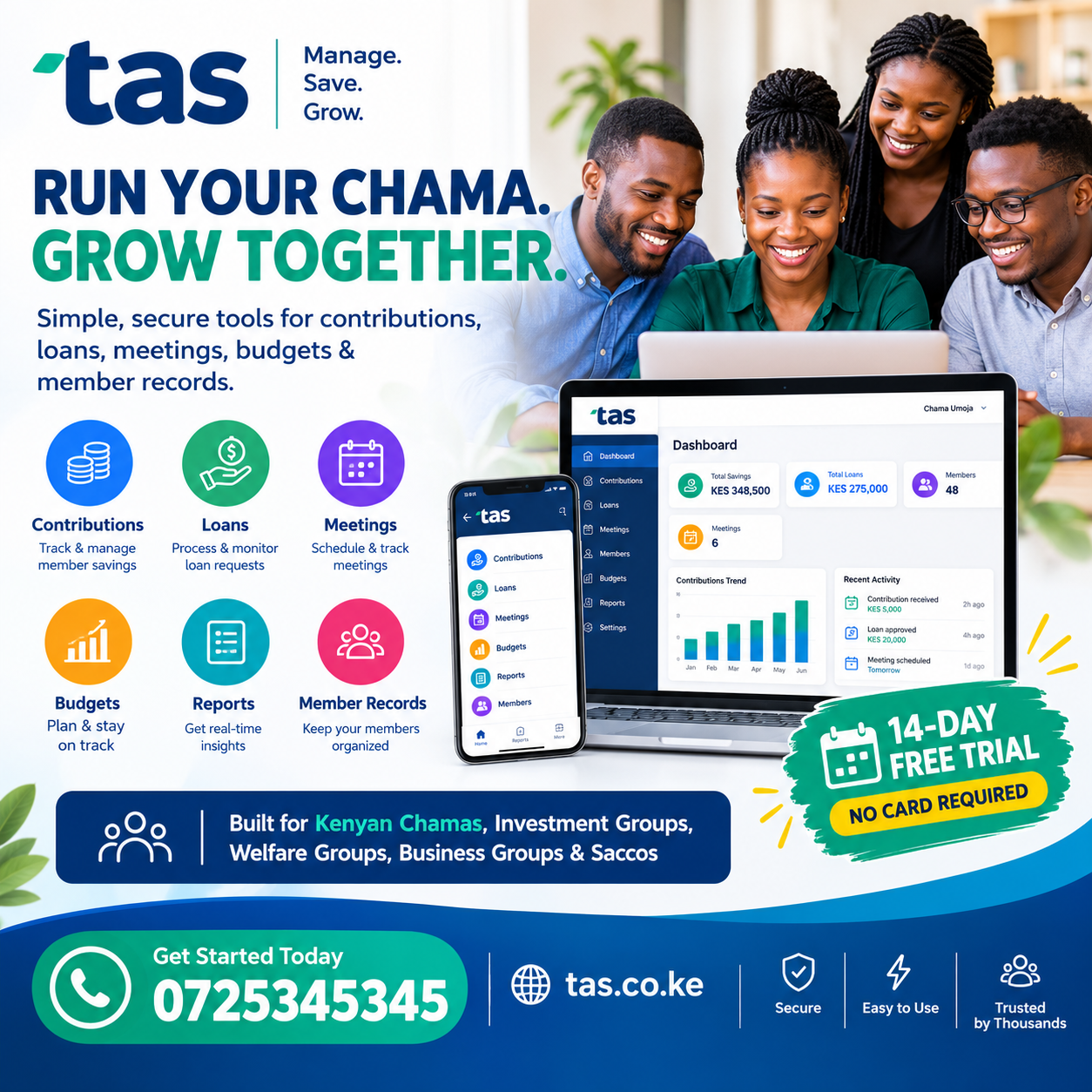
TAS is particularly relevant to organisations looking for a structured way to manage member-based group activities. A welfare group should still conduct its own demonstration and test the workflows that matter most before making a decision.
The strongest implementation combines suitable software with disciplined administration. Committees should reconcile records, protect member information, control access, document approvals and maintain clear financial procedures.
For groups that have outgrown manual administration, this type of software can provide a practical path toward more organised records, faster reporting and greater transparency. The objective is not technology for its own sake. It is to make the work of running the welfare group clearer, more accountable and easier to sustain as membership grows.