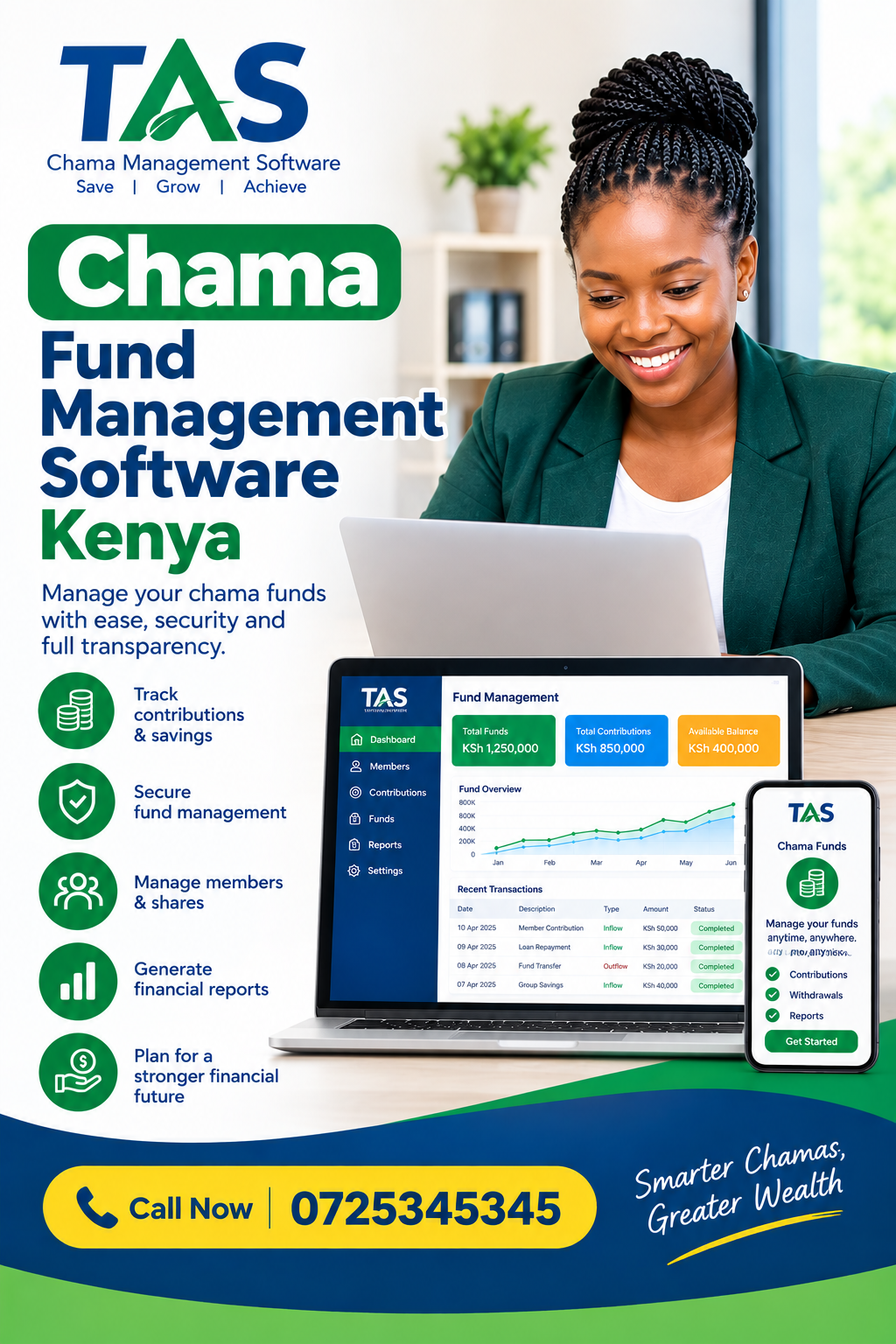
Chama Fund Management Software Kenya: A Practical Guide to Better Savings, Loans and Financial Control
Managing a chama involves more than collecting contributions during meetings and keeping a notebook of who has paid. As a group grows, members expect accurate records, clear financial reports, timely updates, and confidence that every shilling is properly accounted for. Chama Fund Management Software Kenya gives chama officials a structured way to manage these responsibilities while reducing the amount of manual financial administration.
A well-organised system can help a chama record member contributions, monitor savings, manage loans, track repayments, maintain financial records, prepare reports, and give leaders a clearer view of the group’s finances. This guide explains how digital fund management can improve everyday chama operations, what features to consider, common implementation mistakes, and how Kenyan groups can choose a practical solution.
What Is Chama Fund Management Software?
At its simplest, Chama Fund Management Software Kenya is a digital system designed to help savings groups manage money, members, transactions, records, and financial activities from one organised platform.
Traditionally, many chamas rely on exercise books, spreadsheets, WhatsApp messages, notebooks, receipts, and separate bank or mobile-money records. These methods may work when a group is very small. However, they can become difficult to maintain when membership increases or when the group begins handling multiple financial activities.
A digital platform brings these activities together.
Depending on the system selected, a chama may be able to manage:
- Member registration and profiles
- Monthly or weekly contributions
- Savings balances
- Loan applications
- Loan approvals
- Loan repayment schedules
- Outstanding loan balances
- Fines and penalties
- Group expenses
- Income and expenditure
- Financial reports
- Transaction histories
- Member statements
- Fund allocation
- Meeting records
- Notifications and reminders
The objective is not simply to replace a notebook with a computer. The larger objective is to create a reliable financial management process where transactions can be recorded consistently and information can be retrieved when members or leaders need it.
For a growing group, Chama Fund Management Software Kenya can therefore become part of the group’s broader financial control framework.
Why Chamas Need Better Fund Management
Many savings groups start with a simple structure. Members agree on a contribution amount, elect officials, open a way to hold the funds, and begin saving.
The challenge often appears later.
A group may have twenty members today and fifty members next year. Contributions may change. Some members may take loans. Others may repay early. The group may purchase an asset, invest money, pay expenses, collect penalties, or create different savings categories.
Suddenly, the treasurer has several records to maintain.
This is where Chama Fund Management Software Kenya can make the process more manageable.
Instead of asking one official to remember every transaction, the group can establish a consistent digital record. Each transaction can be associated with a member, date, amount, transaction type, and relevant financial account.
This creates several advantages.
First, records become easier to retrieve. A member who wants to understand their contribution history does not have to wait for someone to search through old notebooks.
Second, leaders can identify outstanding obligations more quickly. For example, a treasurer can review unpaid contributions or overdue loans without manually checking multiple pages.
Third, reporting becomes easier. Instead of calculating every total from scratch before a meeting, leaders can work from records already stored in the system.
Finally, better records can improve confidence among members.
Trust is particularly important when a group manages money collectively. Members want to know that contributions, loans, expenses, and other transactions are being recorded correctly.
The Difference Between Fund Management and Simple Record Keeping
It is useful to distinguish financial record keeping from comprehensive fund management.
A basic spreadsheet can record that a member contributed KSh 2,000. It can also calculate a running balance. However, fund management involves a broader picture.
For example, Chama Fund Management Software Kenya can support a process in which a member contributes money, applies for a loan, receives approval, begins repayment, and eventually clears the loan.
The system can also connect that activity to the member’s wider financial history.
A good solution should help leaders answer questions such as:
- How much has each member contributed?
- How much does the group currently hold?
- Which members have outstanding loans?
- How much has been repaid?
- Which repayments are overdue?
- How much has the group spent?
- What income has been received?
- What is the value of outstanding member obligations?
- How much money is available for another investment?
- What transactions occurred during a particular period?
These questions require more than a single contribution register.
They require connected financial records.
Core Features to Look For
Before selecting Chama Fund Management Software Kenya, a chama should identify the features that matter most to its operations.
Not every group needs the same configuration. A small welfare group may need contribution and expense tracking, while a larger investment chama may require detailed loan management, financial reporting, and multiple fund categories.
1. Member Management
Member information forms the foundation of the system.
A useful platform should allow officials to maintain profiles containing relevant information such as:
- Member name
- Contact details
- Membership status
- Contribution history
- Savings balance
- Loan information
- Payment history
- Outstanding obligations
Centralising member information reduces the risk of relying on scattered documents.
It also makes it easier to identify the financial position of each member.
2. Contribution Tracking
Contributions are at the heart of most chamas.
Chama Fund Management Software Kenya should make it easy to record regular contributions and distinguish them from other transactions.
For example, a group could establish monthly contributions of KSh 5,000. The system can record expected contributions and compare them with actual payments.
This makes it easier to identify:
- Paid contributions
- Partially paid contributions
- Missed contributions
- Arrears
- Historical contribution patterns
The result is a clearer financial picture.
3. Savings Management
Not every amount paid by a member necessarily serves the same purpose.
A chama might maintain ordinary savings, investment savings, emergency funds, or another category agreed upon by members.
A digital system can help separate these categories so that officials do not accidentally treat all funds as one balance.
This becomes increasingly important as a group grows.
4. Loan Management
Many chamas provide loans to members.
A good Chama Fund Management Software Kenya solution should help officials manage the complete loan lifecycle rather than simply recording that a loan was issued.
That may include:
- Loan application
- Eligibility review
- Approval
- Disbursement
- Repayment schedule
- Installment tracking
- Interest calculation where applicable
- Outstanding balance
- Overdue amounts
- Loan completion
Having this information in one system can significantly reduce confusion.
5. Financial Reporting
Reports allow members and officials to understand what is happening financially.
A useful reporting module may provide:
- Contribution reports
- Member statements
- Loan reports
- Income reports
- Expense reports
- Cash-flow summaries
- Outstanding balances
- Transaction reports
- Periodic financial summaries
When reports can be generated quickly, meetings can focus more on decisions and less on manually adding numbers.
How Digital Contribution Tracking Improves Accountability
Accountability starts with accurate records.
When contributions are recorded manually, errors can occur through simple mistakes. A payment may be written in the wrong column. A receipt may be misplaced. A figure may be entered incorrectly. A transaction may be forgotten until much later.
Chama Fund Management Software Kenya provides a structured environment for recording transactions.
The important principle is consistency.
Every contribution should have a clear record. Every adjustment should have an explanation. Every financial activity should be traceable to the appropriate account or member.
This makes reconciliation easier.
Suppose a chama receives several payments during a month. The treasurer can compare the recorded transactions with the relevant bank or mobile-money records. If there is a difference, the group can investigate it instead of assuming the numbers are correct.
Digital records do not eliminate the need for financial controls. They make those controls easier to apply.
Managing Chama Loans More Effectively
Loans are often one of the most complicated parts of chama administration.
Consider a group with thirty members. Ten members have borrowed money at different times, each with different amounts and repayment schedules.
If the treasurer relies on a notebook, calculating outstanding balances can become time-consuming.
With Chama Fund Management Software Kenya, loan information can be organised by member and repayment schedule.
The system can help officials identify:
- Original loan amount
- Amount repaid
- Remaining balance
- Next expected payment
- Overdue amount
- Loan status
- Applicable charges or interest
This helps the committee maintain better oversight.
Why Loan Visibility Matters
Loan money is still part of the group’s financial position even though it may not currently be sitting in the group’s bank account.
If a chama has KSh 500,000 in outstanding member loans, leaders need to know that when considering new investments or additional lending.
A clear loan portfolio therefore helps the group make better decisions.
It can also prevent situations where officials approve additional loans without understanding how much money is already committed.
Managing Contributions and Loans Together
One of the strengths of an integrated platform is the ability to see the relationship between savings and borrowing.
For example, a member might contribute consistently for twelve months and then request a loan.
The committee may need to consider the member’s contribution history, existing obligations, and ability to repay.
Chama Fund Management Software Kenya can help present the relevant information in an organised format.
This does not mean software should make every financial decision automatically. The group’s constitution, rules, committee procedures, and agreed policies should remain the basis for approvals.
The software should support those policies by making accurate information available to decision-makers.
Fund Allocation and Investment Tracking
A chama may eventually move beyond simple saving and lending.
Members may decide to invest in:
- Land
- Property
- Shares
- Business ventures
- Equipment
- Agriculture
- Other agreed investments
When this happens, fund management becomes more complex.
Chama Fund Management Software Kenya can help the group distinguish between money intended for investment and money reserved for other purposes.
For example, suppose a group has KSh 1 million. Members may decide that KSh 600,000 will be allocated toward an investment while KSh 400,000 remains available for lending or other approved activities.
A clear digital record helps officials understand how funds are allocated.
This can also make future reporting easier.
Expense Management for Chamas
Chamas incur expenses, even when their main activity is saving.
Examples include:
- Meeting costs
- Bank charges
- Administrative expenses
- Registration costs
- Transport expenses
- Communication costs
- Professional services
- Investment-related expenses
These expenses should not disappear into a general cash balance.
A platform such as Chama Fund Management Software Kenya can help record the date, amount, category, description, and relevant supporting information for each expense.
Over time, this creates an expense history.
That history can help the committee identify recurring costs and determine whether spending remains within the group’s approved budget.
Financial Reporting for Member Meetings
Chama meetings are an important opportunity for accountability.
Members may want to know how much money has been collected, how much has been loaned, what remains outstanding, what expenses were incurred, and what investments the group owns.
Preparing these figures manually can consume valuable meeting time.
Chama Fund Management Software Kenya can make reporting more structured.
A treasurer can prepare reports before the meeting and present information in a format members can understand.
For example, a monthly report could show:
| Financial Area | Example Information |
|---|---|
| Contributions | Amount received during the month |
| Savings | Total member savings |
| Loans issued | New loans during the period |
| Loan repayments | Amount recovered |
| Outstanding loans | Remaining member balances |
| Expenses | Approved expenditure |
| Investments | Current investment allocations |
| Cash position | Available funds |
The exact reports should reflect the group’s own rules and financial structure.
Member Statements and Transparency
Members should not have to depend entirely on verbal explanations to understand their financial position.
A member statement can provide a useful history of contributions, loans, repayments, and other transactions.
Chama Fund Management Software Kenya can support this type of visibility when the system provides member-level reporting.
For example, a member who believes they have made twelve monthly contributions can review their transaction history and compare it with their own payment records.
If there is a discrepancy, the issue can be investigated while the supporting information is still available.
That is much easier than trying to reconstruct a transaction several months later.
Reconciliation: An Important Financial Control
Recording a transaction is only one part of financial management.
The next step is reconciliation.
Reconciliation means comparing internal records against an external source such as a bank statement, mobile-money statement, receipt record, or other financial evidence.
Chama Fund Management Software Kenya can support an organised reconciliation process by keeping internal transaction records in one place.
A simple monthly reconciliation process might involve:
- Exporting or reviewing the group’s recorded transactions.
- Obtaining the relevant financial statement.
- Comparing transaction dates and amounts.
- Identifying missing entries.
- Investigating unexpected differences.
- Correcting confirmed errors.
- Recording explanations for adjustments.
- Producing a final reconciliation report.
Reconciliation should be treated as a routine activity rather than something done only when there is a dispute.
Using M-Pesa Records More Effectively
M-Pesa is widely used for payments in Kenya, including many group transactions.
For a chama, mobile-money records can provide useful evidence of money received or sent.
However, having a transaction message is not the same as having a complete financial management system.
The group still needs to associate payments with members and the correct financial categories.
For example, a payment received from a member could represent:
- Monthly contribution
- Loan repayment
- Fine
- Registration fee
- Special contribution
- Investment contribution
A good Chama Fund Management Software Kenya workflow can help officials classify transactions appropriately.
The exact integration options depend on the software selected, so groups should verify how payment records are imported, matched, reconciled, and reported before making a purchase.
Reducing Errors in Manual Records
Manual records are not automatically bad. Many successful groups have operated with them for years.
The problem is that manual processes depend heavily on individual discipline.
If a treasurer is unavailable, another official may struggle to understand the records.
If a notebook is damaged or misplaced, reconstructing the information may take considerable effort.
Chama Fund Management Software Kenya provides a centralised alternative where authorised users can work from the same financial information.
This can reduce dependence on one person’s memory.
It also helps create continuity when officials change.
Supporting Leadership Transitions
Chama leadership changes over time.
A treasurer may complete their term. A secretary may move away. A new committee may take responsibility for financial administration.
Without organised records, leadership transitions can become difficult.
The new treasurer must understand:
- Current balances
- Member contributions
- Outstanding loans
- Pending payments
- Investments
- Expenses
- Financial obligations
- Previous transactions
A digital system can make handover more structured.
For this reason, Chama Fund Management Software Kenya should be viewed as an institutional record rather than merely a tool used by one treasurer.
The group owns the process. Officials manage it on behalf of members.
Security and Access Control
Financial records should not be accessible to everyone without restrictions.
A chama system should provide sensible access controls.
For example:
- Treasurer: financial transactions and reports
- Secretary: member records and meeting administration
- Chairperson: oversight and approvals
- Ordinary member: permitted personal statements or information
The exact permissions depend on the software.
The important principle is separation of responsibilities.
A person who records transactions should not necessarily have unrestricted authority to modify every historical record.
A platform offering Chama Fund Management Software Kenya should therefore be evaluated not only for features but also for user permissions, account security, backups, and audit history.
Why an Audit Trail Matters
An audit trail provides a record of important changes or actions within a system.
For example, if a transaction is edited, the system may record who made the change and when.
This can be valuable when investigating discrepancies.
A strong Chama Fund Management Software Kenya solution should make financial activity easier to review rather than creating another opaque system.
The goal is simple: officials should be able to explain what happened to the group’s money.
That principle should guide software selection.
How Chama Leaders Can Use Reports for Decision-Making
Reports are useful only when they lead to better decisions.
Suppose a chama discovers that a large percentage of its funds are tied up in unpaid loans.
The committee may decide to strengthen its loan approval process.
If the group discovers that administrative expenses are increasing, it may review its spending.
If contributions are declining, leaders may investigate whether members are facing affordability issues or whether the contribution structure needs discussion.
Chama Fund Management Software Kenya can provide the information needed to identify these patterns.
The software does not replace leadership.
It gives leaders better information with which to work.
Choosing Software for a Small Chama
A small group does not necessarily need a complicated system.
If a chama has ten or fifteen members, its requirements may be relatively simple.
The group may prioritise:
- Member records
- Contributions
- Savings balances
- Basic loans
- Expenses
- Statements
- Simple reports
In such a case, Chama Fund Management Software Kenya should be judged on ease of use as much as functionality.
If the system is difficult for the treasurer to operate, adoption may become a problem.
A simple interface can sometimes be more valuable than a long list of features that the group never uses.
Choosing Software for a Large Chama
Larger groups generally have more complex requirements.
A group with hundreds of members may need:
- Advanced member management
- Multiple contribution categories
- Detailed loan management
- Role-based permissions
- Automated reminders
- Financial dashboards
- Detailed reports
- Transaction histories
- Data backups
- Better audit controls
For these groups, Chama Fund Management Software Kenya should be evaluated according to scalability.
The system should be able to handle increasing numbers of members and transactions without making everyday operations unnecessarily complicated.
What Should You Ask a Software Provider?
Before choosing a platform, chama officials should prepare questions.
Ask:
- Can the system manage member contributions?
- Can it track loans and repayments?
- Can members receive statements?
- Can officials generate financial reports?
- Can the system record expenses?
- Does it support different fund categories?
- How are user permissions managed?
- How is data backed up?
- Can records be exported?
- Is there customer support?
- How are updates handled?
- What happens if the group changes officials?
- Can the system accommodate growth?
- What are the total costs?
- Is training provided?
These questions help a chama evaluate the product based on its actual needs.
Common Mistakes When Digitising a Chama
Moving from paper records to software does not automatically solve every financial problem.
There are several mistakes groups should avoid.
Mistake 1: Entering Poor Historical Data
If old records contain errors, transferring them into a new system may simply move the problem.
Before migration, officials should review existing balances and resolve obvious discrepancies.
Mistake 2: Giving Everyone Full Access
Convenience should not override financial controls.
Users should receive only the permissions appropriate to their roles.
Mistake 3: Ignoring Reconciliation
Digital records still need to be compared with actual financial statements.
Mistake 4: Failing to Train Officials
A powerful system is useless if officials do not understand how to use it.
Mistake 5: Choosing Features Instead of Processes
A chama should first identify what it needs to accomplish.
Only then should it compare software features.
Mistake 6: Forgetting Data Continuity
Leadership changes are inevitable.
The group’s records should remain accessible through controlled institutional accounts rather than being tied to one individual’s personal account.
Building a Simple Digital Chama Workflow
A practical workflow might look like this:
Step 1: Register members
Create a profile for each approved member.
Step 2: Define contribution rules
Set contribution amounts, frequency, and categories according to the group’s agreed policies.
Step 3: Record payments
Enter or import confirmed payments and associate them with the correct member.
Step 4: Reconcile
Compare internal records with available financial statements.
Step 5: Manage loans
Record approved loans, disbursements, repayment schedules, and repayments.
Step 6: Track expenses
Record approved group expenditure.
Step 7: Review reports
Generate periodic financial reports.
Step 8: Share appropriate information
Give members access to information they are entitled to receive.
Step 9: Review controls
Periodically check user permissions, records, and reconciliation procedures.
Step 10: Back up important information
Maintain appropriate backups and ensure officials know how records can be recovered.
This workflow creates a repeatable financial administration process.
The Role of the Treasurer
Software does not eliminate the treasurer’s responsibilities.
Instead, it can change how the treasurer spends time.
Without a digital system, a treasurer may spend hours:
- Adding figures
- Searching notebooks
- Calculating balances
- Preparing statements
- Checking loan repayments
- Preparing meeting reports
With Chama Fund Management Software Kenya, much of the repetitive calculation and organisation can be handled through structured records.
The treasurer can then spend more time reviewing transactions, reconciling records, investigating exceptions, and preparing useful financial information for the committee.
The Role of the Secretary
The secretary often manages member information and meeting records.
A well-organised financial system can complement this work.
For example, the secretary may need to confirm:
- Current membership
- New members
- Departures
- Meeting decisions
- Approved financial activities
- Committee changes
When membership information and financial records are properly organised, administrative work becomes easier to coordinate.
The Role of the Chairperson
The chairperson provides oversight rather than handling every transaction personally.
A dashboard or summary report can help the chairperson understand the group’s position without going through every transaction.
Chama Fund Management Software Kenya can therefore support governance by giving authorised leaders timely access to relevant information.
The chairperson can ask better questions when the underlying information is available.
For example:
- Why have loan arrears increased?
- Why did expenses rise this month?
- How much money is currently available?
- Which investments are pending?
- Are members meeting contribution commitments?
Good governance depends on evidence.
Using Financial Data to Plan Investments
A chama should avoid committing money simply because the account appears to have a large balance.
The group needs to understand its actual obligations.
For example, if members have made substantial contributions but a significant amount has been lent out, the available cash may be lower than the total recorded funds.
A Chama Fund Management Software Kenya report can help separate different components of the group’s financial position.
This makes investment planning more disciplined.
Before making an investment, leaders should consider:
- Available cash
- Outstanding loans
- Expected repayments
- Emergency reserves
- Existing investments
- Planned expenses
- Member commitments
- The group’s governing rules
Software can organise the numbers, but members still need to make the final decisions according to their agreed governance process.
Improving Communication With Members
Financial transparency is partly a communication issue.
Members are more likely to trust a system when they can understand their own records and receive clear updates.
Depending on the platform, communication features may include:
- Payment confirmations
- Loan reminders
- Contribution reminders
- Member statements
- Meeting notifications
- Financial updates
For a chama with members in different locations, digital communication can reduce the need for every question to be answered manually by the treasurer.
Automating Routine Reminders
Missed contributions and late loan repayments create additional administrative work.
A system that supports reminders can reduce the need for officials to contact members individually.
For example, the system could remind a member that a contribution is due or that a repayment deadline is approaching.
Chama Fund Management Software Kenya can be particularly useful when a group has many members and officials need a more consistent communication process.
Automation should remain respectful and aligned with the group’s policies. A reminder is intended to support compliance, not embarrass members.
Measuring the Financial Health of a Chama
A chama should periodically review its financial health.
Useful indicators may include:
- Total member savings
- Contribution consistency
- Outstanding loans
- Loan repayment performance
- Total expenses
- Investment allocation
- Available cash
- Member growth
- Fund utilisation
These indicators should be interpreted together.
For example, high total savings may look positive, but if a large proportion is tied up in overdue loans, the group may face liquidity challenges.
A Chama Fund Management Software Kenya dashboard can help leaders see these relationships more clearly.
Cost Considerations When Selecting Software
Price matters, but it should not be the only consideration.
A cheaper platform may become expensive if officials spend excessive time correcting records or if important reports have to be prepared manually.
A more capable platform may justify its cost if it reduces administration and improves financial visibility.
When comparing costs, consider:
- Subscription fees
- Setup charges
- Training
- Support
- Additional users
- Data migration
- Payment integrations
- Reporting features
- Future upgrades
Ask for the complete pricing structure before making a commitment.
The right question is not simply, “How much does the software cost?”
It is also, “What value will the chama receive for that cost?”
Data Migration From Excel or Paper Records
Many chamas already have years of records.
Moving to a digital system therefore requires careful planning.
Start by identifying the records that need to be transferred.
These may include:
- Member lists
- Contribution balances
- Loan balances
- Repayment histories
- Savings balances
- Investment records
- Expense records
Then clean the data.
Duplicate members should be removed. Obvious errors should be investigated. Unknown balances should not simply be guessed.
Once the opening balances are confirmed, they can be entered into the new system.
A controlled migration makes future reconciliation much easier.
What Makes a Chama Management System Successful?
Technology alone does not create good financial management.
Successful adoption depends on three things:
People: Officials need to understand their responsibilities.
Processes: The chama needs clear procedures for contributions, loans, approvals, reconciliation, and reporting.
Technology: The software needs to support those procedures.
If any one of these is weak, the overall system can struggle.
A group may purchase excellent software but fail to use it consistently. Another may have disciplined officials but inadequate records. The strongest approach combines capable people with clear processes and appropriate technology.
A Practical Implementation Plan
A chama can introduce Chama Fund Management Software Kenya gradually rather than changing every process overnight.
Phase One: Understand the Current Process
Document how the chama currently handles:
- Contributions
- Loans
- Expenses
- Savings
- Reports
- Approvals
- Reconciliation
Phase Two: Clean Existing Records
Resolve obvious discrepancies before entering historical information.
Phase Three: Configure the System
Set up members, financial categories, contribution rules, loan policies, and user permissions.
Phase Four: Train Officials
Give the treasurer and other authorised users practical training.
Phase Five: Test Transactions
Enter sample transactions and verify the resulting balances and reports.
Phase Six: Go Live
Begin recording actual transactions in the system.
Phase Seven: Reconcile Regularly
Continue comparing records against financial statements.
Phase Eight: Review After Several Months
Ask members and officials what is working and what needs improvement.
This approach reduces disruption.
When a Chama Should Consider Upgrading Its System
A group may be ready for better software when:
- Records are becoming difficult to maintain.
- The treasurer spends too much time preparing reports.
- Members frequently ask for balance statements.
- Loan tracking has become complicated.
- Multiple officials need access to records.
- The group has grown substantially.
- Manual reconciliation takes too long.
- Financial information is scattered across different files.
- Leadership changes create record-keeping problems.
- Members want greater transparency.
These are practical signs that the group’s administrative requirements have outgrown its current tools.
Frequently Asked Questions
What is Chama Fund Management Software Kenya used for?
Chama Fund Management Software Kenya can be used to organise member records, contributions, savings, loans, repayments, expenses, financial reports, and other group financial activities. The exact features depend on the software.
Can a small chama use fund management software?
Yes. A small chama can use digital software if the system matches its size and needs. The group should prioritise ease of use, essential financial records, member management, reporting, and affordability.
Can software track chama loans?
Yes. Many systems can record loan applications, approvals, disbursements, repayments, outstanding balances, and loan histories. Before choosing a platform, confirm that its loan functionality matches the group’s specific lending rules.
Can members view their contribution records?
This depends on the platform. Some systems provide member statements or portals that allow members to view relevant financial information. Groups should check the available access and permission features before implementation.
Is M-Pesa integration important for a Kenyan chama?
It can be useful because many Kenyan groups receive or send money through mobile-money channels. However, integration requirements differ between platforms, so officials should verify exactly how payments are captured, matched, and reconciled.
How does software improve chama accountability?
Chama Fund Management Software Kenya can improve accountability by creating structured transaction records, making reports easier to prepare, supporting controlled user access, and helping officials review financial activity.
Can software manage different chama funds?
A suitable system may support different categories of funds, depending on its configuration. This can help a group distinguish ordinary savings, investment funds, emergency funds, loan-related funds, or other categories established by its rules.
What should a chama check before buying software?
The group should evaluate member management, contribution tracking, loan management, reporting, security, user permissions, backups, support, integrations, scalability, ease of use, and total cost.
Does chama software replace a treasurer?
No. Software supports the treasurer; it does not replace financial oversight. The treasurer and committee remain responsible for reviewing transactions, following the group’s policies, reconciling records, and presenting information to members.
How often should chama financial records be reviewed?
The frequency should match the group’s activity level. A chama handling frequent transactions may benefit from regular monthly reconciliation and reporting, while the committee can determine additional reviews based on its rules and financial controls.
Final Checklist Before Choosing a Chama Fund Management Platform
Before signing up for any solution, the committee should work through a simple checklist.
Member management
- Can all members be recorded?
- Can membership status be updated?
- Can individual statements be generated?
Contributions
- Can regular contributions be tracked?
- Can missed payments be identified?
- Can different contribution categories be handled?
Loans
- Can applications and approvals be recorded?
- Can repayment schedules be monitored?
- Can outstanding balances be viewed?
Financial management
- Can income and expenses be recorded?
- Can funds be categorised?
- Can financial reports be generated?
- Can transactions be reconciled?
Security
- Are user roles available?
- Are permissions configurable?
- Are backups maintained?
- Can important changes be reviewed?
Usability
- Can officials learn the system quickly?
- Does it work well on commonly used devices?
- Is support available when problems arise?
Scalability
- Can the system handle more members?
- Can the chama add additional financial activities?
- Can the platform continue supporting the group as it grows?
These questions help turn software selection into a practical business decision instead of a feature comparison exercise.
Why Digital Fund Management Is Becoming More Important for Chamas
The fundamental purpose of a chama is collective financial progress. Members contribute because they expect their group to manage those contributions responsibly and use them according to agreed objectives.
As the amount of money managed by a group increases, the importance of organised records increases with it.
Chama Fund Management Software Kenya can provide the structure needed to bring contributions, savings, loans, expenses, and reporting into one workflow.
The biggest benefit is not simply speed.
It is visibility.
Leaders can see what is happening. Members can receive clearer information. Treasurers can spend less time searching for records. Committees can make decisions using organised financial information.
That can help a chama operate with greater consistency.
The Future of Chama Financial Management
Kenyan savings groups are increasingly operating in environments where members expect convenient communication, accurate records, and faster access to information.
A chama that starts small can eventually become a substantial financial organisation.
Its processes therefore need to be capable of growing with it.
Chama Fund Management Software Kenya provides a foundation for that growth by turning financial administration into a structured digital process.
However, technology should remain a means to an end.
The goal is not to have the most complicated system.
The goal is to have accurate records, responsible financial management, transparent reporting, efficient administration, and informed decision-making.
A chama that combines those principles with suitable software can create a stronger foundation for long-term financial activity.
Conclusion
Effective chama management requires more than collecting money and recording balances. As membership, contributions, loans, expenses, and investments increase, manual administration can become difficult to control.
A properly selected Chama Fund Management Software Kenya solution can help bring these activities into one organised system. It can support member management, contribution tracking, savings records, loan administration, expense management, reconciliation, reporting, and controlled access to financial information.
The best system will depend on the size and structure of the group. A small chama may need a simple platform focused on contributions and member records, while a larger investment group may require advanced loan management, reporting, permissions, and multiple financial categories.
Before selecting a platform, leaders should document their current processes, identify their biggest administrative problems, compare relevant features, evaluate security and support, and consider the total cost of ownership.
Most importantly, software should strengthen the chama’s existing governance rather than replace it.
When financial information is organised, accessible to authorised people, regularly reconciled, and presented clearly to members, the group is better positioned to manage its funds responsibly.
That is the real value of Chama Fund Management Software Kenya: creating a dependable financial management structure that helps chama leaders spend less time chasing records and more time managing the group’s financial objectives.
Additional Implementation Considerations
A chama introducing digital financial management should also establish a clear internal policy covering who enters transactions, who approves them, who reviews reports, and how corrections are handled.
This separation can help prevent confusion.
For example, one official may record a contribution while another reviews the monthly reconciliation. Loan approvals can follow the group’s existing committee process rather than being treated as automatic software decisions.
The group should also keep its operating procedures simple enough for new officials to understand.
When a new treasurer takes over, the transition should involve a review of opening balances, outstanding loans, current investments, recent reports, and unresolved reconciliation items.
A platform that supports Chama Fund Management Software Kenya processes can make this handover easier when records are properly maintained.
The same principle applies to member communication. Financial reports should use language members understand. Complicated dashboards are less useful if ordinary members cannot interpret the figures.
A good report should answer practical questions:
- How much did members contribute?
- How much was spent?
- How much was loaned?
- How much was repaid?
- What remains outstanding?
- How much money is available?
- What financial decisions require member attention?
When those questions can be answered consistently, the chama has a much stronger administrative foundation.
Making the Most of Digital Records
The value of a digital record increases when the group uses it consistently.
Officials should avoid maintaining parallel systems indefinitely. If the chama uses software but continues relying primarily on a notebook or disconnected spreadsheet, differences can eventually emerge.
The committee should agree on the system of record and establish a routine for updating it.
For example, contributions can be recorded promptly after confirmation, loans can be entered when approved and disbursed, repayments can be recorded as they occur, and expenses can be entered with appropriate descriptions.
Monthly reporting can then be based on the same information.
Chama Fund Management Software Kenya can become more useful when it is treated as part of the chama’s standard operating process rather than an optional administrative tool.
That consistency also makes historical analysis easier.
A committee reviewing twelve months of records can identify contribution patterns, loan repayment trends, expenditure changes, and investment activity more easily when all transactions have been recorded using the same structure.
A Practical Final Decision Framework
Before making the final software decision, the committee can score each potential system against five broad areas:
Functionality: Does it cover the group’s actual financial requirements?
Usability: Can officials operate it without unnecessary complexity?
Control: Does it provide suitable permissions, records, and security?
Scalability: Can it support the chama if membership and transactions increase?
Value: Does the overall benefit justify the cost?
Using these questions creates a more balanced evaluation.
A chama should not select software simply because it has the largest number of features. Nor should it automatically choose the cheapest option.
The appropriate solution is the one that fits the group’s financial structure, operating capacity, and long-term objectives.
For many Kenyan savings groups, moving from fragmented records to a structured digital process can be a significant administrative improvement. With the right implementation approach, Chama Fund Management Software Kenya can help create better visibility over member funds while making routine financial administration more manageable.
The ultimate objective remains straightforward: accurate records, accountable leadership, informed members, and responsible management of collective funds.
Chama Fund Management Software Kenya
Chama Fund Management Software Kenya
Chama Fund Management Software Kenya
Chama Fund Management Software Kenya
Chama Fund Management Software Kenya
Chama Fund Management Software Kenya
Chama Fund Management Software Kenya
Chama Fund Management Software Kenya
Chama Fund Management Software Kenya
Chama Fund Management Software Kenya
Chama Fund Management Software Kenya
Chama Fund Management Software Kenya
Chama Fund Management Software Kenya
Chama Fund Management Software Kenya
Chama Fund Management Software Kenya
Chama Fund Management Software Kenya
Chama Fund Management Software Kenya
Chama Fund Management Software Kenya
Chama Fund Management Software Kenya
Chama Fund Management Software Kenya
Chama Fund Management Software Kenya
Chama Fund Management Software Kenya
Chama Fund Management Software Kenya
Chama Fund Management Software Kenya
Chama Fund Management Software Kenya
Chama Fund Management Software Kenya
Chama Fund Management Software Kenya
Chama Fund Management Software Kenya