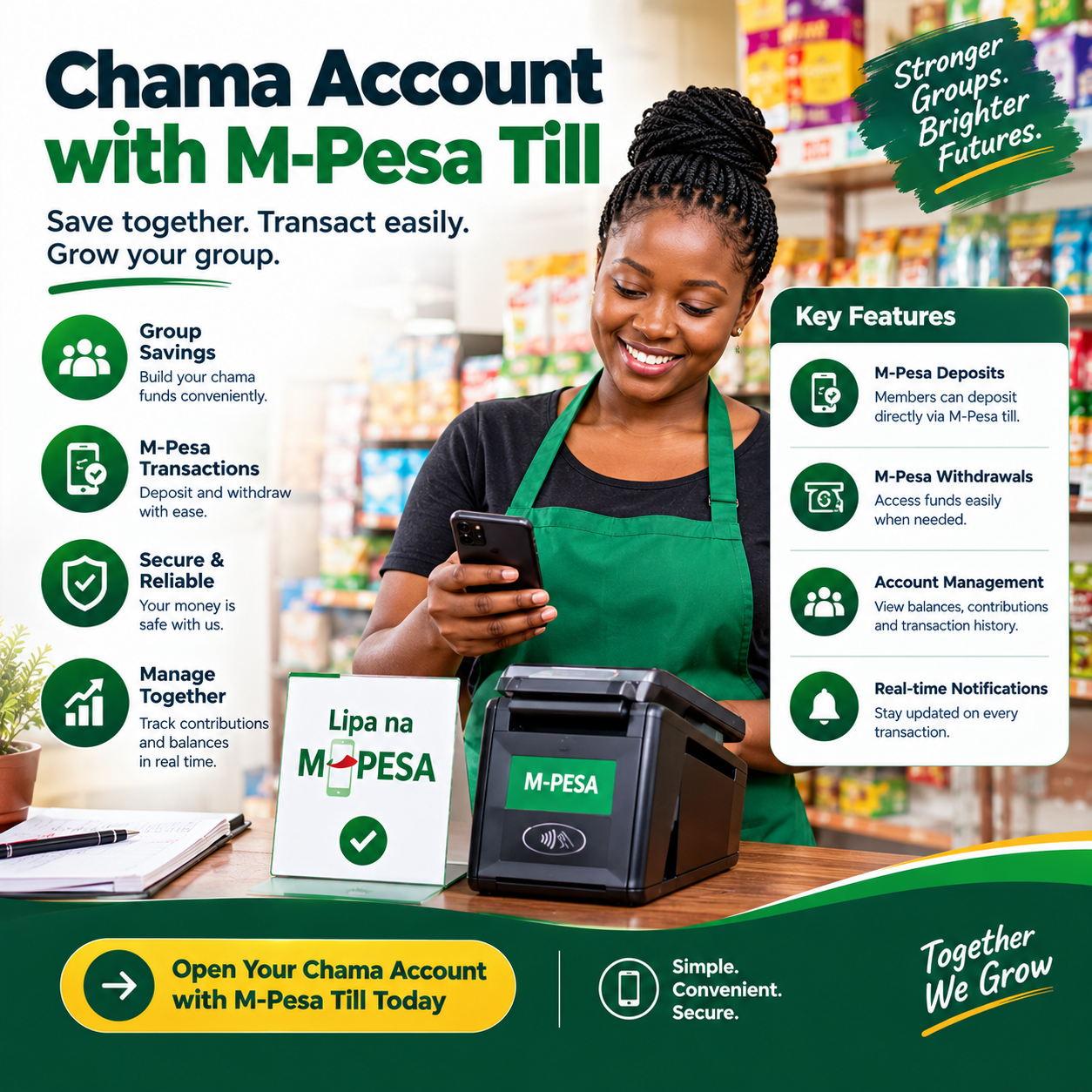
A chama account with M-Pesa till has become the first digital milestone for thousands of Kenyan investment groups, and the reason is easy to understand. The notebook worked for decades, the treasurer’s personal number held on longer than it should have, but the moment a group gets serious, collections need a proper institutional channel. That is exactly what a chama account with M-Pesa till provides — a branded payment identity that turns collections from a chase into a flow.
The logic behind the till is simple and powerful. Members pay into a till number exactly as they pay a supermarket, with the group’s name appearing on every payment. Every contribution arrives with records, every member becomes traceable, and the treasurer’s evenings of manual matching begin to disappear. That transformation is why the search for a chama account with M-Pesa till has become the most common digital question in group finance today.
The confusion surrounding the topic usually comes from vocabulary. Kenyans use “till,” “paybill,” and “wallet” loosely in conversation, yet each is a distinct Safaricom product with different requirements and purposes. Understanding those differences is the essential first lesson in any proper chama account with M-Pesa till guide.
This guide is the complete playbook for that journey. It explains the products available, the documents commonly needed, the application steps, and how to connect the till to the rest of the group’s financial life. By the end, the chama account with M-Pesa till process will feel like a checklist your group can complete in days rather than a mystery stretching across months.
The article is written for treasurers preparing the group’s first digital collection channel, chairpersons drafting the authorizing minutes, and founders building new groups that want clean systems from day one. It is equally written for the members who will pay into the till and deserve to understand how it works. Everyone benefits when the group approaches the chama account with M-Pesa till journey with structure rather than improvisation.
One honesty statement belongs before the details begin. Requirements, timelines, and processes are set by Safaricom and do change over time, so this guide presents what is commonly involved while always directing you to confirm current specifics with Safaricom directly. That careful framing runs through every section of this chama account with M-Pesa till walkthrough.
The good news is that the process is more accessible than most groups fear. The documents are things a well-run chama already possesses, the application is a familiar errand, and the payoff arrives within the very first collection cycle. Groups that prepare their chama account with M-Pesa till application properly routinely wonder why they waited so long.
There is also a bigger picture hiding behind this small administrative task. The till is the group’s gateway into professional digital finance — automatic records, reconciled statements, and visible discipline that members and outsiders both notice. That foundation is the deeper meaning behind the chama account with M-Pesa till milestone.
So read this guide with your group’s documents close by and a folder ready to fill. Tick each item as your group secures it, and confirm the details with Safaricom as this guide directs. By the final page, the chama account with M-Pesa till project will have a clear finish line in sight.
Till, Paybill, or Wallet: Understanding the Options
The first lesson in till education is vocabulary. A buy goods till, a paybill account, and a personal mobile wallet are three different channels, each designed for different flows of money. Choosing between them is the first real decision inside the chama account with M-Pesa till journey.
A personal wallet is the default channel most informal groups start with. Members send money to the treasurer’s number, and the treasurer keeps informal records. That arrangement works briefly and fails predictably — it is precisely the weakness that motivates groups toward a proper chama account with M-Pesa till or paybill solution.
A paybill account is built for organizations collecting payments from the public or from members, with the organization’s name appearing when payment is made. It typically suits formal entities with registration documents and supports structured business collections. Understanding the paybill alternative is a required part of any honest chama account with M-Pesa till comparison, because some groups are better served by it.
A buy goods till is built for merchants selling goods and services, with a till number that members use to pay. Groups often adopt tills because members find the payment flow familiar — the same flow they use at the supermarket daily. That familiarity is the practical appeal groups discover when evaluating a chama account with M-Pesa till against paybill alternatives.
The honest guidance is this: the right channel depends on your group’s registration status, its collection style, and Safaricom’s current requirements for each product. Some groups open a till, others a paybill, and the strongest move is asking Safaricom directly which fits your structure. That confirmation habit is the first discipline of the chama account with M-Pesa till process.
One more comparison belongs in this section. Whatever channel you choose, the till or paybill collects money but does not manage it — invoicing, reminders, reconciliation, and statements still need a system behind the channel. That division of labor is the design principle that shapes the rest of this chama account with M-Pesa till guide.
Why a Till Transforms Group Collections
The first transformation is identity. Payments arrive under the group’s name rather than an individual’s, which changes both psychology and record-keeping permanently. That identity shift is the first reward groups notice after setting up a chama account with M-Pesa till.
The second transformation is traceability. Every payment through the till carries a record that can be matched to a member, a month, and a purpose. Gone are the days of “I sent it to your number” arguments, because the till creates the evidence trail that a chama account with M-Pesa till was designed to produce.
The third transformation is member convenience. Members pay the way they pay everywhere else — a familiar flow with no new habits to learn. That frictionless experience is the adoption secret behind every successful chama account with M-Pesa till rollout.
The fourth transformation is reconciliation speed. With payments arriving under one identity, matching them to member accounts becomes systematic rather than investigative. That speed compounds monthly, which is why groups running a chama account with M-Pesa till report faster closes almost immediately.
The fifth transformation is official protection. When money flows to a group till rather than a treasurer’s personal line, the treasurer stops being a walking target of suspicion. That armor is one of the quietest gifts of running a chama account with M-Pesa till properly.
The sixth transformation is growth readiness. A till scales effortlessly from ten members to two hundred, while personal-number collections collapse somewhere in between. Scalability is the strategic reason the chama account with M-Pesa till milestone belongs in every growing group’s plan.
The Documents Commonly Needed
Document preparation is the heart of the application. While exact requirements vary and must be confirmed with Safaricom, the items below are what group applications commonly involve. Gathering them before applying is the efficiency secret of the chama account with M-Pesa till process.
The group’s registration documents lead the list for registered groups. A certificate of registration — for a society, CBO, cooperative, or company — proves the group legally exists. That certificate is typically the anchor document within a chama account with M-Pesa till application for formal groups.
The constitution serves the same purpose for informal groups. It demonstrates the group’s purpose, its officials, and its rules, giving the application a legitimacy anchor even without registration. Keeping the constitution current and signed matters throughout the chama account with M-Pesa till application.
The authorizing minutes are commonly required. A minuted resolution stating that the group resolved to open the till, naming the appointed officials, proves the application has collective backing. That minute is often the single most decisive document in the chama account with M-Pesa till application.
Identification for the officials follows. The chairperson, treasurer, and secretary typically provide national IDs or passports, verified against their names in the constitution and minutes. Individual verification runs as a parallel track within the chama account with M-Pesa till application.
KRA PINs are commonly requested for the officials, and sometimes for the group itself depending on its status. Confirming PIN registration in advance prevents a predictable stall. That small preparation step frequently speeds up the chama account with M-Pesa till application considerably.
Contact details complete the file. Phone numbers and addresses for the group and its officials are recorded, and the group’s chosen till name must be decided — appearing as the payment identity members see. Naming decisions belong at this stage of the chama account with M-Pesa till preparation.
A practical tip binds the documents together. Build one folder with everything, verified by two officials for name consistency before the application goes anywhere. Paired checking catches the small mismatches that cause most delays in the chama account with M-Pesa till process.
The Application Process: Step by Step
Step one is confirming the current process. Safaricom’s application routes and requirements evolve, so begin by confirming through official Safaricom channels — its website, customer care, or a Safaricom business desk. That confirmation is the zero-cost first step of the entire chama account with M-Pesa till journey.
Step two is document assembly at home. Gather the registration certificate or constitution, prepare the authorizing minutes, and compile official IDs and PINs into one verified folder. One organized afternoon usually completes the preparation behind the chama account with M-Pesa till application.
Step three is choosing the till name. The name members will see when paying should match or clearly resemble the group’s known name, avoiding confusion at the moment of payment. Naming care is a small but genuine factor within the chama account with M-Pesa till process.
Step four is submitting the application through the confirmed channel. Whether online, at a Safaricom shop, or through a business desk, present the complete folder and answer the verification questions honestly. Complete first submissions are what convert the chama account with M-Pesa till process into a single-effort task.
Step five is verification and processing. Safaricom reviews the application, verifies the documents, and processes the request within timelines that vary — so ask what to expect and follow up politely if needed. Patience with confirmation is the realistic posture during the chama account with M-Pesa till processing stage.
Step six is activation and testing. Once the till number is issued, the officials make a test payment, confirm the group’s name displays correctly, and verify that the confirmation messages arrive as expected. The successful test payment is the tangible finish line of the chama account with M-Pesa till journey.
Step seven is the rollout to members. Announce the till number everywhere — the group chat, meeting announcements, and a pinned message — and show members exactly how to pay during the next meeting. That collective launch is the adoption moment that completes the chama account with M-Pesa till process.
Choosing the Right Officials to Manage the Till
The till becomes a shared financial instrument, and its management deserves the same care as a bank mandate. Decide early who receives the confirmations, who reconciles the payments, and who responds when a member’s payment fails to reflect. Role clarity is the governance layer of every chama account with M-Pesa till implementation.
The treasurer is the natural primary manager. Daily visibility of incoming payments, reconciliation duties, and member queries all belong to the treasury function naturally. That alignment makes the treasurer the anchor official throughout the chama account with M-Pesa till implementation.
The chairperson and secretary should hold oversight. Monthly review of the till’s statements, cross-checking against the group’s records, keeps the system honest without burdening anyone. Shared oversight is the integrity structure recommended in every mature chama account with M-Pesa till arrangement.
Never let the till rest under one person’s full control. Even with Safaricom’s own records as backup, the group’s reconciliation and response functions should involve at least two officials. Dual involvement is the protection principle that shapes every well-run chama account with M-Pesa till.
Document the roles in the minutes. When the group minuted the till application, it should also minute who manages, who reconciles, and who reports. Documented stewardship is the governance finish to the chama account with M-Pesa till process.
After the Till Is Live: The Reconciliation System
The till collects money, but collection without reconciliation is only half a system. Matching each payment to the right member, month, and purpose is where the real administrative work lives. That matching layer is what makes a chama account with M-Pesa till genuinely useful rather than merely new.
Manual reconciliation works briefly and fails predictably. A treasurer copying payments into a notebook or spreadsheet by hand eventually slips, and slips become disputes. That fragility is why groups pair the till with automated tools from the very beginning of their chama account with M-Pesa till journey.
Modern platforms close that gap completely. They connect to the till’s payment stream, match every payment automatically to the right member’s account, and update balances and statements in real time. Automation at that level turns the chama account with M-Pesa till achievement into a complete financial system.
Tas.co.ke serves groups at exactly this point. Contributions, loans, fines, statements, and welfare records run in one reconciled system with real Kenyan support, pairing naturally with your till or paybill. Groups that combine their till with Tas.co.ke report that the discipline established through the chama account with M-Pesa till process carries straight into daily operations.
The monthly rhythm completes the system. Payments reconcile automatically, the treasurer reviews exceptions, two officials verify the month-end figures, and statements circulate to members. That paired verification is the ongoing discipline a chama account with M-Pesa till begins and good practice continues forever.
One habit deserves special mention. Keep the till confirmations flowing into the group’s records even when payments look routine, because the routine months are exactly when systems drift. Consistent recording is the maintenance discipline of a chama account with M-Pesa till managed well after the launch excitement fades.
Costs and Practical Considerations
Costs around tills involve a few layers worth understanding upfront. Safaricom’s tariff structures for till transactions differ from personal send-money rates, and groups should understand what paying members experience and what the group may absorb. Confirming current tariffs directly with Safaricom is the financially honest step within the chama account with M-Pesa till preparation.
Member experience deserves testing before full rollout. Have several members make test payments and confirm the process feels natural on different phones. That user testing is the practical polish that separates smooth chama account with M-Pesa till launches from confusing ones.
Communicate the change clearly to members. Explain why the till replaces the treasurer’s personal number, how to pay, and what confirmation to expect. That explanation is the trust bridge that carries members across the transition a chama account with M-Pesa till enables.
Keep the old channel retired cleanly. Once the till is live and members are paying, declare the personal-number era closed, so records stay unified. Clean channel retirement is the discipline that preserves the clarity a chama account with M-Pesa till creates.
Common Mistakes to Avoid
The first classic mistake is applying without complete documents. Incomplete submissions stall, return for corrections, and stretch a one-week process into a one-month frustration. Complete first submissions are the efficiency rule of the chama account with M-Pesa till application.
The second mistake is naming the till inconsistently with the group’s known name. Members hesitate when the payment name looks unfamiliar, and hesitation slows adoption. Naming alignment is a small correction with outsized impact within the chama account with M-Pesa till rollout.
The third mistake is skipping the authorizing minutes. Applications backed by a minuted resolution move smoothly, while improvised applications raise questions the group then scrambles to answer. That single meeting before applying is the governance prerequisite of the chama account with M-Pesa till process.
The fourth mistake is leaving the till under one person’s management. A single official receiving, reconciling, and responding alone recreates the exact concentration risk the till was meant to remove. Shared stewardship is the protection principle throughout every chama account with M-Pesa till implementation.
The fifth mistake is treating the till as the whole system. A till collects; it does not invoice, remind, reconcile, or report — and groups that stop at collection recreate manual work in new forms. That distinction is the most important lesson in this entire chama account with M-Pesa till guide.
Real Stories from Kenyan Groups
The Nakuru welfare table opened its till after a year of screenshot-chasing. Within two cycles, collections rose noticeably because members could pay in ten seconds without asking for numbers, and the treasurer’s evenings were reclaimed entirely. Convenience, they say, was the immediate reward of their chama account with M-Pesa till project.
The Kitengela landlords’ group paired the till with full automation from day one. Payments reconcile automatically into member accounts, statements generate before every meeting, and the AGM presents figures nobody disputes. Their complete implementation of the chama account with M-Pesa till journey is now the template neighboring groups borrow.
The Eldoret youth group tells the cautionary version. Their first application stalled for weeks because the minutes named no officials and the constitution showed a retired treasurer. Repairing the documents taught them that the chama account with M-Pesa till process rewards governance and punishes haste.
Frequently Asked Questions
What is the difference between a till and a paybill for a chama?
A till is designed for merchant-style payments with a familiar buy-goods flow, while a paybill is built for organizational collections — and the right choice depends on your group’s registration status and Safaricom’s current requirements for each product. Confirm both options directly with Safaricom when deciding. That comparison is the foundational decision within the chama account with M-Pesa till journey.
Can an unregistered chama get a till?
Requirements vary by product and change over time, so the honest answer comes from Safaricom directly — informal groups have commonly used constitutions and authorizing minutes to demonstrate legitimacy. Prepare those documents before asking. That preparation is the universal first step of the chama account with M-Pesa till process.
How long does approval take?
Timelines vary, and the reliable answer comes from Safaricom’s current guidance — complete, well-documented applications typically move faster than incomplete ones. Prepare thoroughly, submit once, and follow up politely. That approach is the realistic path through the chama account with M-Pesa till processing stage.
Who should manage the till once it is live?
The treasurer manages daily reconciliation, with the chairperson and secretary holding oversight, and the roles minuted formally. Shared stewardship protects both the money and the officials. That structure is the governance recommendation for every chama account with M-Pesa till implementation.
Do we still need a bank account if we have a till?
Yes — the till handles collections while a bank account provides custody, dual control, and formal statements, and the two serve complementary purposes. The strongest setups pair both channels with a management platform. That layering is the complete architecture that follows the chama account with M-Pesa till milestone.
What if a member pays into the till by mistake?
Errors are resolved through the till’s records and the group’s reconciliation process, with the treasurer confirming the payment and crediting the correct member’s account. Documented resolution keeps such incidents minor. That recovery path is part of operating a chama account with M-Pesa till well after launch.
How do we automate reconciliation after getting the till?
Connect the till to a dedicated management platform that matches payments to member accounts automatically, generating statements and dashboards without manual entry. That automation is the completion of the chama account with M-Pesa till journey — the step that turns collection into a true financial system.
Where does Tas.co.ke fit in?
Tas.co.ke runs contributions, loans, fines, statements, and welfare records in one reconciled system that pairs naturally with your till or paybill, so every payment lands matched, receipted, and visible. Groups that combine their till with Tas.co.ke find that the discipline begun with the chama account with M-Pesa till becomes a complete financial ecosystem — and the same platform extends to tenants and rent when the group owns property.