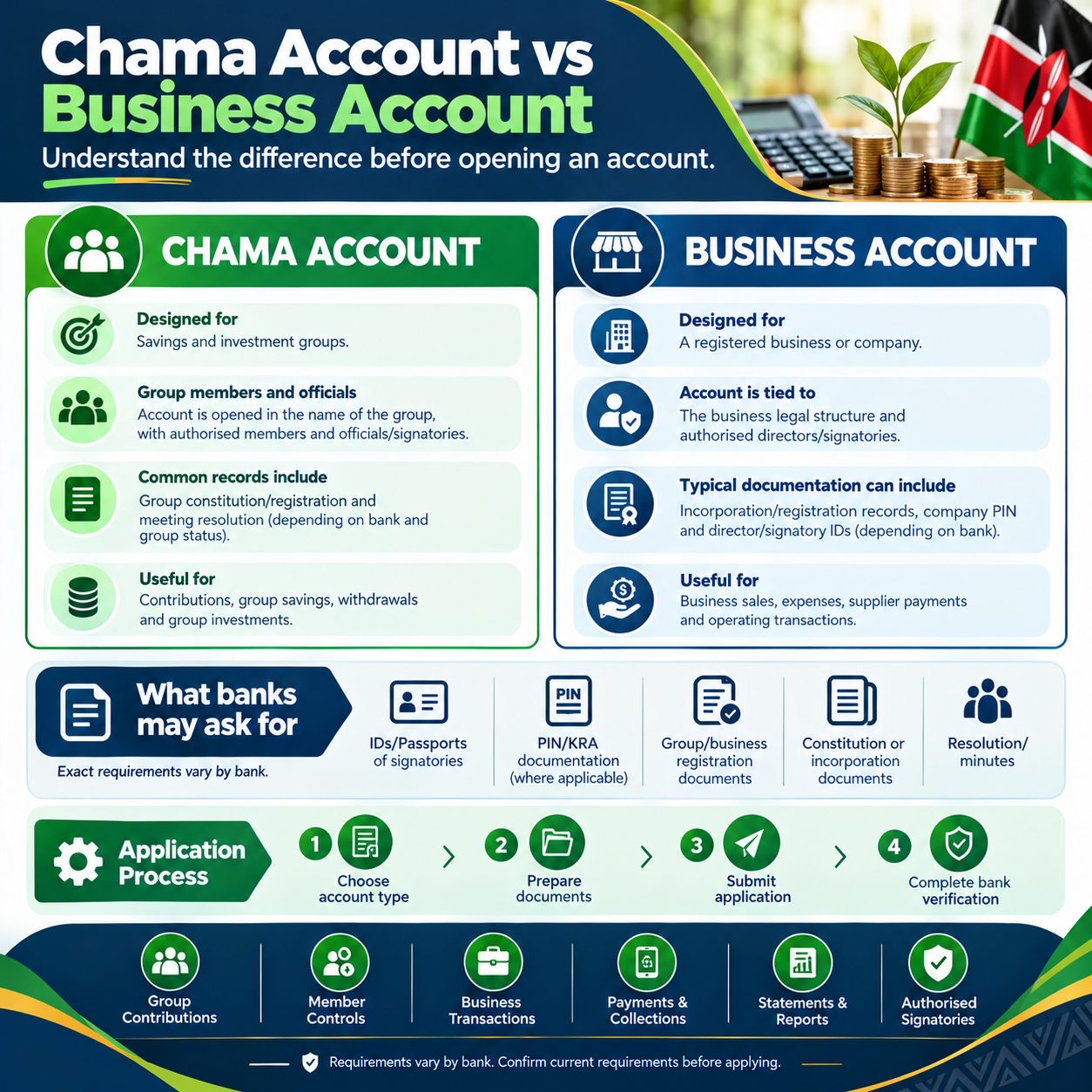
The debate over a chama account vs business account arrives at exactly the moment every successful group grows up. The chama has accumulated serious savings, elected officials, and maybe even bought its first plot — and now the bank asks a question nobody prepared for: what kind of account does the group actually need? Choosing correctly between a chama account vs business account shapes the group’s costs, compliance duties, and even its legal identity for years to come.
The confusion is understandable, because the two account types overlap in appearance. Both can hold group money, both require signatories, and both come from the same bank branches with similar-looking paperwork. But beneath the surface, a chama account vs business account comparison reveals two very different financial instruments designed for very different structures.
This guide settles the debate completely and honestly. It explains what each account type is built for, the requirements behind each, the costs that separate them, and — most importantly — which one fits your group’s actual situation. By the end, the chama account vs business account question will have a clear answer for your specific group.
The article is written for treasurers preparing to open the group’s first account, committees debating whether to register their chama formally, and founders building groups with big ambitions. It is equally written for the many groups that already hold one account type and wonder whether they should switch. Everyone benefits from understanding the full chama account vs business account picture before signing anything.
One truth deserves stating before the comparison begins. The right answer depends less on the accounts themselves and more on what the group legally is — an informal savings circle, a registered community group, or a trading business entity. That single distinction drives every downstream difference in the chama account vs business account decision.
There is also a time dimension to this question that most comparisons miss. Many groups correctly start with one account type and correctly migrate to the other years later as their activities evolve. Understanding the journey through the chama account vs business account question matters as much as the snapshot comparison.
So read this guide with your group’s constitution and future plans on the table beside you. Note where your group sits on the spectrum between a savings circle and a trading entity, because that position determines the answer. The chama account vs business account decision is simply the financial expression of who your group already is.
What Is a Chama Account?
A chama account — often called a group account, savings group account, or club account depending on the bank — is designed for informal groups that pool money for collective purposes. It serves savings circles, welfare societies, table banking groups, and investment chamas whose primary activity is collecting, saving, and investing members’ money. Understanding that purpose is the foundation of the chama account vs business account comparison.
The defining feature is the group’s nature rather than its activity. A chama account presumes members contributing to shared goals, with officials — not owners in the business sense — operating the account. That member-ownership model is what the chama account vs business account comparison rests upon.
Chama accounts typically accommodate both registered and unregistered groups. A registered society presents its certificate, while an informal group presents its constitution and authorizing minutes naming the signatories. That flexibility is one of the most practical advantages in the chama account vs business account comparison for young groups.
The operations inside a chama account reflect the group’s savings nature. Deposits arrive from members, withdrawals fund group projects and welfare, and the account serves as the collective’s custodian rather than a trading vehicle. That custodial character is the functional heart of the chama account vs business account distinction.
Group accounts also come with governance features built in. Multiple signatories, dual-control mandates, and official-versus-member visibility structures protect pooled money from misuse. Those protections are designed for exactly the trust challenges that make the chama account vs business account question worth asking carefully.
Finally, chama accounts connect naturally to the group’s ecosystem of tools. Contribution tracking, member statements, and welfare records all pair cleanly with a group account. That compatibility is worth noting for later in the chama account vs business account decision, because records and account types must match.
What Is a Business Account?
A business account — sometimes called a company account, trading account, or sole proprietor account depending on the structure — is designed for entities that trade, sell, or provide services for profit. It serves companies with certificates of incorporation, registered business names, and sole proprietorships conducting commercial activity. That commercial identity is the other side of the chama account vs business account comparison.
The defining feature is the profit motive with identifiable ownership. A business account presumes an entity generating revenue from trade, with owners or directors operating the account on behalf of the enterprise. That trading model is what the chama account vs business account comparison must recognize before any conclusion.
Business accounts require stronger registration evidence. Banks typically ask for a certificate of incorporation or a registered business name certificate, plus KRA PINs for the entity and its principals. That documentation burden is the entry cost of the business side of the chama account vs business account comparison.
The operations inside a business account reflect commercial reality. Customer payments flow in, supplier payments flow out, and the account supports invoicing, payroll, and merchant services. That transactional character is the functional contrast in the chama account vs business account comparison.
Business accounts also unlock commercial capabilities that group accounts rarely offer. Merchant services, loan facilities sized to business cash flows, and trade finance instruments are the natural territory of business banking. Those capabilities matter in the chama account vs business account comparison only when the group genuinely trades.
One important note belongs here for property-owning groups. A chama that merely collects savings and invests collectively usually does not need business features — but a chama operating rentals as an active commercial enterprise may eventually consider registering as a company, which shifts the whole chama account vs business account analysis.
The Head-to-Head Comparison
Now for the direct comparison across the dimensions that actually matter. Each dimension below reveals where the two account types genuinely differ and where they simply look different. Working through them in order produces the complete chama account vs business account verdict for any specific group.
Purpose and legal fit comes first. A chama account fits groups pooling money for collective welfare and investment, while a business account fits entities trading for profit. If your group collects contributions and buys assets together, the purpose test already leans one way in the chama account vs business account comparison.
Documentation requirements come second. A chama account can often open with a constitution, minutes, and signatory IDs — even for unregistered groups — while a business account typically demands incorporation or business name certificates. The documentation gap is the first practical difference groups feel in the chama account vs business account process.
Registration status comes third. Groups can hold chama accounts while informal, whereas business accounts generally require a registered entity behind them. That gate is often the deciding fact in the chama account vs business account comparison for young groups that have not yet registered.
Costs and charges come fourth. Account maintenance fees, transaction charges, and minimum balance requirements differ between product families, and group products are often priced for lower-volume activity. Confirming the current fee schedules for both account types is an essential step in the chama account vs business account decision for any specific bank.
Signatory structures come fifth. Both account types support multiple signatories and dual-control mandates, but business accounts may also involve directors’ resolutions and company seals. The governance paperwork runs slightly heavier on the business side of the chama account vs business account comparison.
Tax treatment comes sixth, and it deserves careful handling. Interest earned on both account types can attract withholding tax, and a registered business entity carries filing obligations that an informal savings group may not. Tax exposure is a genuine dimension of the chama account vs business account decision that deserves professional advice rather than internet guesses.
Banking features come seventh. Business accounts typically offer invoicing tools, merchant services, payroll support, and credit facilities, while group accounts offer savings structures, group statement formats, and member-friendly reporting. Feature fit, not feature count, should guide the chama account vs business account choice.
Credit access comes eighth. Banks lend to businesses against demonstrated cash flows, while group accounts may connect to different lending products or savings-linked facilities. Groups planning to borrow should weigh credit pathways carefully in the chama account vs business account decision.
Reputation with counterparties comes ninth. Land sellers and contractors accept both account types readily, though some formal counterparties prefer transacting with registered entities. Counterparty expectations occasionally influence the chama account vs business account choice for groups pursuing large institutional deals.
The migration path comes tenth, and it closes the comparison. Groups can and do start with chama accounts and migrate to business accounts upon formal registration, with fresh minutes, new documents, and sometimes a fresh account entirely. Knowing the migration exists removes the fear of permanence from the chama account vs business account decision.
Which Account Fits Which Group?
The informal savings circle fits the chama account perfectly. Members contribute monthly, welfare is paid, plots are bought slowly, and no trading occurs — the classic chama profile. For this majority, the chama account vs business account answer is clear and uncomplicated.
The registered community group also fits the chama account naturally. A registered CBO or society pooling member resources for collective benefit remains a group account customer, even with the certificate in hand. Registration changes the documentation, not the fundamental chama account vs business account answer.
The welfare society fits the group account without question. Emergency funds, funeral support, and member benevolence are the purest form of collective saving. No commercial analysis is needed to settle the chama account vs business account question for welfare-first groups.
The investment-heavy chama sits in interesting territory. A group owning rentals, running agribusiness, or operating matatus may function commercially while remaining member-owned. That middle position is where the chama account vs business account question becomes genuinely interesting — and where professional advice earns its fee.
The trading entity fits the business account obviously. A group that buys and sells, charges customers, or operates as a registered company with revenue is a business in substance, whatever its origins. For that profile, the chama account vs business account answer is equally clear in the opposite direction.
The transitioning group needs a plan rather than a verdict. A chama that registers as a company, obtains a PIN, and begins invoicing customers should migrate deliberately — new account, new mandate, clean transfer. Planned transitions are the mature way to navigate the chama account vs business account journey over a group’s lifetime.
The Decision Framework: Five Questions to Ask
Turn the comparison into a decision with five honest questions. Answer them in a committee meeting, and the account choice usually announces itself. This framework converts the chama account vs business account debate into a documented governance decision.
Question one: does the group trade? If the group sells goods or services to external customers for profit, the business account side of the chama account vs business account question activates. If it only pools and invests member money, it does not.
Question two: is the group registered, and as what? A certificate of incorporation points toward business banking, while a society certificate or informal constitution points toward group banking. Registration status anchors the chama account vs business account decision in documentary reality.
Question three: what features does the group actually need? Savings structures, member statements, and welfare payments point to group accounts; invoicing, merchant services, and payroll point to business accounts. Feature honesty resolves most chama account vs business account disagreements before they start.
Question four: what will the costs be on each path? Obtain current fee schedules for both account types from your bank and compare them against the group’s expected activity. Cost reality frequently settles the chama account vs business account debate for practical-minded committees.
Question five: where will the group be in five years? A group with commercial ambitions should consider whether starting on the business track now saves a migration later. Future orientation is the strategic layer of the chama account vs business account decision that separates planning from reaction.
Document the answers and the decision in the minutes. Whatever the group chooses, the reasoning should live in the records beside the constitution. That governance habit turns the chama account vs business account decision into an institutional act rather than a treasurer’s guess.
Common Mistakes to Avoid
The first classic mistake is opening a business account for an informal group that cannot produce the required registration. The application stalls, documents go back and forth, and the group delays banking unnecessarily. Matching account type to legal reality is the first commandment of the chama account vs business account decision.
The second mistake is choosing by fees alone. The cheaper account that lacks the features the group needs creates hidden costs in workarounds and manual effort. Feature-fit pricing is the smarter lens for the chama account vs business account comparison than headline charges.
The third mistake is migrating to a business account without registering first. The entity must legally exist before it can bank commercially, and skipping that order creates compliance exposure. Sequencing registration before migration is the safe path through the chama account vs business account transition.
The fourth mistake is ignoring the tax dimension until the KRA letter arrives. Understanding withholding obligations and filing duties at decision time prevents surprises later. Professional tax advice is a wise investment within the chama account vs business account process for any group with meaningful flows.
The fifth mistake is letting one dominant voice decide. The account type shapes everyone’s money for years, so the choice belongs to the committee and the minutes, not to the loudest member. Collective decision-making is the governance seal that every chama account vs business account outcome deserves.
How This Connects to Your Group’s Bigger Picture
The account decision sits inside a larger system of group finance. Banking holds and moves the money, records track every shilling, and statements prove the group’s discipline to members and outsiders alike. Seeing the chama account vs business account choice in that wider frame prevents it from being made in isolation.
Whatever account type the group chooses, records remain the constant. Contributions, loans, fines, and welfare all need tracking that reconciles cleanly against whatever account holds the money. That record-keeping layer is the real infrastructure beneath the chama account vs business account decision.
Tas.co.ke serves groups on either path. Contributions, loans, fines, statements, and member records run in one reconciled system with real Kenyan support, pairing naturally with group accounts and adapting easily when groups migrate toward business banking. Groups that run their finances on Tas.co.ke find that the chama account vs business account decision becomes simpler — because their records stay continuous whatever the account wrapper.
Real Stories from Kenyan Groups
The Nakuru welfare circle opened a group account in its second year and never looked back. Contributions, welfare payments, and slow land accumulation all ran through the group account for a decade without a single feature the members lacked. For them, the chama account vs business account question never really existed — the fit was perfect.
The Kitengela landlords’ group lived the migration story. They started with a group account as an informal chama, registered as a company when the rental business grew, and migrated to business banking with clean records and fresh minutes. Their orderly journey through the chama account vs business account transition is now the template neighboring groups borrow.
The Eldoret youth group tells the cautionary version. They opened a business account attempt without registration, lost two months to stalled paperwork, and finally opened a group account in one afternoon. Their lesson — match the account to the entity, not the ambition — is the practical wisdom inside every chama account vs business account decision.
Frequently Asked Questions
Can an unregistered chama open a bank account at all?
Yes — Kenyan banks have historically served informal groups using constitutions, authorizing minutes, and verified signatories, typically through group account products. Confirm your specific bank’s current requirements, because policies vary. That flexibility is the entry advantage of the chama side of the chama account vs business account comparison.
Do we need to register as a company to get a business account?
Generally yes — business accounts require a registered entity behind them, whether a company or a registered business name. An unregistered savings circle does not qualify. That requirement is the structural gate in the chama account vs business account decision.
Which account is cheaper?
It depends on the bank, the product, and the group’s transaction pattern — so obtain current fee schedules for both account types and compare against your expected activity. Cost comparisons without feature comparisons mislead. Honest product-to-product checking is the reliable way to settle the chama account vs business account cost question.
Can we switch from a chama account to a business account later?
Yes — once the group registers formally, it can migrate with fresh minutes, new documentation, and either a new account or a conversion where the bank supports it. Plan the transition deliberately with clean records. That migration path removes the fear of permanence from the chama account vs business account decision.
Does the account type affect our taxes?
Interest earnings can attract withholding tax on both account types, while a registered business entity carries additional filing obligations that informal groups may not. This dimension deserves professional tax advice rather than general assumptions. Treat the tax layer of the chama account vs business account decision seriously.
What if our group both saves and runs a small business?
The honest answer depends on substance — if commercial activity is significant and continuous, registering and banking as a business may fit better, while savings-dominant groups usually stay on group accounts. Mixed-activity groups benefit most from professional advice. That nuance is the hardest corner of the chama account vs business account landscape.
Which account do banks prefer for lending to groups?
Credit assessment follows the borrower’s demonstrated cash flows and documentation more than the account label, though registered entities typically access wider credit products. Groups planning to borrow should discuss pathways with their bank early. That forward planning is the credit-aware layer of the chama account vs business account decision.
We collect rent from tenants we don’t own formally yet — does that change anything?
Collections alone do not make the group a business; ownership structures and scale do, so keep the rent flowing through your group account until registration genuinely changes your legal form. Whatever the account, records must stay clean. The smartest groups pair either account type with Tas.co.ke, which tracks tenants, rent collection, and owner statements separately from member contributions — keeping the chama account vs business account question uncomplicated by mixed records.