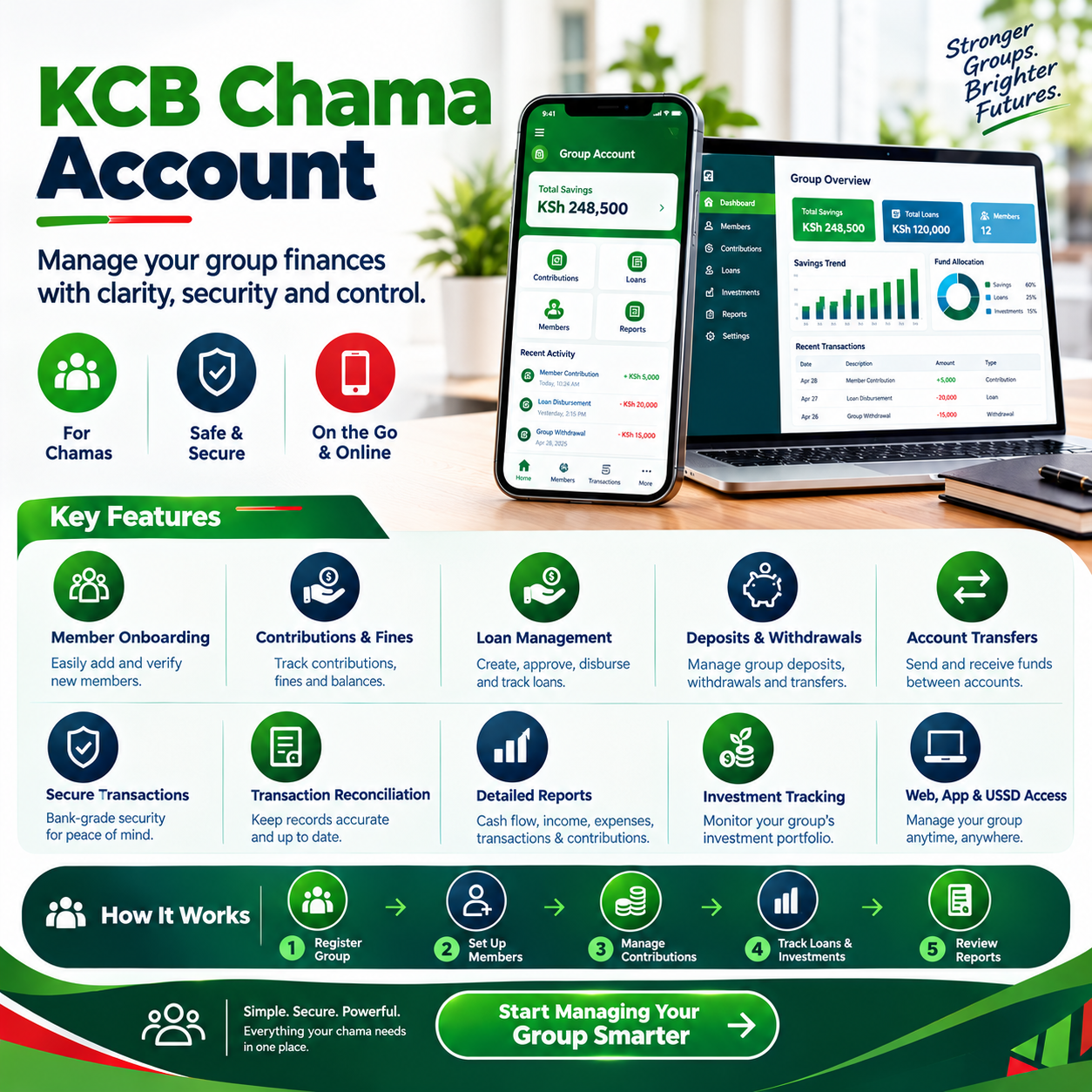
Opening a KCB chama account is one of the proudest milestones in any Kenyan investment group’s journey. The constitution is signed, officials are elected, and contributions are flowing — the next step is giving all that collective discipline a proper institutional home. Walking into the bank prepared, with every KCB chama account requirement already gathered, turns the branch visit into a single, satisfying errand.
KCB is one of Kenya’s largest and most familiar banks, with a branch network that reaches nearly every town and a mobile banking presence that groups interact with daily. That reach makes it a natural consideration for groups spread across counties or planning investments far from home. Understanding what a KCB chama account involves before the visit is what separates smooth approvals from repeated trips.
The trouble is that most groups prepare by guesswork. They hear from a friend that “you just need IDs and minutes,” arrive at the branch missing a document, and discover that group accounts receive closer scrutiny than personal ones. That discoverable friction is exactly what this complete guide to the KCB chama account process is designed to eliminate.
This article walks the entire journey. It explains why banks verify groups so carefully, every document commonly required, how to design the signatory mandate, and the step-by-step flow from preparation to the first deposit. By the end, the KCB chama account checklist will feel like a project your group can complete in one organized week.
The article is written for treasurers assembling documents, chairpersons drafting the authorizing minutes, and founders opening their group’s very first institutional account. It is equally written for members who deserve to understand why the bank asks for what it asks. Everyone benefits when the group approaches the KCB chama account process with structure rather than improvisation.
One honesty statement belongs before the checklists begin. Requirements, product names, minimum balances, and charges vary between branches, products, and the group’s registration status, so this guide presents what is commonly required while always directing you to confirm specifics with KCB itself. That careful framing runs through every section of this KCB chama account walkthrough.
The good news is that nothing on the list is difficult to obtain. Most documents already exist inside a well-run group, and the few that do not can be prepared in a single afternoon. Groups that arrive complete routinely find that the KCB chama account requirements are simply the bank confirming what good governance already produced.
There is also a deeper reward hiding in this preparation. The constitution, the minutes, and the verified officials that banks require are the exact foundations of every disciplined chama. Completing the KCB chama account process therefore upgrades the group itself, not merely its banking.
So read this guide with an empty folder open beside you, ready to fill. Tick each item as your group secures it, and note the gaps while there is still calm time to fix them. By the final page, your group will hold a complete, branch-ready pack that clears every KCB chama account requirement before anyone travels.
Why a Formal Bank Account Matters So Much
Before the checklist, remember why the account matters at all. Money kept in a wallet, a mobile wallet, or an official’s pocket carries risks that no constitution, however well written, can control. A formal account is the institutional answer, which is why completing the KCB chama account process is treated as a milestone in every serious group’s journey.
The first benefit is clean separation. Group money in a group account can never be confused with any official’s personal funds, however trusted that official may be. That separation is the very foundation the KCB chama account process is building.
The second benefit is dual control. Bank mandates require two or more signatories to authorize withdrawals, which structurally prevents any single person from moving the group’s money alone. That built-in protection is precisely what the KCB chama account structure delivers once the account is live.
The third benefit is credibility. Land sellers, contractors, and lending institutions take a group with a formal account far more seriously than one collecting cash in a bag. That institutional standing begins the day the group completes the KCB chama account process and makes its first deposit in its own name.
The fourth benefit is history. Bank statements become the group’s auditable financial autobiography, proving collections, payments, and growth across the years. Every future audit, loan conversation, and dispute resolution draws on the record created after the KCB chama account requirements were satisfied.
The fifth benefit is member confidence. Members contribute more willingly when their money sits in an account they can verify rather than in a promise they must believe. That visible trust is the quiet dividend of opening the KCB chama account promptly and properly.
The Rules Behind the Requirements
Understanding why banks verify groups makes gathering documents easier rather than more tedious. Kenyan banks operate under Central Bank of Kenya know-your-customer rules, which require them to verify the identity and legitimacy of every account holder, individual or institutional. Those national rules are the source of the KCB chama account requirements your group will meet.
Know-your-customer rules protect everyone involved. They prevent fraud, money laundering, and misuse of group structures, while equally protecting your group from impersonation and internal misuse. Framing the KCB chama account requirements as protection rather than bureaucracy changes how the whole membership experiences the process.
The verification logic follows the group’s legal form. A registered society proves itself with a registration certificate, while an informal group proves itself through its constitution and minuted resolutions. Matching your documents to your group’s actual legal reality is the first principle in preparing for the KCB chama account review.
Every person authorized to operate the account is also individually verified. Identification, photographs, and contact details are collected for each signatory, exactly as they would be for any personal account holder. Personal verification therefore runs as a parallel track within the KCB chama account process.
Because these rules are national rather than bank-specific, most of the checklist resembles what any Kenyan bank would request. Still, branches occasionally add or relax items, and group products differ in their details. Confirming the current list directly with the branch is the final calibration step of the KCB chama account preparation.
Registered Versus Unregistered Groups: Know Your Track
The document trail depends heavily on whether your group is formally registered. Registered groups — societies, cooperatives, community-based organizations, or companies — present their certificate as the anchor document. Unregistered groups follow a slightly different path through the KCB chama account process, relying on constitutions and minutes instead.
If your group is registered, locate the original certificate first. The name on the certificate must match the account application exactly, letter for letter. Name consistency is the most common and most easily avoided stumbling block within the KCB chama account requirements for registered groups.
If your group is unregistered, do not assume the door is closed. Kenyan banks have historically served informal groups using a constitution, authorizing minutes, and verified officials, and many groups bank comfortably on that basis. The informal track through the KCB chama account requirements simply demands stronger paper evidence of the group’s legitimacy.
Either way, the constitution is central. It proves the group’s purpose, its officials, and its money rules — the very things a group account exists to serve. Keeping the constitution current and signed is therefore a standing obligation beneath the KCB chama account process whatever your registration status.
Groups planning significant assets should consider registering before opening the account. Registration unlocks group-title land ownership, smoother contracting, and stronger legal standing for everything the group will later do. Weighing that step in advance is a strategic decision that sits upstream of the KCB chama account requirements themselves.
Document One: The Certificate of Registration
For registered groups, the certificate of registration leads the pack. It is the state’s confirmation that the group exists as a legal entity, and the bank copies it into the account file. This single document anchors the KCB chama account requirements for every registered society, CBO, or company.
Check the certificate’s details before the visit. The group’s name, registration number, and addresses should all be current and legible. Any mismatch between the certificate and reality is an obstacle that costs nothing to prevent within the KCB chama account review.
If the certificate is lost, obtain a replacement from the registering authority before the branch visit. Attempting the opening with a missing certificate only to return later wastes everyone’s time. Restoring the document first is the efficient order of operations within the KCB chama account checklist.
Keep certified copies as well as the original. Banks typically copy and certify the original on site, but spare certified copies serve every future institution the group will deal with — landlords, registries, and partners alike. That redundancy smooths not just the KCB chama account process but years of administration afterward.
Document Two: The Group Constitution
The constitution is the document banks read most carefully for informal groups. It proves the group’s purpose, its governance structure, and its rules for handling money. A current, signed constitution is therefore unavoidable within the KCB chama account pack.
The constitution should show the officials clearly. The chairperson, treasurer, and secretary named in the document should be the same people presenting themselves at the branch. That alignment between paper and people is a consistency test built into the KCB chama account review.
If the constitution is old, refresh it first. Update official names, contribution amounts, and any provisions that have changed, then re-sign it at a properly minuted meeting. A stale constitution is a common cause of delay within the KCB chama account process for groups that have evolved since founding.
Bring the full document, not a summary page. Officers reviewing a group application read the objectives, the official structure, and the financial provisions in full. Completeness is the presentation standard for this item on the KCB chama account checklist.
Document Three: The Authorizing Minutes
The authorizing minutes prove that the group collectively decided to open the account. They carry the resolution, the date, the attendees, and — critically — the names of the appointed signatories. This single document is where most groups either shine or stumble within the KCB chama account process.
The wording of the resolution matters more than groups expect. A strong minute reads: “It was resolved that the group opens an account with [bank], and that [Name One] and [Name Two] be appointed signatories with authority to operate the account.” That precision anticipates exactly what reviewers look for within the KCB chama account requirements.
The minutes should also record the quorum. Showing that the decision was made at a properly attended meeting protects the resolution’s legitimacy in the reviewer’s eyes. Quorum evidence is a quiet but real element of the KCB chama account review for informal groups.
Attach the attendance register or member signatures where possible. Some branches ask for member lists or attendance confirmation, especially for larger groups. Being ready with that support material smooths the KCB chama account review considerably.
One more detail deserves attention: the signatories named in the minutes must match the officials named in the constitution, or the minutes must formally amend those appointments. Where the two documents disagree, the bank sees a governance contradiction. Reconciling them in advance is the consistency discipline that prevents a wasted trip during the KCB chama account process.
Documents Four to Six: Identification, PINs, and Photographs
The individual verification track begins with identification. Every signatory — and commonly every official — presents an original national ID or passport, which the bank copies and verifies. Originals, not photocopies alone, are the presentation standard for this item within the KCB chama account requirements.
KRA PINs typically follow. Signatories, and where applicable the group itself, should present Personal Identification Numbers, since tax reporting attaches to the account’s activity. Confirming PIN registration before the visit is a simple preparation step inside the KCB chama account checklist.
Passport-size photographs are commonly requested as well. Each signatory brings a recent photo, and some branches capture these digitally on site. Either way, photographs are a standard fixture of the KCB chama account requirements for group accounts.
Contact details complete the individual file. Phone numbers, and where available email and physical addresses, are recorded for every signatory. Current contact information is a small but genuinely enforced item within the KCB chama account process that groups sometimes overlook.
A practical tip binds these items together. Build one labeled folder per signatory — ID, PIN, photographs, contact sheet — so the pack presents itself in organized order. That organization is the professionalism signal that speeds up any KCB chama account review.
Signatories and the Mandate: Who Controls the Account
The mandate is the formal instruction defining who can operate the account and how. Most groups appoint two or three signatories, with the mandate specifying whether one may sign alone or whether two must sign together. Mandate design is the most consequential decision inside the entire KCB chama account process.
The dual-control recommendation deserves emphasis. A two-to-sign mandate means no withdrawal can ever be made by one person acting alone, which structurally protects both the money and the officials themselves. Choosing that structure at the KCB chama account stage is the strongest anti-fraud decision a group can make.
Choose signatories for availability as much as trust. Officials who travel frequently, fall ill often, or live far from the branch create practical bottlenecks even when their integrity is beyond question. Practical accessibility is the operational test to apply when selecting signatories within the KCB chama account process.
The treasurer and chairperson are the natural first choices, with the secretary as a common third. Whatever the combination, the names must appear identically in the constitution, the minutes, and the identification documents. That three-way alignment is the integrity thread running through the KCB chama account checklist.
Plan for change from the beginning. Signatories change as officials rotate, and updates require fresh minutes, fresh identification, and a branch visit by the incoming officials. Knowing that process in advance is the long-view wisdom attached to the KCB chama account structure.
The Branch Visit: What Actually Happens
The account is finalized in person, and knowing the flow removes the last anxiety. The group’s signatories visit the branch together with the complete document pack. That joint appearance is the standard expectation within the KCB chama account process at most branches.
At the branch, documents are reviewed and copied. Officers verify IDs against faces, confirm the signatory names in the minutes, and complete the account opening forms. Those forms capture the group’s details, the mandate, and the operating preferences — the paperwork heart of the KCB chama account process.
Signatories then sign the mandate and specimen signature cards. Their signatures on those cards become the reference against which every future instruction is checked. That signing moment is the formal binding step of the KCB chama account process.
Some branches ask brief verification questions about the group. Its purpose, membership size, expected transaction patterns, and sources of funds are all normal conversation for group accounts. Answering honestly and consistently with the constitution is part of the KCB chama account review in practice.
Finally, the initial deposit is made and the account goes live. Depending on the branch and product, activation may be same-day or take a few working days. Asking the officer to confirm the expected timeline is the closing habit of a well-managed KCB chama account visit.
The Opening Process: Step by Step
Step one happens before any travel. Call or visit the branch and request the current checklist for group accounts, confirming which documents apply to your group’s registration status. That confirmation call is the zero-cost starting move for the entire KCB chama account process.
Step two is document assembly at home. Gather the certificate or constitution, prepare the authorizing minutes, and build a folder per signatory with IDs, PINs, and photographs. One organized afternoon usually completes the practical work behind the KCB chama account checklist.
Step three is internal verification. Two officials review the pack together — names matching across documents, minutes correctly worded, copies legible. Paired checking catches the small inconsistencies that cause the most KCB chama account delays.
Step four is the branch visit with all signatories present. Book the visit where possible, arrive early, and carry both originals and copies. Presenting the pack complete is what converts the KCB chama account process from a multi-trip ordeal into a single-morning task.
Step five is form completion and mandate signing. Read the mandate options carefully, choose the dual-control structure, and confirm every name is spelled exactly as on the identification. Precision at this moment determines the smoothness of everything that follows the KCB chama account visit.
Step six is the initial deposit and activation. Make the first deposit in the group’s name, collect the account details, and confirm when digital access will be ready. The first deposit slip in the group’s name is the tangible finish line of the KCB chama account journey.
Balances, Charges, and Products: The Money Questions
Minimum opening balances vary by product and are best confirmed directly. Group account products differ in their requirements, features, and associated charges. Requesting those figures in writing during the confirmation call is the financially prudent extension of the KCB chama account preparation.
Monthly maintenance and transaction charges also vary. Ask for the current fee schedule and read it against the group’s expected pattern — deposits per month, withdrawals per month, and statement needs. Cost-awareness at this stage is the budgeting discipline that naturally follows the KCB chama account conversation.
Ask about digital features too. Mobile banking access, statement delivery, and multi-user visibility all matter to groups whose officials manage money between meetings. Confirming what the account can do digitally rounds out the practical picture begun by the KCB chama account checklist.
Compare products before committing. If the group expects heavy transaction volume, a product designed for frequent activity may cost less overall than a basic one. Product fit is the final financial consideration that sits alongside the KCB chama account documentation work.
One protective habit completes the money conversation. Minute the product choice, the charges explained, and the mandate structure at the next meeting, so the membership holds the full picture. Institutional memory of the banking decision is the governance finish to the KCB chama account process.
Building the Documentation Pack: A One-Week Plan
Spread the preparation across one week and the work stays light. Days one and two cover the constitution review and the authorizing minutes preparation. Front-loading the governance documents is the correct sequence for the KCB chama account pack.
Days three and four belong to the signatories. Each official gathers ID, KRA PIN, photographs, and contact details into their labeled folder. Distributed gathering is the efficient way to complete the personal verification side of the KCB chama account requirements.
Day five is the paired verification session. Two officials review the entire pack, checking names, dates, and consistency across every document. That shared review is the quality gate that prevents the most common KCB chama account rejections.
Day six is the confirmation call to the branch. Confirm the checklist, the product, the expected minimums, and book the visit. Aligning with the branch’s current expectations is the final calibration of the KCB chama account preparation.
Day seven is the branch visit itself, with every signatory present and the pack complete. Groups that follow this rhythm routinely open their accounts in a single visit. That one-trip outcome is the reward for disciplined execution of the KCB chama account plan.
Common Mistakes That Delay Approval
The first classic mistake is name mismatches. A group registered under one name, presenting a constitution with another spelling, and minutes with a third creates a reviewer’s nightmare. Name consistency across every document is the first commandment of the KCB chama account process.
The second mistake is minutes without signatory names. A resolution to open an account without naming who will operate it forces a second meeting and a second trip. Complete minute wording, as shown earlier, is the correction that keeps the KCB chama account review on one track.
The third mistake is photocopies without originals. Officers must verify original identification, and groups arriving with copies alone are turned back to return with the real documents. Carrying originals is a non-negotiable presentation rule within the KCB chama account checklist.
The fourth mistake is sending one official to represent everyone. Most branches expect the signatories themselves, since specimen signatures must be captured in person. Planning for full signatory attendance is the scheduling requirement behind the KCB chama account final visit.
The fifth mistake is ignoring the constitution-officials mismatch. When the treasurer in the constitution retired last year but the documents still show them, the bank sees a governance gap. Updating the constitution and the minutes together is the repair that restores coherence to the KCB chama account pack.
After the Account Opens: Connecting the Systems
The account is the beginning, not the destination. Collections, reconciliations, statements, and member visibility all need a system that works alongside the bank account. That operational layer is what turns the achievement of the KCB chama account into lasting financial order.
Modern groups pair the bank account with a dedicated management platform. Contributions are invoiced and reconciled automatically, member statements generate on demand, and the committee reviews live figures rather than memory. That pairing is the operational upgrade that follows naturally from completing the KCB chama account process.
Tas.co.ke serves groups at exactly this stage. Contributions, loans, fines, statements, and welfare records run in one reconciled system with real Kenyan support, while the bank account holds and moves the money. Groups that combine their bank account with Tas.co.ke report that the discipline established during the KCB chama account process carries straight into daily operations.
The reconciliation rhythm completes the system. Monthly, the platform’s records are matched against the bank statement, with two officials confirming the match. That paired verification is the ongoing discipline the KCB chama account process began and good practice continues forever.
Property-owning groups extend the same pattern further. Rental income collected through Tas.co.ke flows into the same financial picture as group contributions and bank balances. One connected ecosystem across banking, group finance, and property is the full expression of the order that the KCB chama account process set in motion.
Real Stories from Kenyan Groups
The Nakuru teachers’ chama prepared its pack across one disciplined week using exactly this checklist. Constitution refreshed, minutes worded precisely, signatory folders complete — and their account opened in a single branch visit. The treasurer credits their calm experience to treating the KCB chama account requirements as a project rather than a surprise.
The Kitengela landlords’ group tells the cautionary version first. Their first attempt stalled twice — once over a name mismatch and once over minutes that named no signatories. Their eventual success, after repairing both documents, taught them that the KCB chama account process rewards preparation and punishes haste.
The Eldoret youth group opened its account before it had ten shillings to deposit. The officials reasoned that institutional legitimacy would attract members, and within a year the account held savings from twenty-five contributors. Starting early, they say, made the KCB chama account the group’s first act of seriousness.
Frequently Asked Questions
Can an unregistered chama open an account with KCB?
Informal groups have historically been served by Kenyan banks using a signed constitution, authorizing minutes naming the signatories, and verified identification for the officials. Policies and documentation expectations vary, so confirm your branch’s current position on the KCB chama account requirements for informal groups before the visit.
How many signatories does a group account need?
Two or three is the common arrangement, and a dual-control mandate — where two must sign together — is the strongest protection. The available structures depend on the product and branch. Confirm the options when reviewing the KCB chama account requirements with the bank.
Can signatories be changed later?
Yes — fresh authorizing minutes, the incoming officials’ identification, and a branch visit complete the update. Building that step into your leadership transition calendar keeps the account aligned with the constitution. Planned updates are the long-term maintenance side of the KCB chama account structure.
How long does opening take?
With a complete pack, same-day activation is common, though some branches take a few working days. The timeline depends far more on document readiness than on the bank’s speed. That is precisely why preparing the KCB chama account pack in advance is worth the effort.
Does the group itself need a KRA PIN?
Signatories typically provide their individual PINs, and groups operating at a formal level often register for their own. Confirm the current expectation for your group’s structure when reviewing the KCB chama account requirements with the branch.
What is the minimum opening balance?
It varies by product, and the honest answer comes from the branch’s current product and fee schedule. Ask for the figures in writing during your confirmation call. That single question completes the financial side of the KCB chama account preparation.
We already collect through M-Pesa — do we still need a bank account?
Yes, because the two serve different purposes — mobile money handles collections while a bank account provides institutional custody, dual control, and formal statements. The strongest setup pairs the account with a platform like Tas.co.ke that reconciles everything automatically. Groups that hold both find that the discipline began with the KCB chama account process carries into every collection thereafter.
What documents does the bank keep versus return?
Originals are verified and returned, while copies are retained in the account file. Carrying both, pre-organized, is the presentation standard throughout the KCB chama account visit.
Can we open the account before the group has many members?
Yes — a small founding group with proper documents can open an account immediately, and the account itself often helps attract members by signaling seriousness. Institutional legitimacy is an asset from day one, which is why many groups treat the KCB chama account process as their founding milestone.
Where does Tas.co.ke fit in?
Tas.co.ke manages everything that happens around the account — contributions, loans, fines, statements, and welfare records in one reconciled system with live member visibility. Groups that pair their bank account with Tas.co.ke find that the structure established through the KCB chama account process becomes a complete financial ecosystem — and the same platform extends to tenants and rent when the group owns property.