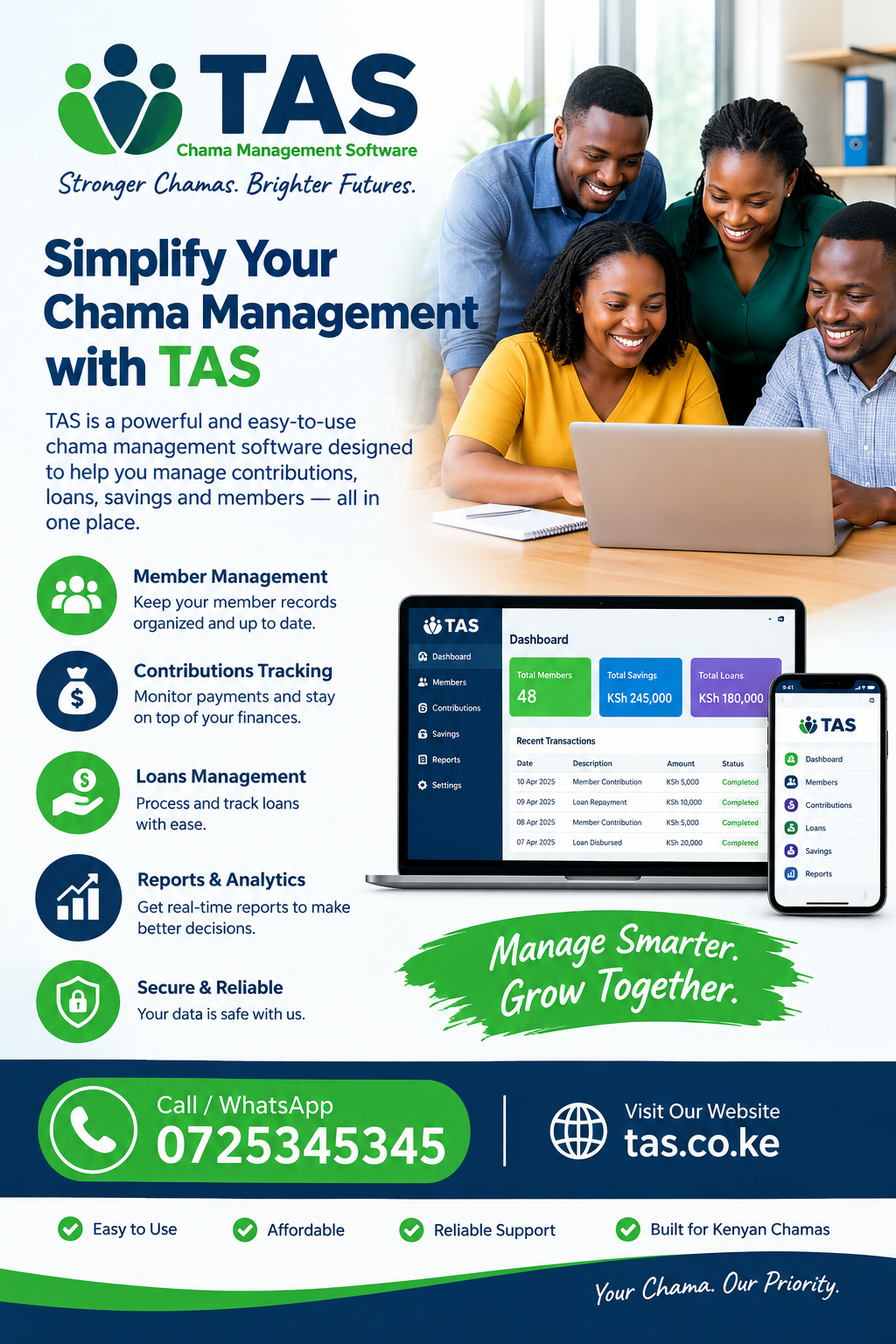
Welfare Group Management Software Kenya: Complete Guide to Managing Contributions, Members and Welfare Funds
Managing a welfare group becomes much easier when members, contributions, meetings, loans, welfare payments and financial records are organized in one place. Welfare Group Management Software Kenya gives welfare groups a structured way to replace scattered notebooks, spreadsheets and informal records with a centralized management system. For Kenyan welfare groups, chama administrators, employee welfare associations, community groups and savings teams, the right software can improve accountability while reducing the administrative work involved in managing members and money.
Many welfare groups begin with simple methods. A treasurer may record contributions in a notebook, a secretary may keep member details in a spreadsheet, while payment confirmations remain in WhatsApp conversations or mobile-money messages. That approach can work when a group has only a few members. As membership grows, however, it becomes increasingly difficult to know who has paid, who is in arrears, how much money is available, which members have received welfare assistance and whether financial reports agree with actual transactions.
This is where Welfare Group Management Software Kenya becomes valuable. A properly configured system can bring member management, contribution tracking, welfare assistance, financial records, reporting and communication into a more organized workflow.
This guide explains what welfare group management software is, why Kenyan groups need it, the features to consider, how it can improve accountability, how to handle M-Pesa-related records, common implementation mistakes, and how to select a solution that fits your group.
What Is Welfare Group Management Software?
Welfare Group Management Software Kenya refers to digital software designed to help welfare organizations manage members, contributions, financial activities, benefits and administrative processes from a centralized system.
A welfare group may collect regular monthly contributions, create emergency funds, support members during bereavement, assist with medical emergencies, provide education support or organize other forms of member assistance. The software should therefore do more than simply record payments.
A complete welfare management system can help administrators:
- Register and manage members
- Track member contributions
- Record payment transactions
- Monitor outstanding contributions
- Manage welfare benefits
- Record assistance issued to members
- Maintain member financial histories
- Generate financial reports
- Track group income and expenditure
- Maintain meeting and administrative records
- Improve accountability
- Reduce manual data entry
- Provide a clearer picture of the group’s financial position
The exact features required depend on the welfare group’s rules and activities. A small employee welfare association may need straightforward contribution and benefit tracking, while a large community-based organization may require more advanced financial controls.
Why Kenyan Welfare Groups Are Moving Away From Manual Records
Many groups still depend on notebooks, Excel files, receipts and WhatsApp messages. These methods are familiar, but they can create problems when financial activity increases.
For example, imagine a welfare group with 80 members. Each member contributes KSh 1,000 every month. The treasurer must identify payments, update individual balances, record arrears, prepare a monthly report and answer members’ questions.
If the information is spread across multiple notebooks and spreadsheets, mistakes become easier to make.
A member may ask:
“How much have I contributed this year?”
Another may ask:
“Why does the system show that I have an outstanding balance?”
The treasurer then has to search through records before giving an answer.
With Welfare Group Management Software Kenya, the group can maintain a centralized record of contributions and member transactions. Instead of relying entirely on manual calculations, administrators can use the system to retrieve transaction histories and generate reports.
This does not eliminate the need for responsible financial management. It simply makes the process more structured.
The Main Problems Welfare Groups Face Without Software
Before choosing a system, it helps to understand the problems that software should solve.
1. Missing contribution records
When contributions are recorded manually, a payment can be forgotten or entered incorrectly.
A digital contribution register makes it easier to associate payments with the correct member and period.
2. Difficult reconciliation
A group may have money entering through different channels. If the records are not reconciled properly, the treasurer may struggle to establish whether the recorded balance matches actual funds.
3. Poor visibility of arrears
Manual records make it harder to identify members who have missed one or more contributions.
A software system can provide contribution status information that helps administrators follow up.
4. Slow reporting
Preparing a monthly or annual report manually can consume considerable time.
With Welfare Group Management Software Kenya, reports can be generated from information already recorded in the system.
5. Limited accountability
Members want confidence that their contributions are being handled correctly.
A clear audit trail and properly maintained records can make financial administration more transparent.
6. Duplicate data
A member’s information may appear in several files. If one file is updated and another is not, inconsistencies develop.
Centralized records reduce unnecessary duplication.
Key Features to Look For
Not every software product has the same capabilities. When evaluating a solution, welfare groups should focus on features that directly support their operations.
Member Management
Member management is the foundation of the system.
The software should allow administrators to maintain information such as:
- Member name
- Membership number
- Contact details
- Joining date
- Membership status
- Contribution requirements
- Transaction history
- Welfare eligibility
- Other group-specific information
A centralized member profile makes it easier to understand each member’s relationship with the group.
For organizations with many members, Welfare Group Management Software Kenya can help reduce the administrative burden associated with maintaining individual records.
Contribution Tracking
Contribution management is one of the most important functions for any welfare group.
The system should allow administrators to define contribution requirements and record payments against individual members.
Useful information may include:
| Contribution information | Purpose |
|---|---|
| Member | Identifies the contributor |
| Amount | Shows payment value |
| Date | Establishes when payment occurred |
| Period | Identifies the contribution month or cycle |
| Payment reference | Helps trace the transaction |
| Status | Shows whether the obligation is complete |
| Balance | Identifies outstanding amounts |
This information gives the group a clearer view of its collection performance.
Welfare Benefit Management
A welfare organization may provide assistance based on predefined rules.
For example, a group could offer assistance for:
- Bereavement
- Medical emergencies
- Hospitalization
- Education-related events
- Family emergencies
- Accidents
- Other approved welfare situations
The system should allow administrators to record requests, approvals and payments according to the group’s policies.
Financial Records
Financial management should be connected to member activity.
If a group receives contributions and later issues welfare assistance, administrators need to understand both sides of the transaction.
Welfare Group Management Software Kenya can support better organization of financial information when contribution and welfare records are maintained systematically.
Reporting
Reports are essential for management meetings and accountability.
Useful reports can include:
- Contribution reports
- Member balances
- Arrears reports
- Welfare assistance reports
- Income reports
- Expense reports
- Transaction histories
- Monthly summaries
- Annual summaries
The best reports are not simply attractive documents. They should answer practical questions.
How Contribution Tracking Works
Consider a welfare association where every member is expected to contribute KSh 500 each month.
Suppose a group has 100 members.
The administrators need to know:
- Who has paid?
- Who has not paid?
- How much has been collected?
- Which members have partial payments?
- What amount remains outstanding?
- How much money is available for welfare activities?
With Welfare Group Management Software Kenya, these questions can be addressed through organized contribution records.
Instead of calculating balances repeatedly from notebooks, the administrator can review member records and reports.
This becomes especially useful when contribution rules become more complex.
For instance, a group may have:
- Monthly membership contributions
- Special emergency contributions
- Annual membership fees
- Welfare event contributions
- Additional voluntary contributions
The software should distinguish these transactions where necessary.
M-Pesa and Digital Payment Records
M-Pesa is an important part of financial activity for many Kenyan organizations.
Welfare groups may receive contributions through mobile-money transactions, and members often expect payments to be easy to make and easy to verify.
However, receiving money through M-Pesa does not automatically create a complete accounting record.
The group still needs to know:
- Who made the payment?
- How much was paid?
- When was it paid?
- What was the payment for?
- Has it been allocated correctly?
- Was the payment duplicated?
- Does the payment agree with the group’s records?
Welfare Group Management Software Kenya can help administrators organize payment information and connect transaction records with member accounts, depending on the system’s supported payment capabilities.
The important principle is that payment collection and financial reconciliation should work together.
Managing Member Arrears
Arrears are common in membership-based organizations.
A member may miss a monthly contribution because of financial difficulties, forget to pay or make a partial payment.
The challenge is not necessarily that an arrear exists. The bigger challenge is failing to identify it accurately.
A good system should make outstanding balances visible.
For example:
| Member | Expected | Paid | Balance |
|---|---|---|---|
| Member A | KSh 6,000 | KSh 6,000 | KSh 0 |
| Member B | KSh 6,000 | KSh 5,000 | KSh 1,000 |
| Member C | KSh 6,000 | KSh 4,000 | KSh 2,000 |
This allows the committee to focus on actual exceptions instead of checking every member manually.
For larger groups, Welfare Group Management Software Kenya can make contribution monitoring more manageable by bringing member obligations and payments into one organized workflow.
Welfare Assistance Management
Welfare groups exist primarily to support members.
Therefore, software should not treat welfare assistance as an afterthought.
A group may need to record:
- Member requesting assistance
- Type of welfare event
- Date of request
- Amount requested
- Amount approved
- Approval status
- Date of payment
- Payment method
- Supporting notes
- Remaining welfare balance
The exact workflow should reflect the organization’s constitution and internal rules.
Example
Suppose a member experiences an approved emergency and the group’s policy allows a KSh 20,000 welfare benefit.
The administrator should be able to record the request and approval.
Once payment is made, the system should preserve the transaction history.
This gives the committee a reliable record for future reporting.
Improving Accountability
Financial accountability is one of the strongest reasons to digitize welfare administration.
Members contribute their money because they expect the organization to manage it responsibly.
A structured system can improve accountability by making it easier to answer questions such as:
- How much has each member contributed?
- How much has the group collected?
- How much has been paid out?
- Which welfare cases have been approved?
- What expenses has the group incurred?
- What balance remains?
- What transactions took place during a particular period?
Welfare Group Management Software Kenya can provide an organized foundation for these records.
However, software should support governance rather than replace it. Committees should still follow approval procedures, financial controls and organizational policies.
Reports for Welfare Group Meetings
Committee meetings often require current financial information.
Instead of spending hours preparing figures manually, administrators can use system-generated reports where available.
A monthly meeting may review:
- Total contributions received
- Outstanding contributions
- Welfare assistance paid
- Administrative expenses
- Current balance
- Members added or removed
- Pending welfare requests
This makes meetings more focused.
The committee can spend less time compiling basic figures and more time discussing decisions.
Benefits for Treasurers
The treasurer is often one of the people who benefits most from digitization.
A treasurer may traditionally be responsible for:
- Receiving payment information
- Updating records
- Calculating balances
- Preparing reports
- Answering member questions
- Tracking welfare payments
- Maintaining receipts
- Preparing meeting summaries
Welfare Group Management Software Kenya can reduce repetitive administrative work by centralizing information.
That can also make handovers easier.
When a new treasurer takes over, they should not have to reconstruct the group’s financial history from scattered files.
Benefits for Secretaries
The secretary can also benefit from centralized member information.
A secretary may be responsible for maintaining:
- Membership records
- Meeting records
- Committee information
- Member communication details
- Welfare case documentation
- Administrative records
A centralized system reduces the likelihood of important information being lost when committee members change.
Benefits for Members
The software is not only for administrators.
Members can benefit from improved visibility and more reliable records.
Depending on the system, members may be able to receive information about:
- Their contribution status
- Payment history
- Outstanding balances
- Welfare eligibility
- Approved assistance
- Membership information
The exact member-facing features depend on the software selected.
A good implementation should also consider privacy. Members should only have access to information they are authorized to see.
Managing Different Types of Welfare Groups
Welfare organizations are not all identical.
Employee Welfare Groups
Employee welfare associations may collect regular contributions from employees and provide assistance during approved events.
They may need:
- Employee member records
- Contribution tracking
- Benefit management
- Reports
- Committee administration
Community Welfare Groups
Community groups may have diverse members and more flexible contribution structures.
They may require:
- Member registration
- Contributions
- Welfare requests
- Financial reports
- Communication records
Chama-Style Welfare Groups
Some groups combine welfare activities with savings, investments or lending.
These organizations may need broader functionality covering:
- Contributions
- Savings
- Loans
- Investments
- Welfare
- Accounting
The software should be selected according to the actual activities of the organization.
How Software Can Reduce Human Error
Human beings make mistakes, especially when repetitive calculations are involved.
A treasurer handling hundreds of transactions may accidentally:
- Enter an incorrect amount
- Assign a payment to the wrong member
- Forget to update a record
- Duplicate a transaction
- Miscalculate a balance
- Omit an expense
Automation cannot eliminate every possible mistake, but it can reduce the amount of repetitive manual work.
Welfare Group Management Software Kenya can provide a structured process for recording transactions and producing reports.
The organization should still review entries and establish appropriate controls.
Data Security and Access Control
Welfare groups handle personal and financial information.
That means security should be part of the software selection process.
Consider whether the system provides:
- User accounts
- Password protection
- Role-based access
- Data backups
- Audit trails
- Controlled permissions
- Secure hosting
- Recovery procedures
Not every committee member needs access to every financial function.
For example, a general member may need access to their own contribution information, while the treasurer may need access to financial reports.
Role-based permissions can help limit unnecessary access.
Why Cloud-Based Access Can Be Useful
A cloud-based system can make information accessible from different locations, provided users have the required permissions and internet access.
This can help when committee members need to review information outside the office.
For Kenyan groups operating across Nairobi or other counties, this can be particularly convenient.
Welfare Group Management Software Kenya can be especially useful when the group’s administrative activities need to be centralized rather than tied to one computer.
However, organizations should always consider connectivity, support, security and backup arrangements before choosing a cloud-based solution.
How to Choose the Right Software
Selecting software should start with the group’s actual requirements.
Do not choose a system simply because it has a long feature list.
Ask these questions:
1. What does the group need to manage?
List the group’s activities.
Does it manage:
- Contributions?
- Welfare benefits?
- Loans?
- Savings?
- Investments?
- Expenses?
- Membership?
- Meetings?
2. How many members does the group have?
A system should be capable of handling the current membership and expected growth.
3. How are payments collected?
Identify whether members use:
- M-Pesa
- Bank transfers
- Cash
- Other approved payment methods
4. What reports are required?
Ask for examples of the reports the committee needs.
5. Who will use the system?
Identify:
- Treasurer
- Secretary
- Chairperson
- Committee members
- Ordinary members
- Administrators
6. What support is available?
Ask how users receive assistance when they encounter problems.
7. Can the system scale?
The software should not become unusable when membership increases.
Features Checklist
When comparing options, use a checklist like this:
| Feature | Importance |
|---|---|
| Member management | Essential |
| Contribution tracking | Essential |
| Welfare management | Essential |
| Financial records | Essential |
| Reports | Essential |
| Arrears tracking | Important |
| Payment reconciliation | Important |
| User permissions | Important |
| Audit trail | Important |
| Data backup | Important |
| Mobile accessibility | Useful |
| Notifications | Useful |
| Integration options | Depends on requirements |
Welfare Group Management Software Kenya should be evaluated against the actual needs of the organization rather than simply the number of features advertised.
Implementation: Moving From Paper to Software
Digitization requires planning.
Do not immediately enter thousands of records without first deciding how information should be organized.
Step 1: Clean Existing Records
Review current member information.
Identify:
- Duplicate members
- Incorrect names
- Missing contacts
- Outdated records
- Unclear balances
Step 2: Confirm Opening Balances
Before migration, agree on the opening financial position.
This is important because inaccurate opening figures can create confusion later.
Step 3: Establish Contribution Rules
Document how contributions work.
For example:
- Monthly amount
- Due date
- Grace period
- Penalty rules
- Special contributions
- Exemptions
Step 4: Train Users
Treasurers and administrators should understand the system before going live.
Training should cover common tasks rather than only theoretical features.
Step 5: Test Reports
Run sample reports and compare them with known figures.
Step 6: Go Live
Once records and workflows have been verified, the group can begin using the system for live transactions.
Common Mistakes When Introducing Software
Digital transformation can fail when organizations focus only on technology.
Mistake 1: Choosing software without understanding requirements
A group may purchase a system that looks impressive but lacks the functions it actually needs.
Mistake 2: Migrating inaccurate data
If old records contain errors, those errors may continue in the new system.
Mistake 3: Giving everyone administrator access
Broad permissions can increase security and accountability risks.
Mistake 4: Ignoring training
Even good software becomes difficult to use when users do not understand the workflow.
Mistake 5: Failing to reconcile
Digital records should still be checked against actual financial records.
Mistake 6: Treating software as a substitute for governance
Technology cannot replace committee approvals, policies or financial controls.
Budgeting for Welfare Management Software
Cost is an important consideration, particularly for smaller groups.
However, the cheapest option is not automatically the most economical.
Consider the total value provided.
For example, software may reduce the time spent on:
- Manual data entry
- Report preparation
- Balance calculations
- Member queries
- Record searches
- Contribution follow-ups
A group should compare these benefits against subscription or implementation costs.
Before purchasing, ask about:
- Setup fees
- Monthly or annual charges
- Number of users
- Number of members supported
- Payment integration costs
- Support costs
- Training
- Data migration
- Backup arrangements
Avoid assuming that a quoted price includes every service.
Mobile Accessibility for Kenyan Groups
Many Kenyan users rely heavily on mobile devices.
A welfare management system should therefore be practical for administrators who may not spend their entire working day at a desktop computer.
Mobile-friendly access can be useful for:
- Checking contribution status
- Reviewing member information
- Confirming transactions
- Monitoring reports
- Responding to administrative requests
Welfare Group Management Software Kenya should therefore be assessed not only on desktop functionality but also on how easily authorized users can access important information from mobile devices.
Notifications and Member Communication
Communication can be another useful component.
A welfare group may need to remind members about:
- Upcoming contributions
- Outstanding balances
- Meetings
- Welfare activities
- Approved benefits
- Other group announcements
Notifications should be used responsibly.
The objective is not to overwhelm members with messages. It is to make important information easier to communicate.
Using Reports for Better Decisions
Reports become more valuable when committees use them to make decisions.
For example, contribution reports may reveal that many members are consistently paying late.
Instead of simply chasing individuals, the committee could investigate why.
Perhaps the payment deadline is inconvenient. Maybe members need clearer reminders. Perhaps the contribution structure needs to be reviewed.
Similarly, welfare reports can help the group understand how frequently different types of assistance are requested.
This information can inform future budgeting.
Welfare Group Management Software Kenya can therefore be more than a record-keeping tool. When properly used, organized information can support better management decisions.
Example of a Monthly Welfare Workflow
Consider a welfare association with 120 members.
The group could use the following workflow:
- Contribution obligations are created for the month.
- Members make their payments.
- Transactions are recorded.
- Payments are matched to member accounts.
- Outstanding balances are identified.
- Administrators follow up on arrears.
- Welfare requests are submitted.
- Approved requests are recorded.
- Welfare payments are entered.
- The treasurer reviews the monthly financial report.
- The committee reviews the report.
- Members receive appropriate updates.
The important point is consistency.
A good system is most effective when the group follows a defined process every month.
Contribution Reconciliation
Reconciliation should be a standard financial control.
Suppose the system indicates that KSh 250,000 was collected during a month.
The treasurer should verify that this figure agrees with the relevant payment records.
Differences should be investigated rather than ignored.
Possible causes include:
- Duplicate entries
- Missing entries
- Incorrect member allocation
- Reversed transactions
- Timing differences
- Manual adjustments
Welfare Group Management Software Kenya can help organize transaction records, but the group should still maintain sound reconciliation procedures.
Handling Member Changes
Members may join, leave, suspend membership or change their details.
A centralized system should allow administrators to maintain current membership information without destroying historical records.
This is important for financial reporting.
If a former member contributed for several years, the organization may still need access to their historical transactions.
A well-designed system should distinguish current membership status from historical activity.
Supporting Committee Handover
Committee leadership can change.
A new treasurer should be able to understand the organization’s records without depending entirely on the outgoing treasurer’s personal files.
This is one of the strongest advantages of structured digital records.
Welfare Group Management Software Kenya can provide a centralized historical record that supports smoother administrative transitions when properly maintained.
The group should also document user permissions and ensure former administrators no longer have unnecessary access.
Scaling as the Group Grows
A welfare group that has 30 members today could have 100 or more members later.
The system should be capable of handling growth.
Consider whether it can support:
- More members
- More transactions
- More administrators
- Additional contribution types
- More welfare categories
- More reports
- Additional branches or groups
Growth should not require the organization to abandon its records and start again.
Welfare Group Management and Financial Discipline
Software can improve financial organization, but discipline remains essential.
The group should establish clear rules for:
- Approvals
- Withdrawals
- Welfare payments
- Expense authorization
- Record access
- Reconciliation
- Reporting
- Data changes
Technology works best when it operates inside a strong governance framework.
Welfare Group Management Software Kenya should therefore be viewed as an operational tool that supports the group’s policies.
How to Improve Transparency With Members
Transparency does not mean giving every member unrestricted access to every record.
Instead, it means providing appropriate information through clear processes.
For example, members could receive:
- Contribution statements
- Personal transaction histories
- Group financial summaries
- Approved welfare information
- Meeting reports
The exact approach should reflect the organization’s constitution and privacy requirements.
Data Backup and Business Continuity
A welfare organization should consider what happens if its primary records are lost.
Paper files can be damaged. Computers can fail. Spreadsheets can be accidentally deleted.
Reliable backups help reduce this risk.
When evaluating Welfare Group Management Software Kenya, ask how data is backed up, how recovery works and who is responsible for maintaining backups.
The organization should understand the backup policy rather than assuming that every software provider offers the same level of protection.
How Software Supports Audits and Reviews
Welfare groups may periodically review their financial records.
A centralized transaction history can make reviews more manageable.
An auditor or internal reviewer may need to examine:
- Contributions
- Welfare payments
- Expenses
- Member balances
- Income
- Supporting transaction records
A structured audit trail can help explain how figures were produced.
It can also make it easier to identify unusual transactions that require further review.
Comparing Manual Records With Digital Management
| Area | Manual records | Digital management |
|---|---|---|
| Member records | Often scattered | Centralized |
| Contribution tracking | Manual | System-supported |
| Arrears identification | Time-consuming | Easier to monitor |
| Reports | Usually prepared manually | Can be generated from records |
| Historical searches | Can be slow | Faster |
| Data duplication | More likely | Can be reduced |
| Accessibility | Depends on physical files | Potentially broader |
| Audit trail | Depends on record quality | Can be structured |
| Scalability | Becomes difficult | Generally easier |
The comparison does not mean every manual process is bad. Smaller groups can operate successfully with simple methods. The question is whether the existing process remains practical as the organization grows.
Questions to Ask a Software Provider
Before choosing a solution, ask the provider specific questions.
About functionality
- Can the system track regular contributions?
- Can it record special contributions?
- Can it manage welfare benefits?
- Can it track arrears?
- Can it generate financial reports?
About payments
- Does it support the group’s preferred payment methods?
- Can transactions be reconciled?
- Can payment references be recorded?
About security
- How are user accounts managed?
- Are permissions configurable?
- Are backups maintained?
- Is there an audit trail?
About support
- Is onboarding provided?
- Is user training available?
- How are technical problems handled?
- Is ongoing support available?
About scalability
- Is there a member limit?
- Can additional users be added?
- Can the system accommodate more transactions as the group grows?
These questions can reveal whether a product is suitable before the group commits to it.
The Role of Automation
Automation can be particularly valuable for repetitive administrative work.
Instead of manually performing the same process every month, a system may support recurring workflows such as contribution schedules, reports or reminders, depending on its capabilities.
The objective should be simple: automate predictable work while keeping important financial decisions under human control.
Welfare Group Management Software Kenya can support this type of structured administration when its features align with the group’s requirements.
Making the Transition Easier for Members
Members may initially be uncomfortable with a new system.
The group can reduce resistance by explaining:
- Why the system is being introduced
- What information will be stored
- How members benefit
- How contribution records will work
- Who can access information
- How members can raise discrepancies
Communication matters.
People are more likely to accept a new process when they understand its purpose.
What a Successful Welfare Software Implementation Looks Like
A successful implementation should produce measurable improvements in administration.
For example:
- Members can be registered consistently.
- Contributions can be traced to members.
- Arrears are easier to identify.
- Welfare payments are documented.
- Reports can be produced efficiently.
- Committee members have clearer information.
- Financial reconciliation is more structured.
- Historical records are easier to retrieve.
The software does not need to make every task automatic.
It needs to make the organization’s overall process more reliable.
Welfare Groups and Long-Term Financial Planning
A welfare group should think beyond individual transactions.
Historical data can help the committee understand trends.
For example, administrators may review contribution collections and welfare payouts over time.
This can help the committee think about questions such as:
- Is the current contribution level sustainable?
- Are welfare payouts increasing?
- Is the emergency reserve sufficient?
- Which months experience higher welfare activity?
- Are arrears becoming a recurring problem?
Welfare Group Management Software Kenya can support organized record-keeping that makes these questions easier to investigate.
The final decisions should still be made according to the group’s rules and financial objectives.
Avoiding Overcomplicated Systems
More features do not always mean better software.
A welfare group should avoid purchasing a system filled with functions that users will never need.
An effective system should be:
- Easy to understand
- Relevant to the group’s activities
- Reliable
- Secure
- Scalable
- Supported
- Affordable
Complexity can discourage adoption.
The best solution is often the one users can consistently operate correctly.
Welfare Management for Small Groups
Small welfare groups sometimes assume that software is only necessary for large organizations.
That is not always true.
A smaller group may benefit from digital records if its activities involve multiple contribution categories, regular welfare payments or frequent reporting.
Starting with organized records can also make future growth easier.
Welfare Group Management Software Kenya can be considered even when the group is relatively small, provided the features and cost are appropriate.
Welfare Management for Large Groups
Large organizations have different challenges.
They may have hundreds or thousands of members, numerous transactions and multiple administrators.
At this scale, manual records become increasingly difficult to maintain consistently.
Large groups should pay particular attention to:
- Performance
- Permissions
- Audit trails
- Reporting
- Data security
- Backup
- Integration
- User management
They should also establish clear responsibilities for data administration.
The Importance of User Roles
Different users should have different responsibilities.
For example:
| Role | Typical responsibility |
|---|---|
| Chairperson | Oversight and approvals |
| Treasurer | Financial records and reports |
| Secretary | Membership and administration |
| Committee member | Review and decision-making |
| Member | Personal information and contribution status |
The exact roles depend on the organization’s governance structure.
Welfare Group Management Software Kenya can be evaluated partly on whether it provides the permissions required by the group’s internal controls.
Reviewing the System Regularly
Software selection should not be the end of the process.
The committee should periodically review whether the system is still meeting the group’s needs.
Ask:
- Are members using it?
- Are records accurate?
- Are reports useful?
- Are administrators following the correct process?
- Are there recurring errors?
- Has membership grown?
- Have the group’s activities changed?
If the organization changes significantly, its software requirements may change as well.
Practical Example: A Kenyan Welfare Association
Consider a hypothetical association with 150 members.
Each member contributes KSh 1,000 monthly.
The group therefore expects regular monthly contributions of KSh 150,000 if all members contribute the full amount.
The committee also has rules for welfare assistance.
Without software, the treasurer might need several spreadsheets:
- Member register
- Monthly contributions
- Welfare payments
- Expenses
- Bank or M-Pesa records
- Annual summaries
With Welfare Group Management Software Kenya, these records can potentially be organized into a centralized workflow.
At the end of the month, the treasurer can review contribution performance, identify outstanding amounts and prepare the relevant report.
If a welfare request is approved, the transaction can also be recorded against the organization’s financial activity.
The example is deliberately simple. Real welfare organizations may have more complex rules and multiple categories of payments.
Measuring the Value of Software
The group should define what success means.
Possible indicators include:
- Less time spent preparing reports
- Fewer contribution-recording errors
- Faster response to member queries
- Better visibility of arrears
- More consistent welfare records
- Faster reconciliation
- Easier committee handovers
- Better access to historical information
These measures are more useful than simply saying that the organization has “gone digital.”
Welfare Group Management Software Kenya should deliver practical improvements that members and administrators can recognize.
Frequently Asked Questions
What is welfare group management software?
Welfare group management software is a digital system designed to help welfare organizations manage members, contributions, welfare assistance, financial records, reports and related administrative processes from a centralized platform.
Can welfare software track monthly contributions?
Yes, suitable systems can track member contributions, payment dates, amounts, outstanding balances and historical transaction information. The exact functionality depends on the software.
Can welfare groups use M-Pesa with management software?
Many Kenyan organizations use M-Pesa for payments, but the exact integration and reconciliation capabilities vary by software provider. Groups should confirm the supported payment workflows before selecting a system.
Is software suitable for a small welfare group?
Yes. A small group can use software if the cost and functionality are appropriate. The important consideration is whether the system solves actual administrative problems without adding unnecessary complexity.
How does software help with welfare payments?
It can provide a structured way to record welfare requests, approvals, payments and related member information. The workflow should reflect the group’s own welfare policies.
Can software help identify members with contribution arrears?
A suitable system can make outstanding contributions easier to identify by comparing expected contributions with recorded payments.
What reports should a welfare group have?
Useful reports can include contribution reports, member balances, arrears, welfare payments, expenses, income, transaction histories and financial summaries.
Is welfare management software secure?
Security depends on the specific provider and implementation. Groups should ask about user permissions, passwords, backups, audit trails, hosting and data recovery before adopting a system.
Can several committee members use the same system?
Many management platforms support multiple users with different permissions. The group should ensure that access is assigned according to each user’s responsibilities.
How much does welfare management software cost in Kenya?
Pricing varies according to the provider, features, number of users, number of members, integrations, implementation requirements and support arrangements. A group should compare total costs rather than looking only at the advertised subscription price.
Final Thoughts
Welfare groups handle money, member information and important moments in people’s lives. That makes accurate administration essential.
Manual records may be sufficient for a very small organization, but as membership, transactions and welfare activities increase, the administrative burden can become significant. Centralizing member records, contributions, welfare payments, arrears and reports can give committees better visibility over the organization’s operations.
The right Welfare Group Management Software Kenya should therefore be selected based on actual requirements rather than the number of features listed on a sales page. A useful system should make contribution tracking easier, improve financial organization, support welfare administration and provide reports that help the committee make informed decisions.
Kenyan welfare groups should also consider payment methods, mobile accessibility, data security, user permissions, backups, support and scalability. M-Pesa-related workflows are particularly important where members rely on mobile money for contributions.
Most importantly, software should work alongside good governance. Clear approval procedures, reconciliation, financial controls and responsible handling of member information remain necessary.
When technology and sound administration are combined, welfare groups can spend less time searching through records and more time focusing on their members.
For organizations evaluating digital solutions, Welfare Group Management Software Kenya can be an important part of building a more organized, transparent and scalable welfare management process.
Welfare Group Management Software Kenya
Welfare Group Management Software Kenya
Welfare Group Management Software Kenya
Welfare Group Management Software Kenya
Welfare Group Management Software Kenya
Welfare Group Management Software Kenya
Welfare Group Management Software Kenya
Welfare Group Management Software Kenya
Welfare Group Management Software Kenya
Welfare Group Management Software Kenya
Welfare Group Management Software Kenya
Welfare Group Management Software Kenya
Welfare Group Management Software Kenya
Welfare Group Management Software Kenya
Welfare Group Management Software Kenya
Welfare Group Management Software Kenya
Welfare Group Management Software Kenya
Welfare Group Management Software Kenya
Welfare Group Management Software Kenya
Welfare Group Management Software Kenya
Welfare Group Management Software Kenya
Welfare Group Management Software Kenya
Welfare Group Management Software Kenya
Welfare Group Management Software Kenya
Welfare Group Management Software Kenya
Welfare Group Management Software Kenya
Welfare Group Management Software Kenya
Welfare Group Management Software Kenya