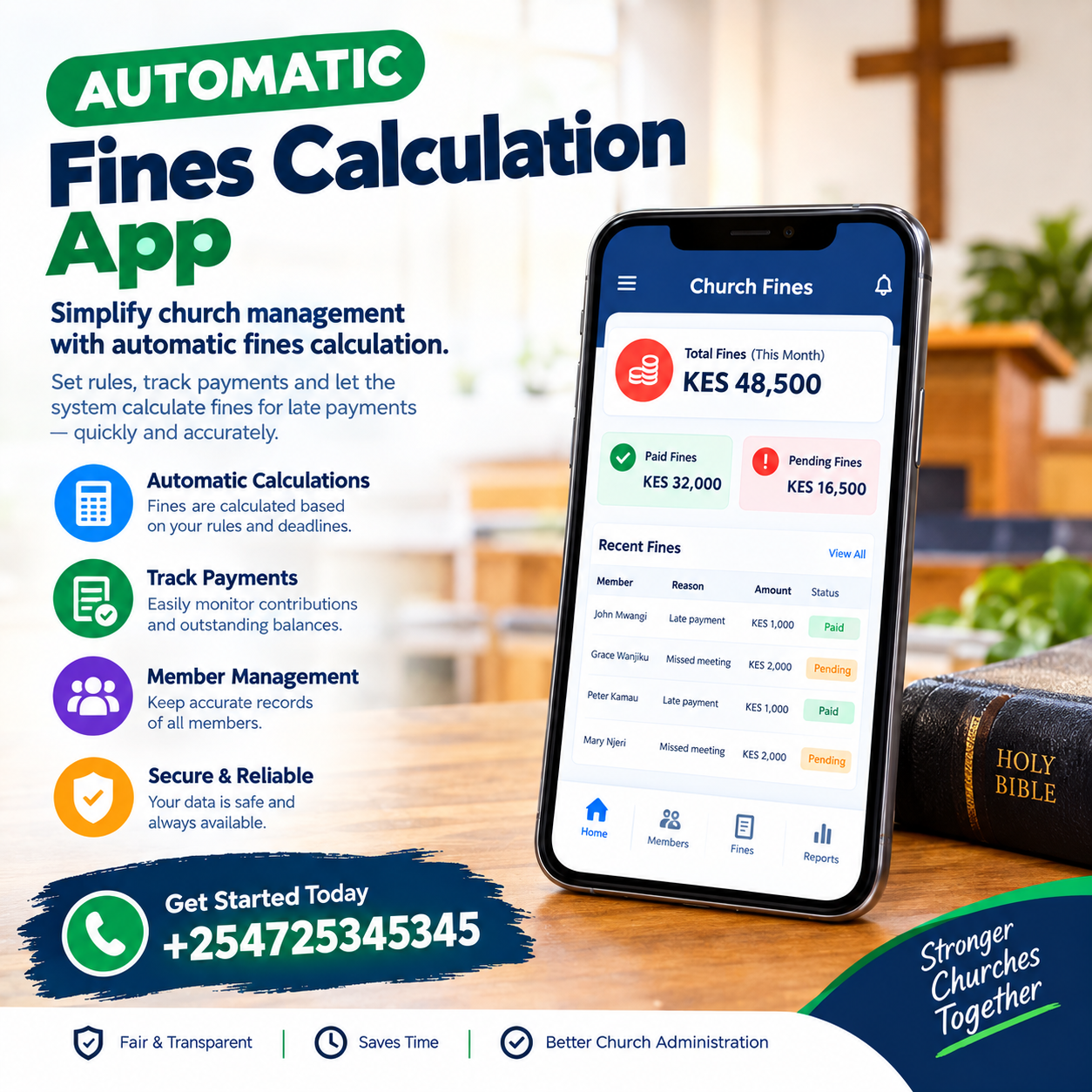
An automatic fines calculation app is quietly becoming the most appreciated tool in Kenyan group finance, because it solves the problem members complain about most — unfair, inconsistent, and awkward fines. Every chama uses fines to keep discipline alive, yet hardly any group enjoys administering them. The moment an automatic fines calculation app takes over, enforcement stops being personal and starts being impartial
Fines exist in groups for a good reason. They protect the contribution rhythm, honor the meeting schedule, and keep the loan book healthy for everyone’s sake. Without them, the most reliable members end up subsidizing the least reliable ones.
Ask any group of members what frustrates them most about their chama, and you will hear the same three answers wherever you travel. Late payments, hidden records, and disputed fines dominate every honest conversation. Two of those three frustrations are actually the same frustration wearing different clothes.
That shared frustration is the doorway through which this guide walks. The chama world has tolerated fine disputes for generations because nobody believed a better way existed. Now that a proven better way does exist, learning about an automatic fines calculation app becomes one of the most practical steps any group can take.
The trouble with the old way is that it was never designed — it simply happened. Fines grew out of necessity, shaped by whatever tools a group had: notebooks, memory, and meetings where everyone could see everyone else’s discomfort. Nobody ever sat down and asked whether the manual approach could actually be fair.
This guide asks that question properly and answers it completely. It explains what an automatic fines calculation app actually does, which fine types it handles, and how the calculation happens behind the scenes. By the end, choosing and implementing one will feel like a project your group can complete within a single month.
The article is written for treasurers tired of playing the villain, chairpersons tired of refereeing fine disputes, and members tired of never knowing where they stand. It is equally written for founders building new groups who want discipline built in from day one. Everyone in the group wins when an automatic fines calculation app handles enforcement fairly.
One truth deserves stating before anything else. Fines are not punishment — they are the guardrails that keep the group’s promises to each other intact. Groups that frame fines this way, and enforce them through an automatic fines calculation app, build cultures where discipline feels like care rather than control.
There is a quiet psychology behind that framing worth understanding. People accept consequences they can predict, verify, and see applied equally to everyone. What people resist is not the fine itself but the uncertainty, the inconsistency, and the personality that comes attached to it. Automation removes all three at a stroke.
The good news is that the shift is simple, affordable, and fast. Most groups complete the transition within one billing cycle, and nearly all of them report calmer meetings immediately. The sections ahead show exactly how an automatic fines calculation app delivers those results.
So read this guide with your constitution open beside you. Note which fine rules your group already has, and which ones the coming sections will help you tighten. The calmest time to modernize enforcement with an automatic fines calculation app is today, long before the next disputed fine arrives.
There is also a deeper reward hiding in this decision. Groups that enforce rules impartially attract better members, retain them longer, and lend with greater confidence. Impartiality, automated through an automatic fines calculation app, quietly becomes the group’s strongest cultural asset.
What Is an Automatic Fines Calculation App?
An automatic fines calculation app is a digital platform that applies your group’s fine rules to members’ behavior without any human intervention. When a contribution misses its due date or a member misses a meeting, the system detects it, calculates the fine exactly as your constitution prescribes, and posts it to the member’s ledger. Nobody has to notice, decide, announce, or defend the fine at any point.
The phrase “calculation” carries the full weight here. The app does not merely record fines that officials invent — it computes them from the rules the group wrote in advance. That distinction is what separates a genuine automatic fines calculation app from a simple note-taking tool.
Think of the app as your constitution brought to life. Every rule written on paper — amounts, grace periods, escalation bands, caps — becomes executable logic inside the system. A well-configured automatic fines calculation app enforces the document the members actually voted for.
That idea deserves a moment of reflection, because it represents something genuinely new in group finance. For centuries, rules existed only in documents, and documents depended entirely on the humans appointed to apply them. The application was always where fairness lived or died. Now the application itself can be delegated to a system that never tires, never favors, and never forgets.
It is also worth separating these platforms from generic bookkeeping tools. A spreadsheet can total fines after the fact, but it cannot detect lateness, apply bands, notify members, or prevent disputes in real time. Only a purpose-built automatic fines calculation app covers the entire enforcement journey from trigger to settlement.
The best platforms are built specifically for Kenyan group culture. They understand lateness fines, absence fines, penalty interest on loans, and welfare defaults as distinct categories with their own logic. That local fluency is what makes a serious automatic fines calculation app feel tailor-made for chamas.
A useful analogy is the traffic system in any modern city. Traffic lights enforce the rules of the road without a police officer standing at every corner, and drivers accept them because they are identical for everyone. An automatic fines calculation app plays exactly that role for group finance — a neutral presence that everyone trusts precisely because it treats everyone the same.
Why Manual Fines Fail Every Group Eventually
The first failure of manual fines is selective memory. A fine noticed at a busy meeting gets recorded, while the same fine noticed during a calm week quietly disappears. Inconsistency like that is the seed from which every later accusation about automatic fines calculation app fairness eventually grows.
The second failure is the awkwardness tax. Chasing a friend for three hundred shillings strains relationships in ways that no constitution can anticipate. Officials who must confront members face to face either become hardened or go soft — and both extremes damage the group, which is the human cost an automatic fines calculation app removes entirely.
The third failure is selective enforcement. When officials waive fines for allies and apply them to rivals, the constitution dies quietly in public view. Members forgive many things, but they never forget visible favoritism — the exact poison an automatic fines calculation app neutralizes through impartiality.
The fourth failure is compounding arrears. A fine that goes unrecorded in March becomes a disputed mystery by June, and disputed fines poison every later reconciliation. Early, automatic, visible posting is the structural cure that only an automatic fines calculation app provides.
The fifth failure is enforcer burnout. The official responsible for chasing fines inherits the group’s most hated job and absorbs all its social friction. Protecting those volunteers from that burden is one of the kindest arguments for an automatic fines calculation app.
The pattern behind these failures deserves naming because it repeats across every manual system ever created. Rules written on paper depend on humans, humans depend on moods, and moods change with hunger, weather, friendship, and fatigue. No group has ever solved that problem through willpower alone.
The solution was never more discipline from the enforcers — it was removing the human variable from enforcement entirely. This is the same insight that transformed banking, taxation, and payroll across the world. Group finance was simply waiting for its turn, and that turn has now arrived through the automatic fines calculation app.
The deeper pattern behind all five failures is the same. Manual systems depend on human moods, and human moods are never consistent enough to enforce rules fairly across a whole year. Systems, unlike moods, apply the identical rule to every member on every occasion — which is the entire philosophy of an automatic fines calculation app.
Types of Fines the App Handles
Late contribution fines are the most common category. When a member’s payment misses the agreed deadline, the app applies the constitutional fine automatically and shows it on the member’s ledger immediately. That instant visibility is the discipline engine of an automatic fines calculation app.
Meeting lateness and absence fines form the second category. Members who arrive after the appointed hour, or miss without an approved excuse, are fined according to the group’s written schedule. Automated attendance tracking paired with an automatic fines calculation app makes this the least contentious fine of all.
Loan repayment penalties form the third and most financially significant category. When an installment slips past its due date, penalty interest accrues exactly as the constitution prescribes, without debate. Precision in this category is what protects the loan book inside an automatic fines calculation app.
Welfare and pledge defaults form the fourth category. Members who commit to emergency fund top-ups and fail to honor them are tracked and fined gently but surely. Compassionate consistency here is a hallmark of a well-configured automatic fines calculation app.
Custom fines form the fifth category, and Kenyan groups invent many. Some fine members for phones switched off on collection day, others for missed site visits or unreturned group property. Flexible rule creation is what makes an automatic fines calculation app adapt to any group’s culture.
Escalation bands tie all the categories together with wisdom. Most constitutions fine small amounts for first lateness, higher amounts for repeated lateness, and stronger consequences for chronic patterns. Graduated enforcement is the mature intelligence built into a serious automatic fines calculation app.
Caps complete the humane side of the structure. Good systems prevent fines from ever exceeding sensible limits, so discipline never turns into debt traps. That protective ceiling is a signature feature of a trustworthy automatic fines calculation app.
Grace periods deserve their own mention because they are the difference between firm and harsh. Many groups allow twenty-four or forty-eight hours after a deadline before any fine triggers, acknowledging that real life has friction. Sensible grace windows are what keep enforcement firm without ever feeling cruel.
Together these categories form a complete disciplinary toolkit. A group that maps its constitution against this list usually discovers gaps it never knew existed — and closing those gaps is itself a valuable exercise. The full picture is what a proper automatic fines calculation app makes visible at a glance.
How Automatic Calculation Works
The process begins with configuration, done once and reviewed annually. Officials enter each fine rule exactly as the constitution states it — the trigger, the amount, the grace period, and the cap. Faithful configuration is the foundation on which every automatic fines calculation app operates.
Next comes trigger detection. The system watches contribution deadlines, meeting attendance, loan schedules, and welfare commitments continuously. The moment any rule is breached, the automatic fines calculation app knows instantly.
Then comes the calculation itself. The app applies the exact amount, band, or percentage prescribed, checking grace periods and caps before posting anything. Deterministic arithmetic — the same input always producing the same output — is the technical heart of an automatic fines calculation app.
Posting and notification follow within moments. The fine appears on the member’s ledger, and the member receives a message explaining what was applied and why. Transparent communication is the dignity layer of an automatic fines calculation app.
The explanation step deserves emphasis because it changes the entire emotional experience. A fine that arrives with its rule quoted feels like information, while a fine that arrives unexplained feels like accusation. Vendors who understand this design their notifications as mini-receipts of justice, which is a hallmark of a thoughtful automatic fines calculation app.
Settlement closes the loop. When the member pays the fine, the app reconciles the payment, clears the entry, and restores the member’s standing visibly. Clean endings are the closure discipline of a mature automatic fines calculation app.
The entire cycle runs without a single manual step. Officials review the results rather than manufacture them, and members experience enforcement as a fact rather than a confrontation. That shift from confrontation to fact is the deepest change an automatic fines calculation app delivers.
Timing is also worth understanding. Most platforms run their checks at fixed moments — midnight of the due date, the close of the meeting, or the end of the grace window. Predictable timing means members always know exactly when consequences take effect, which is another quiet fairness feature of an automatic fines calculation app.
Key Features of a Great Automatic Fines Calculation App
A configurable rule engine comes first. Every fine type, amount, band, and cap must be adjustable to mirror your constitution precisely. Flexibility at this level is the defining feature of a serious automatic fines calculation app.
Real-time ledger updates come second. The moment a fine posts, every balance, statement, and arrears report should refresh automatically. Living records are the operational core of an automatic fines calculation app.
Instant notifications come third. Members should learn of fines within minutes, with the rule that triggered them quoted clearly. Prompt, explainable alerts are the trust feature of an automatic fines calculation app.
Waiver handling with audit trails comes fourth. Legitimate waivers happen — bereavements, emergencies, approved absences — and the app should record who approved what and when. Documented mercy is the compassion feature of a well-designed automatic fines calculation app.
Reports and aging views come fifth. Officials should see total fines issued, collected, waived, and outstanding, sorted by member and by type. Enforcement intelligence is the leadership layer of an automatic fines calculation app.
Member self-service comes sixth. Every member should view their own fines, their payment status, and their standing history without asking anyone. Private visibility is the empowerment feature of an automatic fines calculation app.
Offline resilience comes seventh. Field collections and rural meetings happen where networks fail, and records entered offline must sync safely later. Reliability without connectivity is the resilience mark of a serious automatic fines calculation app.
Integration with the wider financial picture comes eighth. Fines should flow into statements, arrears reports, and dividend calculations without any double entry. Connected data is the efficiency promise of a complete automatic fines calculation app.
Security and roles come ninth. Only authorized officials should be able to configure rules or approve waivers, and every action should be logged permanently. Controlled power is the governance layer of an automatic fines calculation app.
Together these nine features form a complete enforcement system. Missing any one of them creates a gap that disputes eventually find. Completeness is what distinguishes a true automatic fines calculation app from a partial tool.
When evaluating candidates, print this feature list and score each platform against it. Identical checklists are the only honest way to compare products that present very differently in demos. A structured evaluation is what separates a wise purchase from an expensive impulse.
The Benefits for Officials and Members
Impartiality is the first and greatest benefit. The app applies identical rules to the chairperson and the newest member alike, and everyone knows it. That visible equality is the moral authority an automatic fines calculation app gives the whole group.
Treasurer relief is the second benefit. The official who once spent evenings chasing, recording, and defending fines now reviews a dashboard instead. Reclaimed evenings are the personal dividend of an automatic fines calculation app.
Consider what those reclaimed evenings actually mean over a year. An official spending three hours monthly on fine administration gives the group thirty-six hours annually — nearly a full working week of unpaid labor. Automation returns that time to the volunteer, the family, and the day job, which is the humane arithmetic behind every automatic fines calculation app.
Member trust is the third benefit. Members who can see their own fines, understand their triggers, and clear them privately stop feeling policed and start feeling respected. Dignity preserved is the social return on an automatic fines calculation app.
Discipline improves collections, which is the fourth benefit. Groups with consistent fines report contribution rates climbing steadily within two or three cycles. Predictable consequences change behavior more effectively than occasional scolding ever did.
Shorter, calmer meetings are the fifth benefit. Sessions once consumed by fine debates now move through them in a single line of the treasurer’s report. Time returned to planning is the quiet gift of an automatic fines calculation app.
There is also a sixth benefit officials rarely mention aloud. Automated records protect honest officials from suspicion, because every fine can be traced to its trigger and rule. That armor is the reputational shield an automatic fines calculation app provides automatically.
The seventh benefit reaches beyond the group itself. A chama known for fair, transparent enforcement attracts stronger members, wins community respect, and handles growth with fewer growing pains. Reputation compounds, and it begins with the fairness an automatic fines calculation app makes routine.
Aligning the App with Your Constitution
The app must mirror the constitution, never replace it. Before configuring anything, place the document beside the screen and translate each fine clause into the system word for word. Fidelity to the voted rules is the first commandment of any automatic fines calculation app.
Pass the enabling resolution first. Hold a meeting, agree that digital enforcement is binding, and minute the decision clearly. Constitutional recognition is what makes fines applied by an automatic fines calculation app enforceable and dispute-proof.
This resolution matters more than most groups realize. A rule enforced by software that the constitution never authorized can be challenged as invalid, no matter how sensible it is. One short clause recognizing digital records and automated enforcement closes that door forever.
Write compassion clauses into the rules. Approved absences, hardship waivers, and first-offense forgiveness should exist inside the system, not outside it. Kindness configured in advance is what makes an automatic fines calculation app humane rather than harsh.
Review the rules annually at the AGM. Groups grow, amounts feel different after inflation, and escalation bands deserve recalibration. A living configuration keeps the automatic fines calculation app aligned with the membership it serves.
Publish the configured rules back to the members after setup. A short summary showing every fine type, amount, and grace period removes the last shadows where suspicion could hide. Openness at configuration time is the transparency dividend of a well-launched automatic fines calculation app.
How to Choose the Right App
Demand a demonstration with your real rules. Give the vendor your actual fine schedule before the session and watch every rule execute live on screen. A system that performs with your constitution is the only honest candidate for automatic fines calculation app adoption.
Test the edge cases deliberately. Ask what happens with grace periods, partial payments, simultaneous breaches, and waiver approvals — then watch each one demonstrated rather than described. Vendors who welcome these questions are confident in their automatic fines calculation app, while vendors who deflect have told you something important.
Edge cases matter more in fines than in almost any other module, because fines touch emotions directly. A system that handles ordinary contributions roughly still works; a system that misapplies a fine once creates a story members repeat for years. Testing the edges is therefore not caution but necessity when choosing an automatic fines calculation app.
Probe support quality directly. Ask who answers on contribution day, in which language, and within what hours, because enforcement cannot wait for email tickets. Responsive human help is the relationship test for any automatic fines calculation app.
Insist on the total first-year cost in writing. Subscription, SMS volumes, onboarding, and support tiers should appear on one quoted figure. Transparent pricing is the honesty marker of a trustworthy automatic fines calculation app.
Confirm data ownership before signing. Your group’s fine history belongs to the group, and full export must be guaranteed at any time. Exit freedom is the long-term protection built into a fair automatic fines calculation app.
Finally, check references from groups of your own size. A vendor confident in their product will connect you with current users the same day, and those conversations reveal what demos never can. Reference checks are the final validation step before committing to any automatic fines calculation app.
Implementing the App: A Four-Week Plan
Week one is for clean data. Reconcile every outstanding balance and fine before anything moves into the new system, because dirty beginnings become permanent disputes. Accurate history is the prerequisite for a successful automatic fines calculation app launch.
This reconciliation week is also the perfect moment to settle old ghosts. Disputed fines from previous years should be resolved — waived, paid, or formally acknowledged — before the new system inherits them. Groups that start clean report a lightness in the room that no feature list can explain.
Week two is for faithful configuration. Translate the constitution into the rule engine line by line, with two officials verifying each entry together. Careful setup is what makes the automatic fines calculation app enforce the group’s actual rules.
Week three is for collective onboarding. Hold a live demonstration at a meeting, showing members how fines appear, why they appear, and how to clear them. Groups that train together adopt an automatic fines calculation app almost without resistance.
Use real examples during that demonstration, drawn from the group’s own history. Show a fine everyone remembers, replay how it would have appeared automatically, and let members see the fairness with their own eyes. One honest example converts more skeptics than any amount of abstract explanation about an automatic fines calculation app.
Week four is the parallel run. Keep the old method and the new system side by side for one full cycle, then compare the results at month-end. When the totals match, the group graduates permanently to its automatic fines calculation app.
After graduation, retire the old notebook formally at a meeting. A small ceremony — the ledger signed and archived — gives the transition the dignity it deserves. Groups that mark the moment report that the new system simply becomes “how we do things” from that day forward.
What It Costs and What It Returns
Pricing follows familiar patterns across the market. Most platforms charge between one and three thousand shillings monthly for typical groups, with SMS volumes as the main add-on. Ask for the total first-year figure when comparing any automatic fines calculation app.
Now weigh the returns honestly. Recovered fines, improved collection rates, and prevented disputes routinely exceed the subscription several times over. Most groups find that an automatic fines calculation app pays for itself within a single quarter.
Do the arithmetic with your own figures before the group votes. Take the fines your group issued last year, subtract those that were never collected, and place that leakage beside one year of subscription. The gap that appears on that page is usually the most persuasive slide in the entire presentation for an automatic fines calculation app.
There is also the unpriced return that never reaches a spreadsheet. Officials who sleep well, members who feel equally treated, and meetings that run without fine arguments are worth more than the fee by any honest measure. Peace of mind is the invisible dividend of an automatic fines calculation app.
Common Mistakes to Avoid
The first mistake is over-engineering the fine structure. Inventing new penalties just because the software can support them breeds resentment rather than discipline. Restraint is the wisdom that keeps an automatic fines calculation app respected rather than feared.
The second mistake is hiding behind automation. Officials should still personally reach out when a member’s pattern shows genuine struggle, because systems enforce rules while humans offer help. The best results come from pairing an automatic fines calculation app with warm follow-up.
The third mistake is skipping the constitutional update. Fines enforced digitally must be recognized digitally in the group’s founding document, or a future dispute could undo them. That single resolution is the legal foundation beneath every automatic fines calculation app deployment.
The fourth mistake is launching without training the officials themselves. The people who will configure, review, and explain the system need confidence before the members ever see it. An informed official behind an automatic fines calculation app is worth more than any feature on a brochure.
The fifth mistake is treating the first disputed fine as a system failure. Every transition surfaces one or two edge cases, and handling them calmly with the documented trail proves the system’s value rather than undermining it. Patience during the first quarter is part of successfully adopting an automatic fines calculation app.
Real Stories from Kenyan Groups
The Nakuru welfare table abolished fine debates entirely within one cycle. After configuring their rules into an automatic fines calculation app, meetings that once argued for forty minutes began approving the fine report in two. The treasurer described the change as “the group finally growing up.”
The Kitengela landlords’ chama connected both sides of its enforcement. Group fines run automatically through their platform while tenant penalties and rent arrears are managed on Tas.co.ke, giving officials one consistent culture of accountability. Discipline, they say, now feels identical across everything the group owns.
The Eldoret youth group tells the most dramatic story. Their old notebook system had produced nearly a year of uncollected fines that nobody could reconcile, and the argument over that history had frozen lending completely. One reconciliation weekend and a fresh automatic fines calculation app later, their loan book reopened and collections hit their highest level ever.
A diaspora group based in Manchester reports perhaps the most telling detail. Members across four countries now see identical fines applied at identical moments, and nobody any longer wonders whether distance affects fairness. Equality across borders, they say, is what their automatic fines calculation app quietly delivers every month.
Across all these stories the same lesson repeats. Groups do not adopt automated enforcement to punish members — they adopt it to protect the fairness that makes membership worthwhile. That protective purpose is the true heart of every automatic fines calculation app success story.
Frequently Asked Questions
Do fines post automatically without any official pressing a button?
Yes — once rules are configured, the system detects breaches and applies fines on its own. Officials review the results rather than create them. That hands-free quality is the defining trait of an automatic fines calculation app.
Can fines be waived for genuine hardship?
Yes — waivers should be configured as formal rules with approval steps and recorded reasons. Documented mercy protects both the member and the officials. Compassionate flexibility is a standard feature of a good automatic fines calculation app.
What happens if a member disputes a fine?
The app shows the exact rule, trigger, date, and amount behind the fine, which resolves most disputes instantly. Anything genuinely contested follows the constitution’s review path with full records available. That evidence trail is the fairness guarantee of an automatic fines calculation app.
Will members without smartphones see their fines?
Yes — notifications and balance updates reach any phone through SMS, while smartphone users get richer dashboards. Inclusivity is a design principle of every serious automatic fines calculation app.
Can the app apply penalty interest on late loans as well as fixed fines?
Yes — percentage-based penalty interest and fixed-amount fines usually run side by side, each following its own constitutional rule. Dual capability is what makes a mature automatic fines calculation app cover the whole lending book.
How do we stop fines from feeling like punishment?
Frame them in the constitution as shared guardrails, cap them sensibly, waive fairly, and celebrate cleared records warmly. Culture comes from the group; the app simply keeps the rules honest. That partnership is the healthiest way to run an automatic fines calculation app.
How quickly do we see results?
Most groups report calmer meetings within the very first cycle and stronger collection rates by the second or third. Fast, visible improvement is the immediate reward of an automatic fines calculation app.
What if our constitution is silent on some fine types?
Treat the silence as an opportunity — draft the missing clauses, discuss them openly, and pass them at a meeting before configuring the system. Rules adopted by consent and enforced by an automatic fines calculation app are the strongest rules a group can have.
We also manage rental property — can fines apply to tenants too?
Property penalties deserve a dedicated system rather than a group-fines tool. The smartest groups run tenants, rent arrears, and landlord statements on Tas.co.ke while member fines run on the chama platform — one consistent culture of accountability across everything the group manages, anchored by its automatic fines calculation app.