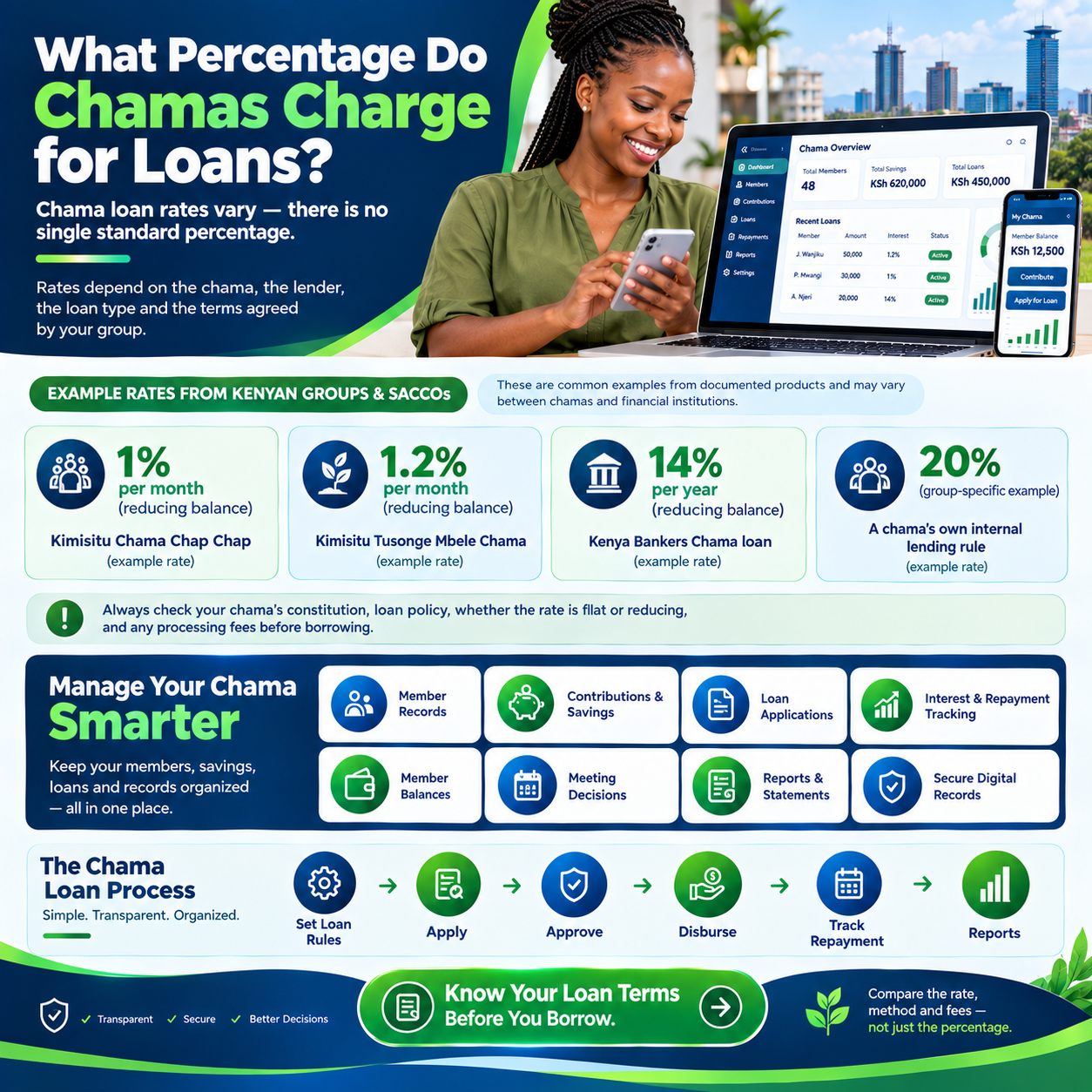
What percentage do chamas charge for loans is the very first question most new members ask before committing their savings to any group. The answer shapes how much a school-fees loan really costs, how fast the group’s capital grows, and whether members feel the terms are fair.
Yet across Kenya, the honest reply is a range rather than a single figure — and understanding that range is the entire purpose of this guide.
The reason no single answer exists is that every chama writes its own lending rules. A teachers’ group in Nakuru, a traders’ circle in Gikomba, and a professionals’ chama in Kilimani can charge very different rates and all remain perfectly legitimate.
So the real task behind what percentage do chamas charge for loans is learning what is common, what is fair, and what suits your own group.
This guide gives you the complete picture in plain language. You will see the typical rates Kenyan groups actually charge, the crucial difference between flat and reducing-balance pricing, and fully worked examples you can verify on any calculator.
By the end, the question of what percentage do chamas charge for loans will feel like a menu of informed choices rather than a mystery.
The timing for this knowledge could not be better. Group lending has exploded in scale as chamas fund rentals, matatus, and businesses worth millions of shillings. In that environment, a clear answer to what percentage do chamas charge for loans protects both borrowers and savers from silent mispricing.
Borrowers need the answer to avoid overpriced credit and unpleasant surprises at repayment time. Savers need it because loan interest is usually the largest income line feeding their annual dividends. Both sides of the table meet in the single question of what percentage do chamas charge for loans.
Officials need it most of all, because they set the rates and defend them at every AGM. A treasurer who can explain the group’s pricing with confidence wins trust that lasts for years. That confidence begins with mastering what percentage do chamas charge for loans from every angle.
One reassurance before we begin. There is no national rulebook that fixes group lending rates, which means your constitution — not the government — is the true authority. That freedom is exactly why getting informed about what percentage do chamas charge for loans matters so much.
The Short Answer: Typical Rates in Kenyan Chamas
Here is the honest snapshot of current practice across the country. Most established chamas charge between 8 and 15 percent per annum, with 10 percent flat per year being the single most common figure.
So the practical heart of what percentage do chamas charge for loans is this: expect to pay roughly one percent of the principal per month.
Smaller and newer groups often charge slightly more, in the 2 to 3 percent per month range. The higher figure reflects thin reserves, higher perceived risk, and the need to build capital quickly.
Anyone researching what percentage do chamas charge for loans among startup groups should expect exactly that pattern.
Mature, well-capitalized groups charge less. Groups with large loan books and diversified income can comfortably lend at 8 to 12 percent per annum while still paying handsome dividends.
Their pricing discipline is one of the quiet lessons hidden inside what percentage do chamas charge for loans.
Table banking circles are the exception worth naming. They commonly charge 10 percent of the monthly pot, which annualizes to far more but lasts only weeks.
That short-cycle pricing is its own distinctive answer to what percentage do chamas charge for loans within the rotation format.
Emergency loans carry premium pricing almost everywhere. A one-month facility for hospital bills might cost a flat 5 to 10 percent regardless of the amount borrowed.
Any complete study of what percentage do chamas charge for loans must include this urgent, short-tenure corner of the market.
The spread between all these figures is not random. It tracks the group’s cost of funds, risk appetite, administrative burden, and financial goals.
Understanding that spread is what turns the raw question of what percentage do chamas charge for loans into real negotiating power.
Flat Rate vs Reducing Balance: The Hidden Difference
Before any percentage means anything, you must know how it is applied. Two groups can both say “10 percent” and produce very different total costs depending on the calculation method.
This single distinction is the most important technical detail in the whole subject of what percentage do chamas charge for loans.
Under a flat rate, interest is computed on the original principal for the entire loan period. Borrow 100,000 at 10 percent flat for a year and you owe 10,000 in interest, full stop, no matter how fast you repay.
Simplicity is the great appeal of flat pricing in what percentage do chamas charge for loans.
Under a reducing balance, interest is charged only on what you still owe each month. The same 100,000 at 12 percent per annum reducing costs roughly 6,600 in total interest over a year.
Members comparing figures in what percentage do chamas charge for loans must therefore always ask which method applies.
Here is the rule of thumb that surprises most members. A flat 10 percent per annum costs roughly the same as a reducing balance of about 18 percent.
Every serious discussion of what percentage do chamas charge for loans should include that conversion, because it prevents false comparisons between groups.
Neither method is dishonest, provided it is disclosed. Flat rates win on simplicity and predictability; reducing balances reward early repayment and cost less overall.
The fairest groups print the method — not just the number — wherever they publish what percentage do chamas charge for loans.
What Determines the Rate Your Group Sets
The first factor is the source of funds. Chamas lend members’ savings, not borrowed money, so there is no bank debt to service beneath the rate.
That structural advantage explains the lower end of what percentage do chamas charge for loans among disciplined groups.
The second factor is the group’s financial mission. A chama that exists to generate member income must charge enough to fund dividends after expenses.
A welfare-first circle may charge minimally, which is why the mission shapes what percentage do chamas charge for loans in every constitution.
The third factor is risk. Loan size relative to savings, member repayment history, and the strength of guarantors all move the price.
Groups that screen carefully can afford softer answers to what percentage do chamas charge for loans than groups lending blind.
The fourth factor is tenure. Short loans justify higher monthly pricing because the administrative cost is the same regardless of size.
Long development loans justify lower annual pricing — a nuance often missed in heated debates about what percentage do chamas charge for loans.
The fifth factor is inflation and opportunity cost. Money parked in a five-percent loan loses ground when prices are rising seven percent a year.
Realistic groups set rates with this arithmetic firmly in mind when deciding what percentage do chamas charge for loans.
The sixth factor is competition. Members who can access a SACCO at 12 percent reducing will not tolerate a chama charging the equivalent of 25.
Market awareness keeps the answer to what percentage do chamas charge for loans honest over time.
The final factor is growth strategy. Some groups deliberately charge higher rates to accelerate capital accumulation toward a building project or land purchase.
Ambition, as much as cost, drives the most aggressive numbers in what percentage do chamas charge for loans.
Monthly Rates vs Annual Rates: Reading the Fine Print
Quoting conventions cause more confusion than actual pricing. “Two percent per month” sounds gentle but equals 24 percent per year on a flat basis.
Clarity about conventions is therefore essential to any honest answer on what percentage do chamas charge for loans.
The reverse is equally true. “Twelve percent per annum” looks formal but equals just one percent monthly on the outstanding balance.
Members comparing notes on what percentage do chamas charge for loans must convert everything to the same basis first.
The cleanest practice is dual disclosure. State the rate as a monthly figure and as an annualized equivalent, with the calculation method named beside both.
Groups that publish both formats never argue about what percentage do chamas charge for loans at the meeting
Put the conversion rule on a poster if you must. Annual flat equals monthly flat multiplied by twelve, and reducing-balance equivalents need the rough 1.8 conversion covered earlier.
A one-line chart of conversions ends most confusion about what percentage do chamas charge for loans permanently.
How Chama Rates Compare with Banks, Mobile Apps, and SACCOs
Context makes group pricing meaningful, so let us place it on the national map. Commercial banks typically price personal loans from the mid-teens upward, plus processing fees and insurance add-ons.
Against that backdrop, mainstream answers to what percentage do chamas charge for loans look genuinely competitive.
Mobile loan apps sit at the extreme end of the market. Their short tenures and stacked fees translate into effective annualized costs that can reach triple digits.
Next to that reality, most findings on what percentage do chamas charge for loans reveal group credit as remarkably affordable.
SACCOs sit closest to chamas in pricing philosophy. Member-owned lenders commonly charge low double digits on a reducing balance, funded by deposits rather than borrowed money.
The resemblance is no coincidence, because both models answer what percentage do chamas charge for loans with member interest at heart.
The chama’s true edge is flexibility, not just price. A group can restructure a struggling member’s loan within the same week, something no bank app will ever do.
That human dimension is part of the complete answer to what percentage do chamas charge for loans.
Emergency Loans: The Premium Corner of Group Lending
Emergency products deserve their own pricing logic. They are small, fast, and unsecured, often disbursed within hours of a hospital call.
Understandably, then, what percentage do chamas charge for loans in emergencies runs higher — commonly a flat 5 to 10 percent for the month.
The premium is not profiteering; it reflects speed and risk. Fast cash without guarantor meetings costs the group administrative attention and carries higher default exposure.
Members who understand this accept emergency pricing as the fair edge of what percentage do chamas charge for loans.
The wisest groups cap emergency pricing in the constitution.
A written ceiling — say 10 percent flat per month, repayable within sixty days — protects vulnerable members in their worst moments.
Compassionate limits are the humane dimension of what percentage do chamas charge for loans.
The Math: Two Fully Worked Examples
Numbers make everything real, so let us price one loan two ways.
Grace borrows 100,000 shillings for twelve months at 10 percent per annum flat. This first branch of what percentage do chamas charge for loans is the easiest to compute by hand.
Flat calculation: interest equals 100,000 × 10% × 1 year, which is 10,000 shillings.
Total repayment is 110,000, giving a fixed instalment of about 9,167 per month. That is the complete, final answer under this flat method of what percentage do chamas charge for loans.
Now the same loan at 12 percent per annum on a reducing balance. The fixed monthly instalment works out to roughly 8,885 shillings, and total interest over the year is about 6,619.
Notice how differently what percentage do chamas charge for loans resolves when only the method changes.
Grace repays 110,000 under the flat plan and about 106,619 under the reducing plan. The reducing route saves her around 3,400 shillings despite the higher headline rate.
That comparison is the practical payoff of understanding what percentage do chamas charge for loans precisely.
One more everyday example completes the picture. A member takes 20,000 for one month at the common 5 percent flat emergency rate, owing 21,000 on payday.
Short, simple, and transparent — the cleanest corner of what percentage do chamas charge for loans.
How to Set a Fair Rate in Your Own Group
Turn now from asking to deciding, because every group eventually writes its own answer. Begin with the group’s purpose: income generation, capital building, or member welfare.
The mission is the compass for what percentage do chamas charge for loans in your constitution.
Second, cost your operations honestly. Platform fees, bank charges, transport, and compliance all need covering from the interest you collect.
A rate set without this arithmetic will quietly underfund the group — the most common error in what percentage do chamas charge for loans.
Third, benchmark against the alternatives your members actually have. Check the nearest SACCO, the main mobile lenders, and prevailing group practice in your own area.
Setting your number inside that map is the realistic way to answer what percentage do chamas charge for loans.
Fourth, choose your method and disclose it loudly. Write “10 percent per annum flat” or “1 percent per month on reducing balance” into the constitution, in those exact words.
Precision here is what makes what percentage do chamas charge for loans enforceable and dispute-free.
Finally, review the rate annually at the AGM. Inflation, portfolio performance, and member feedback all justify small, documented adjustments from time to time.
An annual review keeps your answer to what percentage do chamas charge for loans current without drama.
Hidden Costs That Sit Beyond the Interest Rate
The headline percentage never tells the whole story. Processing fees, insurance charges, and penalty interest can add real cost if they are not disclosed upfront.
Complete transparency about extras is the honest extension of what percentage do chamas charge for loans.
Fines deserve special attention because they masquerade as pricing. Late-payment penalties are legitimate, but they should be published, capped, and applied impartially to everyone.
Members evaluating what percentage do chamas charge for loans should always read the penalty schedule too.
The best groups consolidate everything into one disclosure. A single line — “this loan costs X in interest and Y in fees, repayable as follows” — eliminates every misunderstanding.
That discipline is the gold standard for publishing what percentage do chamas charge for loans.
Keeping Rates Fair: Preventing Conflict Before It Starts
Rate disagreements are really disclosure failures wearing disguises. When members argue about interest, they are usually arguing about what was never clearly written down.
Preventing that argument is the deepest purpose of settling what percentage do chamas charge for loans in advance.
Adopt three fairness habits from the most peaceful groups. Publish the schedule on every application form, show total cost before signature, and apply the rate identically to officials and members alike.
These habits are what make what percentage do chamas charge for loans a settled matter rather than a recurring battle.
Also protect vulnerable borrowers deliberately. Cap emergency pricing, allow documented restructuring in genuine hardship, and never let penalties exceed the principal.
Ethical guardrails are the crown of a well-designed answer to what percentage do chamas charge for loans.
Remember the two-sided bargain at the heart of group lending. Borrowers deserve affordable credit; savers deserve returns that beat inflation and fund real dividends.
The right number sits where both sides can shake hands — that is the art behind what percentage do chamas charge for loans.
Tools That Do the Calculations for You
Manual arithmetic works, but modern tools remove every excuse for error.
Dedicated chama platforms compute flat and reducing-balance schedules automatically, generate statements, and apply penalties consistently.
Automation has quietly standardized the professional answer to what percentage do chamas charge for loans.
When evaluating any platform, bring a real loan to the demo. Ask it to price your actual 100,000 facility both ways and show the full repayment schedule on screen.
A system that passes that test will serve your group’s answer to what percentage do chamas charge for loans faithfully for years.
And once your group owns rental property, connect the two sides of the ledger.
Rental income managed on Tas.co.ke can flow alongside loan interest into one reconciled financial picture.
That integration gives your AGM the most complete version of what percentage do chamas charge for loans in black and white.
Real Stories from Kenyan Groups
The Nakuru teachers’ chama charged “whatever we agreed that day” for its first five chaotic years.
After writing 10 percent flat into the constitution, disputes vanished and their loan book doubled within two years.
Their treasurer credits the transformation to finally codifying what percentage do chamas charge for loans.
The Kitengela landlords’ group priced development loans at 12 percent reducing while capping emergencies at 5 percent flat.
Members now compare their chama favorably with the SACCO next door — and the annual dividends say the same.
Their published schedule has become the neighborhood reference for what percentage do chamas charge for loans.
A third group manages the property side of its wealth through Tas.co.ke, feeding clean rental income into the same AGM accounts as loan interest.
Members saw both income streams reconciled on one page for the first time last year.
Seeing the full picture, they voted to keep lending rates steady rather than raise them.
Frequently Asked Questions
Is 10 percent flat per year a fair chama rate?
Yes — it is the most common figure in Kenya, simple to compute, and competitive with member-owned alternatives. Just disclose the method clearly, because what percentage do chamas charge for loans only means something beside its method.
What rate should a brand-new group of ten members charge?
Start around 2 percent per month flat, review after the first year, and step down as reserves grow. That staged approach is the practical beginner’s answer to what percentage do chamas charge for loans.
Which is cheaper: 10 percent flat or 12 percent reducing?
The reducing option — total interest on a one-year 100,000 loan is about 6,619 reducing versus 10,000 flat. Always convert both offers to total cost before deciding.
Can a chama legally charge any rate it wants?
Informal groups set rates by member consent through their constitutions, with no statutory cap on member-to-member lending. Reasonableness, disclosure, and signed agreements are what protect the group if a dispute ever arises.
Do chamas charge interest on welfare loans?
Many do not, treating welfare lending as a benefit funded by subscriptions rather than a business line. Groups that do charge typically use token flat rates of 2 to 5 percent to cover administration.
Does loan interest affect members’ dividends?
Directly — interest collected is the group’s income, and after expenses and reserves it feeds the distributable pool. That is why savers care as much about lending rates as borrowers do.
We also own rental units — should that change our pricing?
Not necessarily, but it changes your funding mix, because rental income can subsidize cheaper lending. The smartest groups run tenants, rent collection, and owner statements on Tas.co.ke while group lending runs on the chama platform. With both books clean, your answer to what percentage do chamas charge for loans can be more generous than your neighbors’.