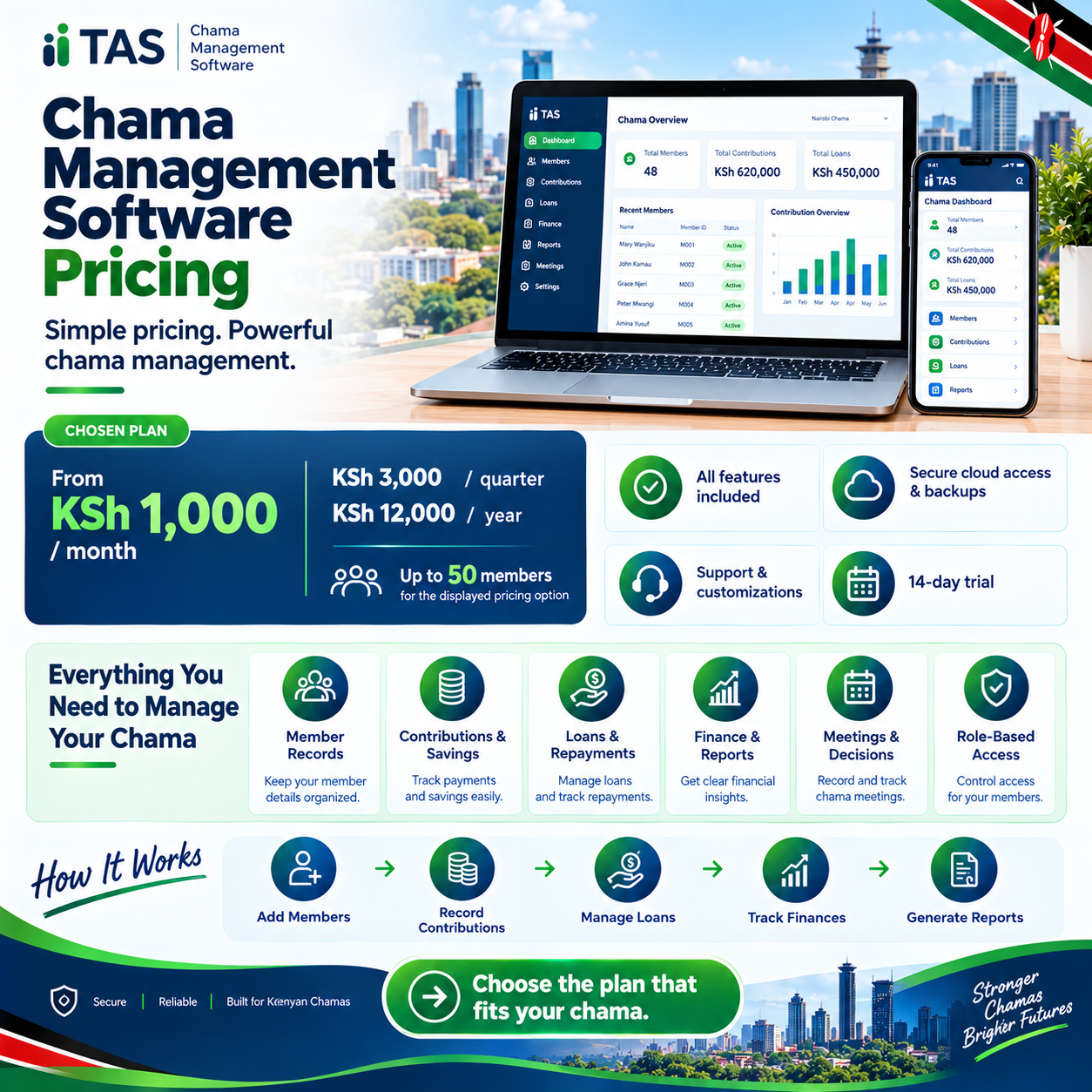
Chama management software pricing is the question every serious Kenyan group asks once the decision to digitize has been made. Members agree on the why, officials agree on the features, and then someone asks the money question. This guide answers it completely, with realistic Kenyan figures rather than vague promises.
Understanding chama management software pricing before you request quotes puts your group in the strongest possible negotiating position. Vendors quote differently to informed buyers than to hopeful ones. Knowledge, in pricing conversations as everywhere else, is money.
The honest starting point is that chama management software pricing in Kenya spans a wide range. Small groups can run professional systems for a few thousand shillings a month, while large federations invest in premium tiers. What matters is matching the tier to your group’s actual size and needs.
This guide walks through every element of chama management software pricing from the ground up. We cover the models vendors use, the add-ons that inflate bills, and fully worked cost examples for groups of different sizes. We finish with a return-on-investment calculation that turns the price question into a profit question.
One reassurance before the numbers begin. Chama management software pricing is almost always far lower than the value of the arrears it recovers in the first quarter. Groups that do the math almost never return to manual records.
Bring your treasurer to this guide. The numbers ahead are meant to be penciled against your own group’s size, contribution levels, and ambitions. That exercise converts chama management software pricing from an abstract quote into a concrete line in your budget.
By the final section, you will know what a fair price looks like for a group exactly like yours. You will also know which questions earn vendors’ respect — and which red flags should lower any offer. That confidence is the real deliverable of mastering chama management software pricing.
What Determines the Price You Are Quoted
The first driver of chama management software pricing is group size, measured either by member count or total units managed. Most vendors price in bands — for example, up to 25 members, up to 100, and enterprise tiers beyond. Know your band before the first conversation.
The second driver is feature depth. A platform handling contributions and reminders costs less than one with full loan books, guarantor tracking, and financial accounting. Deciding which features you actually need is the first step in controlling chama management software pricing.
The third driver is support depth. Packages with dedicated onboarding, training visits, and phone support cost more than self-service tiers. Many groups find mid-tier support the sweet spot for chama management software pricing once they weigh their own technical comfort.
The fourth driver is deployment scale. Platforms serving SACCO-scale federations with thousands of members invest more in infrastructure, which shows in their enterprise pricing. A neighborhood chama should never be paying federation rates — an important sanity check within chama management software pricing.
The final driver is market position. Established vendors with large client bases price for sustainability rather than desperation. That stability is itself worth paying for, which is why the cheapest entry in chama management software pricing is rarely the best deal.
The Main Pricing Models Explained
Model one is the flat monthly subscription. You pay one fixed fee per month regardless of how many members the group has, which makes budgeting beautifully simple. Flat pricing is the friendliest entry point into chama management software pricing for small and medium groups.
Model two is per-member pricing. The platform charges a small amount per active member each month, so costs scale exactly with your group. Growing groups like how per-member chama management software pricing never charges for capacity they do not use.
Model three is tiered packaging. Vendors bundle features into bronze, silver, and gold-style tiers, each with its own fee and member ceiling. Tiered structures give groups room to upgrade as they outgrow lower levels of chama management software pricing.
Model four is annual billing with a discount. Paying twelve months upfront typically saves ten to twenty percent compared to monthly payments. Cash-rich groups often choose annual chama management software pricing precisely to capture that saving.
Model five is one-time licensing with annual support. Older systems charge a large upfront fee plus yearly maintenance, a structure inherited from the banking software era. Most modern vendors have abandoned it, which is one reason current chama management software pricing favors subscriptions.
There is no universally correct model — only the correct model for your cash flow. A group with uneven monthly collections may prefer flat fees, while a stable one may prefer per-member clarity. Test each structure against your own finances before committing to any chama management software pricing arrangement.
Typical Price Ranges in Kenya
Now for the numbers groups actually ask about. Entry-level plans for groups under roughly thirty members typically run between one thousand and three thousand shillings per month. That band is the realistic floor of professional chama management software pricing in Kenya today.
Mid-tier plans serving groups of thirty to a few hundred members generally fall between three and eight thousand shillings monthly. These tiers add loan management, richer reports, and stronger support. Most growing investment groups find their long-term home in this middle band of chama management software pricing.
Premium and enterprise tiers — for federations, large SACCO-style operations, and property-heavy portfolios — can run into tens of thousands monthly. The price buys dedicated support, custom configurations, and guaranteed service levels. Few neighborhood chamas ever need this top slice of chama management software pricing.
Annual totals make budgeting easier to picture. A small group paying two thousand shillings monthly invests twenty-four thousand shillings a year in its entire financial system. Framed that way, chama management software pricing often costs less than the group spends on meeting refreshments.
Prices also shift with promotions and partnerships. Some vendors run launch discounts, while others bundle with banks or SACCO partnerships for member benefits. Watching the market for one quarter before signing can save a group an entire month’s fee.
Always ask what the quoted figure includes. Some vendors bundle SMS and support; others quote a bare platform and bill every message separately. Comparing chama management software pricing without normalizing inclusions is how groups accidentally overpay.
The Add-Ons That Change the Real Bill
SMS charges are the classic add-on within chama management software pricing. Reminders and receipts sent per message typically cost between one and three shillings each, billed monthly by volume. A group of fifty members messaging ten times a month should budget several hundred shillings for messages alone.
Onboarding and data migration are the second common extra. Some vendors include setup free; others charge a one-time fee for importing your historical records and training officials. Ask directly, because onboarding can shift chama management software pricing by thousands of shillings in year one.
Extra admin seats are the third watch-item. Basic plans often include two or three official logins, with additional users billed monthly. Large committees should total this line before comparing chama management software pricing across vendors.
Premium support is the fourth. Dedicated account managers and priority response times usually live in higher tiers or as add-on contracts. Groups that rely heavily on phone support should read chama management software pricing with that dependency included.
Payment processing is the fifth, and it cuts both ways. Some platforms pass M-Pesa transaction costs through to the group; others absorb them inside the subscription. Understanding who pays what is essential to a fair reading of chama management software pricing.
The defense against add-on inflation is a single question, asked in writing. “What is the total first-year cost for a group of our size, including messages, onboarding, and support?” Every vendor confident in chama management software pricing answers it without hesitation — and hesitation is itself an answer.
Worked Examples: Pricing by Group Size
Before the examples, one honest caveat. The figures below reflect typical market bands rather than any single vendor’s list price. Use them as planning anchors, then confirm live quotes for your exact size.
Example 1: The Ten-Member Welfare Table
Take a ten-member welfare table contributing five thousand shillings monthly each. A typical entry plan plus message charges lands total chama management software pricing at around fifteen to twenty thousand shillings for the whole first year. That covers invoicing, reminders, receipts, and simple reports for every member.
Per member, that is roughly 125 to 165 shillings a month — the price of a single soda. The group recovers that amount the first time the platform prevents one disputed or forgotten payment. That is the honest mathematics inside small-group chama management software pricing.
Example 2: The Forty-Member Investment Chama
Now scale to a forty-member investment chama lending to members and saving toward land. A mid-tier plan with loans and reports plus message volume totals around five thousand shillings monthly. Annualized, chama management software pricing for this group runs about sixty thousand shillings.
Against that cost stands the group’s collection reality. Forty members at ten thousand monthly means four hundred thousand shillings crossing the books each month. If digitization improves collection by even five percent, chama management software pricing pays for itself twenty times over.
Example 3: The Property-Owning Chama
Finally, picture a property-owning chama with one hundred members and eight rental units. Group finance runs on the chama platform while tenants, rent collection, and landlord statements run on Tas.co.ke. Together, chama management software pricing across both subscriptions keeps every shilling visible for an outlay that feels trivial beside the portfolio.
The pattern across all three examples is consistent. chama management software pricing scales gently with group size, while the value of clean records scales much faster. That widening gap is why satisfaction rates among digitized groups run so high.
Free Tools Versus Paid Platforms
The free option must be discussed honestly. Spreadsheets and chat groups cost nothing and serve brand-new groups adequately for a season. But they cannot reconcile M-Pesa, send automatic reminders, or survive an official’s departure — the gaps that eventually make chama management software pricing worthwhile.
Freemium platforms occupy the middle ground. They offer genuine functionality free for tiny groups, then move you to paid tiers as you grow. Trying before buying is the best way to learn what chama management software pricing should feel like.
Beware free tools that monetize your data or vanish without notice. If the business model is unclear, the long-term price may be your records. Reputable vendors behind chama management software pricing survive on subscriptions, not on silent data harvesting.
The practical advice is sequenced. Start free if you are under five members with no lending; graduate to a paid plan when loans, arrears, or disputes appear. Treat the move as a milestone rather than an expense — that mindset reframes chama management software pricing entirely.
Calculating the Return on Investment
ROI turns the pricing debate into arithmetic any committee can follow. Begin with recoverable losses: arrears, forgotten fines, and reconciliation errors that manual systems leak. Most groups find these leaks alone exceed their annual chama management software pricing within a single quarter.
Add the treasurer’s hours next. Five hours monthly at even a modest implicit value is sixty hours a year returned to the group. Time recovered is a real, if unbanked, return on chama management software pricing.
Then value the disputes prevented. One avoided crisis — the kind that dissolves decades-old groups — is worth more than a decade of subscriptions. Insurance is the fairest frame for this portion of chama management software pricing.
There is also the confidence dividend that never reaches a spreadsheet. Officials who trust their numbers make faster decisions and sleep better before AGMs. Peace of mind is difficult to price but impossible to replace.
Finally, count the opportunities unlocked. Bank accounts, credit lines, and credible negotiations all favor groups with clean statements. Access to finance is the quiet multiplier behind well-chosen chama management software pricing.
Run the full calculation with your own figures before the AGM vote. Present total cost beside total recovered, and let members see the margin for themselves. Groups that vote on chama management software pricing with the math on one page almost always vote yes.
How to Get the Best Deal
Negotiation in this market is normal and expected. Vendors discount for annual prepayment, referrals, and case studies — ask for all three. Polite bargaining often trims chama management software pricing by ten or fifteen percent without any haggling drama.
Request quotes from at least three vendors using an identical requirements list. Identical inputs are the only way comparisons of chama management software pricing mean anything. Differences that survive like-for-like quoting are real differences.
Ask about nonprofit, welfare, and faith-based discounts where they might apply. Many vendors quietly offer reduced community rates that never appear on public pages. One question can reshape chama management software pricing for qualifying groups.
Timing matters in negotiations too. Vendors are most flexible at quarter-end and during product launches, when internal targets loom. A patient group that asks at the right moment often hears a better number.
Read the renewal terms before signing, not after. Auto-renewal escalations, message-rate changes, and tier migrations all belong in the first conversation. Transparency at signing is what keeps chama management software pricing fair in year three.
Finally, insist on a demo with your own numbers. Enter a real month of contributions and watch the platform compute, remind, and report live. A system that performs has earned its chama management software pricing — one that stumbles has just saved you money.
Real Stories from Kenyan Groups
The Nakuru teachers’ chama nearly rejected digitization over a quoted annual fee. Their treasurer ran the ROI calculation with real arrears figures, and the room reversed its verdict in ten minutes. They now credit that one-page analysis of chama management software pricing with their smoothest financial years ever.
The Kitengela landlords’ group bundled both sides of its operation. Group finance runs on the chama platform while tenants and rent run on Tas.co.ke, with combined statements at every AGM. Members describe the combined spend as the smartest line their review of chama management software pricing ever produced.
The Eldoret youth group started on a freemium plan with nine members. Within two years, growth into lending moved them to a mid-tier subscription without a single complaint about cost. Their journey shows how chama management software pricing can grow step by step alongside the group itself.
Across the country, the pattern repeats. Groups do not complain about what they pay for systems; they complain about what disorder costs them quietly. That inversion is the final lesson of chama management software pricing.
Frequently Asked Questions
How much should a small chama of ten members expect to pay?
Budget between one and three thousand shillings monthly on an entry plan, plus small message charges. At that level, chama management software pricing works out to a few hundred shillings per member per year. Most groups recover the full annual cost within one quarter of cleaner collections.
Is annual billing worth it?
Yes, when cash flow allows — discounts of ten to twenty percent are common for prepaid years. Just confirm refund terms in writing before committing to annual chama management software pricing. A group with stable finances almost always saves by paying upfront.
What hidden costs should we ask about?
Ask specifically about SMS volumes, extra admin seats, onboarding fees, and support tiers. A total first-year figure in writing is the cleanest way to compare chama management software pricing. Vague answers to that request deserve the same suspicion as vague answers anywhere.
Can we negotiate the quoted price?
Yes — annual prepayment, referrals, and multi-year commitments are the standard levers. Most vendors expect the conversation, so never accept the first figure in chama management software pricing as final. A respectful ask routinely saves ten to fifteen percent.
Is a free plan enough for a new group?
It can be, for very small groups without lending. The moment loans and arrears enter the picture, paid chama management software pricing earns its keep immediately. Graduate when the group’s money becomes bigger than the group’s memory.
We own rental units — do we need to pay for two systems?
Many groups pair a chama platform for contributions and loans with Tas.co.ke for tenants, rent collection, and owner statements. Combined, the two subscriptions still cost less than one month’s disputed rent — a decisive fact when judging chama management software pricing. One connected ecosystem beats two half-visible ledgers every time.
What is the single best question to ask any vendor?
Ask: “What is the total first-year cost for a group of our size, with everything included?” Vendors who answer instantly have priced chama management software pricing honestly — and those who hesitate have told you something too.