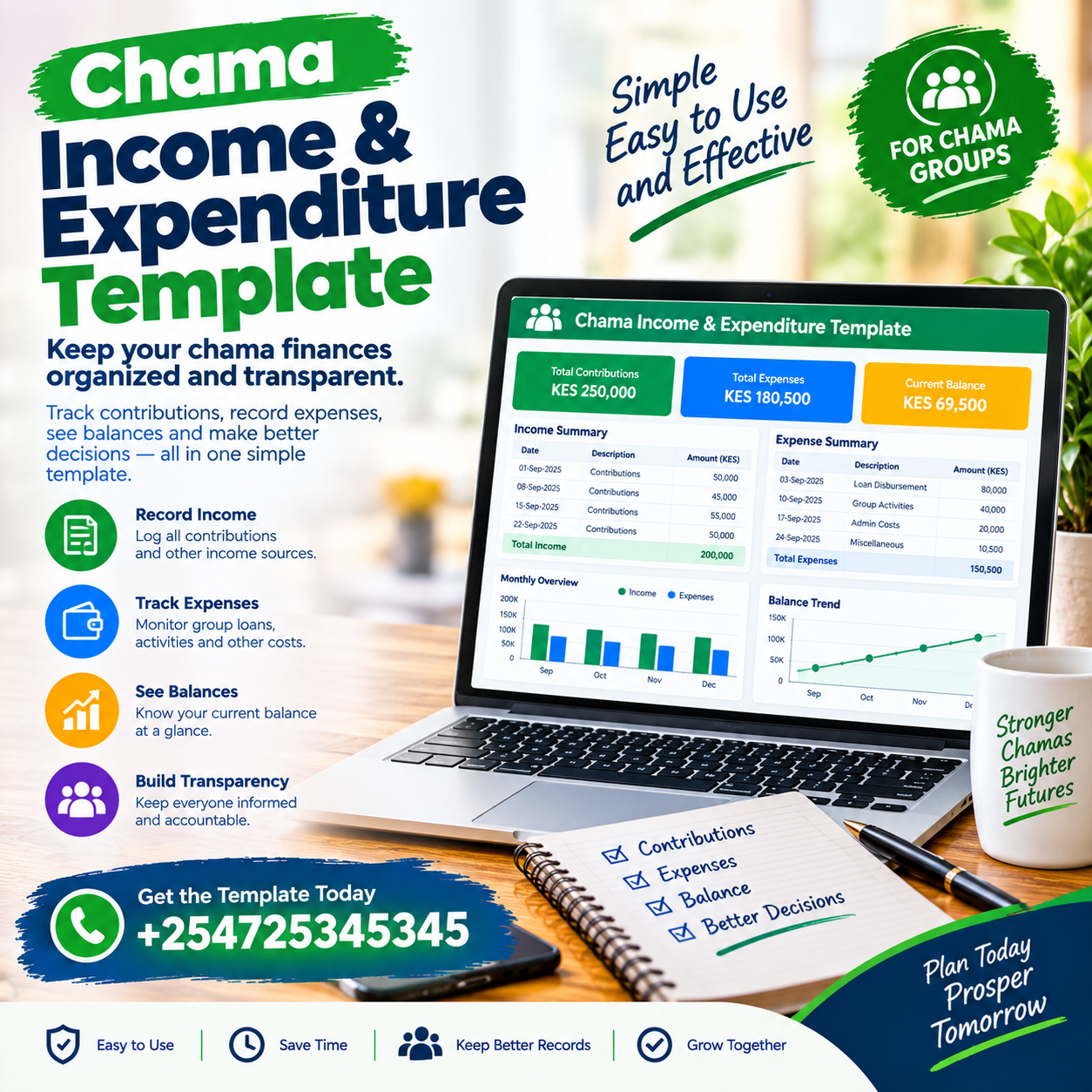
A chama income and expenditure template is the document that turns a group’s scattered financial activity into one clear, honest picture. It records every shilling that comes in and every shilling that goes out, organized into lines any member can read in minutes. For Kenyan chamas, it is the difference between saying “we think we are doing well” and proving “here is exactly how we are doing.”
Most groups believe their finances are simple enough to survive without structure. Then the treasurer changes, a dispute arrives, or a bank asks for statements, and the absence of a proper chama income and expenditure template suddenly becomes the most expensive omission the group ever made. Preparation, as always, costs a fraction of the crisis it prevents.
This guide is the complete playbook for building that document. It explains what belongs on the income side, what belongs on the expenditure side, and how the sections fit together into a format any group can adopt tonight. By the end, creating your own chama income and expenditure template will feel like an afternoon project rather than an accounting degree.
The article is written for treasurers preparing their first formal report, chairpersons facing a skeptical AGM, and founders who want clean books from the very first shilling. It is equally written for members who want to understand the figures their officials present. Everyone touched by group money benefits when a chama income and expenditure template becomes the group’s shared standard.
One truth deserves stating before anything else. Financial chaos in groups is rarely caused by dishonesty — it is caused by unstructured recording that makes honesty impossible to prove. A well-built chama income and expenditure template removes that ambiguity permanently, protecting both the group’s money and its officials’ reputations.
The good news is that the format is genuinely simple. It needs only clear categories, consistent recording, and reconciliation against real bank and M-Pesa records. Groups that master those three habits find that a chama income and expenditure template becomes the most trusted page in every meeting.
So read this guide with your current records open beside you. Note which categories your group already tracks well and which ones the coming sections will help you tighten. The gaps you discover are exactly what a proper chama income and expenditure template is designed to close.
There is also a deeper reward hiding in this discipline. Groups with transparent income and expenditure records attract better members, negotiate from strength, and pass audits without fear. That compounding trust is the quiet dividend of adopting a chama income and expenditure template and using it faithfully.
What Is a Chama Income and Expenditure Template?
A chama income and expenditure template is a standardized financial document that lists all money received by the group and all money spent by the group, organized into labeled categories for any defined period. It answers the two questions every member eventually asks: where did the money come from, and where did it go. Answering both on one page is the entire purpose of the format.
Think of it as the group’s equivalent of a household budget review. A family can feel whether money is enough, but only a written list of earnings and spending reveals the truth of their position. The same honesty applies to a chama, which is why a chama income and expenditure template is the most requested document in group finance today.
The template differs from other financial records in one important way. Contribution ledgers track what members paid, loan books track what members owe, but the income and expenditure template shows the group’s complete financial story. That summary role is what makes a chama income and expenditure template the centerpiece of every treasurer’s report.
It is also worth clarifying what the template is not. It is not an audit, not a balance sheet, and not a substitute for bank statements — it is the readable summary that sits on top of those records. A chama income and expenditure template simplifies the truth; it never replaces it.
The best templates share one design quality above all others. They are built so that a member with no accounting background can read them and understand the group’s position without help. That accessibility is the defining standard of a good chama income and expenditure template done properly.
Why Every Group Needs One
The first reason is dispute prevention. Most group arguments begin with two honest people remembering the same financial story differently. A documented chama income and expenditure template ends those arguments before they start, because the figures live on paper rather than in competing memories.
The second reason is transparency. Members who can see income and expenditure lines each month stop suspecting officials of hiding anything. That confidence is the social dividend of a consistently used chama income and expenditure template.
The third reason is official protection. Honest treasurers are shielded from accusations when every figure they present can be traced to a category and a record. That armor is a quiet gift of a disciplined chama income and expenditure template.
The fourth reason is credibility with outsiders. Banks, land sellers, and partners take groups far more seriously when presented with organized financial summaries. Institutional respect follows every group that standardizes its reporting through a chama income and expenditure template.
The fifth reason is better decisions. Officials who can see which income lines are growing and which expenses are creeping upward make sharper choices than officials working from impressions. Evidence-based leadership flows directly from a well-kept chama income and expenditure template.
The sixth reason is engagement. Members who watch the surplus grow year after year contribute with more pride and less persuasion. Motivation, not just accuracy, flows from a readable chama income and expenditure template presented regularly.
The seventh reason is succession. When treasurers change, a standardized template hands over cleanly, with every category already defined and every figure already structured. Continuity like that is a lasting gift of maintaining a chama income and expenditure template as an institution rather than a habit.
The eighth reason is growth itself. Groups planning rental investments, agribusiness ventures, or expansion into new projects need financial visibility to manage multiple income streams. Scalable reporting is exactly what a mature chama income and expenditure template provides as the portfolio widens.
The Income Side: What Comes In
Member contributions head every income list. This line captures the regular payments members make each month, whether weekly, monthly, or per the group’s agreed schedule. Recording it accurately is the foundation of every chama income and expenditure template in use.
Loan interest is the second major line for lending groups. Every shilling members repay above their borrowed principal is income earned by the group’s collective savings. Tracking it as its own category is what makes the lending profitability visible inside a chama income and expenditure template.
Fines and penalties form the third income line. Late payments, missed meetings, and penalty interest all flow into the group’s coffers and deserve their own labeled row. Clean separation of this line is a hallmark of a professional chama income and expenditure template.
Investment income is the fourth category. Rental collections, agribusiness surpluses, plot resale profits, and dividends from money market holdings all belong here. As groups grow wealthier, this line becomes the most interesting part of any chama income and expenditure template.
Other income completes the list. Registration fees, donations, asset sales, and one-off windfalls each deserve a row so nothing arrives unexplained. Completeness in this section is the honesty test of a thorough chama income and expenditure template.
Two recording rules keep the income side trustworthy. First, record income when it is verified — matched to bank or M-Pesa records — not when it is promised. Second, never mix income categories, because blended lines hide the trends that a proper chama income and expenditure template exists to reveal.
The Expenditure Side: What Goes Out
Administrative costs form the first expenditure block. Bank charges, platform subscriptions, SMS costs, stationery, and transport for officials all belong here. Recording them honestly is what keeps the net figures believable inside a chama income and expenditure template.
Investment expenditure is the second and usually largest block. Land purchases, construction materials, professional fees, and project supplies all flow through this section. Detail in this block is what gives the group’s wealth-building story its substance within a chama income and expenditure template.
Welfare payouts form the third block. Money given to members during bereavements, hospitalizations, and emergencies is expenditure the group should track with dignity and precision. Compassionate accuracy in this section is a signature of a mature chama income and expenditure template.
Loan disbursements deserve careful treatment. Technically, money lent to members is not an expense — it is a transfer to the loan book — so the template should either show it separately or exclude it with a clear note. That distinction is one of the most misunderstood lines in any chama income and expenditure template.
Losses and write-offs form the fourth block. Defaulted amounts, investment losses, and uncollectible balances appear here with explanations attached. Recording losses openly is the courage that keeps a chama income and expenditure template honest rather than decorative.
The same two recording rules apply to expenditure as to income. Verify before recording, matching every payment to a receipt, bank entry, or M-Pesa confirmation. And never blend categories, because the trends a chama income and expenditure template reveals are only as sharp as the lines that feed them.
The Template Structure: Section by Section
Here is the complete structure, described section by section so any group can rebuild it in a word processor tonight. Each section is short, labeled, and designed to be filled rather than interpreted. That fill-in simplicity is the design philosophy of a practical chama income and expenditure template.
The header block opens the document. It carries the group’s name, the reporting period, and the date the template was prepared, so no one ever confuses one month’s figures with another’s. A clear header is the first discipline of every chama income and expenditure template.
The income section follows immediately beneath. Each income category gets one row with the current period’s figure, the same period last year where available, and a cumulative total for the year. Comparison columns are what turn a static chama income and expenditure template into a living trend document.
The expenditure section mirrors the income layout exactly. Every spending category receives its own row with the same period, prior-year, and cumulative columns. Symmetry between the two sections is what makes a chama income and expenditure template easy to read at a glance.
The net position line sits at the heart of the document. Total income minus total expenditure produces the surplus or deficit for the period, shown in bold at the center of the page. That single figure is the headline of every chama income and expenditure template presented at a meeting.
The reserves allocation block follows the net position. It shows how much of the surplus was retained for future investment and how much was distributed or committed. Making that split visible is the governance feature of a complete chama income and expenditure template.
The notes column runs alongside every row. Short explanations — “includes December double contribution,” “excludes pending contractor invoice” — prevent the misunderstandings that bare numbers invite. Contextual notes are the courtesy layer of a thoughtful chama income and expenditure template.
The sign-off block closes the document. The treasurer signs and dates the template, with space for the chairperson or secretary to countersign. Dual sign-off is the verification seal that turns a chama income and expenditure template into a trusted institutional record.
Monthly, Quarterly, and Annual Versions
The monthly version is the workhorse. Prepared within days of month-end, it covers the month’s income and expenditure and feeds directly into the treasurer’s report at the meeting. Regular rhythm is what turns a chama income and expenditure template into a habit members rely on.
The quarterly version adds trend columns. Three months appear side by side, so members see direction rather than isolated snapshots. Momentum becomes visible through a chama income and expenditure template issued every quarter without exception.
The annual version is the AGM centerpiece. It summarizes the full year’s income and expenditure, compares against the previous year, and feeds directly into dividend calculations and investment planning. Prepared well, it becomes the proudest page a chama income and expenditure template ever produces.
Event versions serve special moments. When a group completes a building project or hosts a major fundraiser, a standalone income and expenditure statement for that event keeps its finances transparent. Purpose-built variants are the flexible strength of a well-designed chama income and expenditure template.
How to Build It: Spreadsheet Versus Platform
A spreadsheet can carry a respectable template for small groups. Build one sheet with the income rows, the expenditure rows, and the net line, then duplicate it for each month. Protected formulas and dated copies are the survival kit of a spreadsheet-based chama income and expenditure template.
Use SUM formulas for every total, never hand-typed figures. Typed totals drift from reality within weeks, while formulas stay anchored to the rows beneath them. Formula discipline is the first commandment of spreadsheet-based chama income and expenditure template work.
Add a lookup sheet that pulls verified figures from your contribution and loan ledgers automatically. When the template feeds itself from reconciled records, the risk of error collapses. Automated feeding is the advanced tier of a spreadsheet-based chama income and expenditure template.
But dedicated platforms remove the fragility entirely. They reconcile M-Pesa and bank data continuously, so the income and expenditure figures generate themselves with zero re-entry. Automation is the modern standard for producing a chama income and expenditure template at scale.
When evaluating any platform, bring real figures to the demo. Watch one month of your group’s actual income and expenditure appear on screen, categorized correctly, within minutes. A live test with genuine data is the only honest preview of a chama income and expenditure template tool.
A Fully Worked Example
Let us walk one complete month for a twelve-member group we will call the Ruiru Progress Group. The example uses clean, round figures so every line can be verified with a phone calculator. Follow along, and the same structure will fit your own chama income and expenditure template.
The income side opens with contributions. Twelve members paid five thousand shillings each, producing sixty thousand shillings on the contributions line. That figure becomes the first row of the income section in the chama income and expenditure template for the month.
Loan interest added eight thousand shillings, collected from three active loans repaying on schedule. Fines contributed one thousand shillings from two late payments recorded automatically. The income total therefore reads sixty-nine thousand shillings — three clean lines feeding the top of the chama income and expenditure template.
The expenditure side follows the same discipline. Bank and platform charges totaled one thousand five hundred shillings, transport for a site visit cost two thousand, and welfare support for a hospitalized member consumed ten thousand. Total expenditure stands at thirteen thousand five hundred shillings, properly categorized in the chama income and expenditure template.
The net position line now completes itself. Income of sixty-nine thousand minus expenditure of thirteen thousand five hundred leaves a surplus of fifty-five thousand five hundred shillings. That headline figure is the centerpiece of the month’s chama income and expenditure template.
The reserves block closes the story. The group votes to retain forty thousand shillings toward the Kitengela plot and distribute the balance as decided. Every figure on the page traces to a verified record, which is the entire achievement of a disciplined chama income and expenditure template.
Reconciliation Before Recording
No figure should enter the template before it is verified. Reconciliation means matching every income and expenditure entry to a bank statement, M-Pesa confirmation, or signed receipt. That matching step is the foundation beneath every honest chama income and expenditure template.
Make reconciliation a monthly ritual with two officials present. The treasurer presents the raw records, a second official confirms the match, and only then do figures enter the template. Paired verification is the integrity practice of a disciplined chama income and expenditure template.
Close the year with a full reconciliation afternoon. Every month’s figures are re-verified, the annual template is finalized, and two officials sign the completed document. That annual seal is the closing discipline of a trustworthy chama income and expenditure template.
Using the Template at Meetings and the AGM
Present the monthly template at every meeting without exception. Five minutes on the income lines, five on the expenditure lines, and the meeting moves on with figures everyone has seen. Shared review is the cultural habit that keeps a chama income and expenditure template alive.
The AGM deserves the annual version presented properly. Circulate it a week before the meeting so members arrive with questions rather than suspicion. That preparation window is the strategic use of a chama income and expenditure template at the year’s most important gathering.
Banks and partners ask for these documents too. A group seeking credit, negotiating land purchases, or registering formally will be asked for financial summaries. Producing them instantly from a maintained chama income and expenditure template turns those moments from stress into strength.
Common Mistakes to Avoid
The first classic mistake is mixing group money with personal money. The template can only be honest when group figures live in group accounts, fully separated from any official’s wallet. Separation is the first commandment behind every credible chama income and expenditure template.
The second mistake is calling gross income profit. A template that ignores expenditure presents a flattering number that collapses the first time a real bill arrives. Honest deduction is what gives a chama income and expenditure template its value.
The third mistake is changing categories mid-year. A transport line that absorbs site visits in March and construction deliveries in July tells no meaningful story. Definitional stability is the integrity rule of any chama income and expenditure template kept over time.
The fourth mistake is recording without verifying. Figures pulled from memory and entered directly into the template create confident-looking errors that surface at the worst moments. Reconciliation first is the accuracy standard of every professional chama income and expenditure template.
Real Stories from Kenyan Groups
The Nakuru teachers’ chama replaced read-aloud guesswork with a structured template three years ago. Meeting disputes about money vanished almost immediately, and the AGM now approves the annual figures in under fifteen minutes. Their treasurer calls the chama income and expenditure template “the cheapest peace treaty this group ever signed.”
The Kitengela landlords’ group connects two financial worlds on one page. Group contributions and expenses flow into their template while rental income flows from Tas.co.ke, where tenants, rent collection, and owner statements are managed. At their last AGM, both streams appeared reconciled in a single chama income and expenditure template presentation, and members approved a second building the same afternoon.
The Eldoret youth group tells the cautionary version. Their first year ran on verbal reports, and the arrival of a bank officer who asked simple questions exposed gaps the group could not answer. Rebuilding with a documented chama income and expenditure template turned their second attempt at financing into a success.
Frequently Asked Questions
How often should a chama prepare an income and expenditure template?
Monthly is the ideal rhythm, with quarterly trend versions and a full annual statement for the AGM. Regularity matters more than depth, so start monthly and grow from there. A predictable cycle is what builds confidence around your chama income and expenditure template.
Can we build the template without accounting knowledge?
Absolutely — the format in this guide uses plain-language rows that any member can fill and read. Start simple, keep categories consistent, and let the structure do the work. Simplicity is the design strength of a proper chama income and expenditure template.
Should loan disbursements appear as expenditure?
No — money lent to members is a transfer to the loan book, not a cost, so show it as a separate note or memorandum line. Only interest, penalties, and genuine spending belong on the expenditure rows. That distinction is one of the most important corrections in any chama income and expenditure template.
What figures do we show if the group owns property?
Include rental collections as income and property costs as expenditure, reconciled from your property records. The smartest groups manage tenants, rent invoicing, and owner statements on Tas.co.ke, then feed the verified figures into the group’s template. One connected picture keeps every shilling visible through the chama income and expenditure template.
How do we handle members who question the figures?
Invite queries in writing within seven days and answer with the underlying bank and M-Pesa records attached. Most concerns are honest misunderstandings that a verified template resolves in minutes. That built-in review path is the fairness feature of a good chama income and expenditure template.
Do we need software, or is a spreadsheet enough?
A protected spreadsheet serves small groups well, provided figures are reconciled and formulas are locked. The moment lending, fines, and multiple income streams grow, a dedicated platform generates the template automatically and removes the fragility. Choose the tool that matches the workload behind your chama income and expenditure template.
How long should we keep completed templates?
Permanently — each month’s and year’s template belongs in the group’s archive beside the minutes that approved them. Old figures settle future disputes, support loan applications, and document the group’s journey. Permanent filing is the final discipline of a complete chama income and expenditure template.